
Ganges River Dolphin
- 14 Apr 2026
In News:
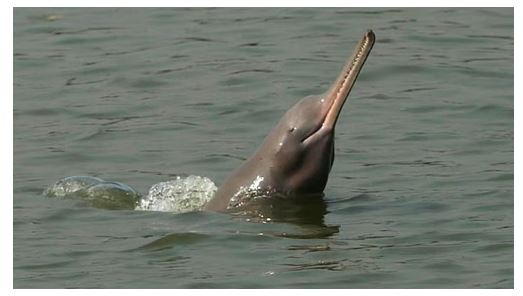
A recent report by the Wildlife Institute of India (WII) has sounded an alarm for India’s national aquatic animal. Drastic reductions in the water flow of the Chambal River are forcing the endangered Ganges River Dolphin to abandon its traditional territory and migrate downstream toward the confluence with the Yamuna. This displacement highlights the growing conflict between human water demands and ecosystem preservation.
Profile of the Ganges River Dolphin (Platanista gangetica)
Often described as one of the world's oldest living creatures, the Ganges River Dolphin is a flagship species that serves as an indicator of the river ecosystem's health.
- Taxonomy & Discovery: Formally discovered in 1801, it is popularly known as the ‘Susu’—an onomatopoeic name derived from the sound it makes when breathing.
- National Status: Recognized as India’s National Aquatic Animal.
- Conservation Status:
- IUCN Red List: Endangered.
- Wildlife Protection Act (1972): Schedule I.
- Biological Traits:
- Blindness: They are essentially blind and rely entirely on echolocation (ultrasonic sound waves) to navigate and hunt in murky river waters.
- Size: Females (approx. 2.7m) are larger than males (approx. 2.1m).
- Strictly Freshwater: Unlike most marine dolphins, this species cannot survive in saline water.
- Distribution: Found across the Ganges-Brahmaputra-Meghna and Karnaphuli-Sangu River systems in India, Nepal, and Bangladesh. In India, they are spread across seven states, including Assam, Uttar Pradesh, Rajasthan, and Bihar.
The Chambal Crisis: Flow Reduction and Its Impacts
The Chambal River was traditionally a safe haven for these dolphins due to its relatively pollution-free waters. However, the river is currently facing a hydrological crisis.
1. Habitat Shrinkage: Dolphins require a minimum water depth of 3 meters for survival. Extensive water extraction for irrigation and industrial use has lowered the Chambal’s flow to levels that make the upper reaches uninhabitable. This has triggered a forced migration toward the Yamuna confluence, where deeper pools are still available.
2. Fragmentation by Infrastructure: The construction of dams and barrages has fragmented the dolphin population. These physical barriers prevent migration, isolate groups, and lead to a narrowed gene pool, making the species more vulnerable to disease and environmental changes.
3. Collateral Ecological Damage
The low water levels have ripple effects on other biodiversity:
- Land Bridges: Receding water creates land bridges to river islands that were previously protected from terrestrial predators.
- Threat to Avifauna: Predators like jackals and stray dogs can now access these islands, destroying the nests of rare birds such as the Indian Skimmer and the Black-bellied Tern.
India's First-Ever Ganges River Dolphin Tagging in Assam
- 19 Dec 2024
In News:
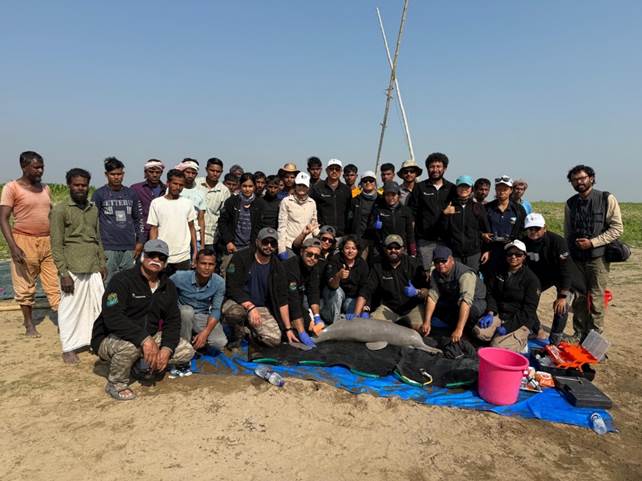
India conducts the first-ever satellite tagging of the Ganges River Dolphin (Platanista gangetica) in Assam, a key step in wildlife conservation.
Key Highlights:
Objective of Tagging: The tagging aims to understand:
- Migratory patterns
- Range and distribution
- Habitat utilization, especially in fragmented river systems.
Key Participants:
- Ministry of Environment, Forest and Climate Change (MoEFCC)
- Wildlife Institute of India (WII)
- Assam Forest Department
- Aaranyak (NGO)
- Funded by the National CAMPA Authority.
Significance of the Tagging:
- Technology Used: Lightweight satellite tags compatible with Argos systems were employed, minimizing interference with the dolphin’s movement despite its limited surfacing time (5-30 seconds).
- Insight into Dolphin Ecology: Helps fill knowledge gaps regarding habitat needs and seasonal migration, especially in disturbed river ecosystems.
Ganges River Dolphin – India's National Aquatic Animal:
- Endemic to India with around 90% of the population in India.
- Known for being nearly blind and using echolocation for navigation and hunting.
- Plays a crucial role as an apex predator and indicator species for river ecosystem health.
Project Dolphin:
- Launched by PM Narendra Modi in 2020, modeled after Project Tiger.
- Focuses on conservation of riverine and marine dolphins.
- A 10-year initiative funded by MoEFCC to safeguard dolphin populations and address ecosystem challenges.
Conservation Status:
- IUCN: Endangered.
- Protection: Included in Schedule I of the Wildlife Protection Act (1972) and CITES Appendix I.
- Major Threats: Habitat degradation, pollution, bycatch, and water abstraction, compounded by damming and sand mining.
Broader Impact:
- The tagging initiative contributes to evidence-based conservation strategies for Ganges River Dolphins.
- Will aid in the development of a comprehensive conservation action plan for the species.
- Expands the understanding of critical habitats within river ecosystems, benefiting both biodiversity and the communities dependent on these resources.