
Arogya Van Initiative
- 09 Apr 2026
In News:
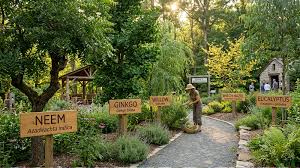
In a significant move toward ecological sustainability and environmental health, the National Highways Authority of India (NHAI), under the aegis of the Ministry of Road Transport & Highways (MoRTH), has launched the ‘Arogya Van’ initiative. This program seeks to utilize vacant land parcels along National Highways (NH) for the development of thematic medicinal tree plantations, moving beyond traditional landscaping to functional, biodiversity-rich green belts.
Core Objectives and Vision
The Arogya Van initiative is designed to create "Health Forests" along the country's transit arteries. Its primary goals include:
- Biodiversity Enrichment: By introducing diverse medicinal tree species, the initiative aims to create habitats for pollinators (bees, butterflies), birds, and microfauna.
- Ecosystem Resilience: The systematic planting of native and medicinal species strengthens the local environment's ability to withstand climate stressors and pollution.
- Productive Land Use: It transforms idle or vacant government land into productive ecological assets.
Implementation Strategy: Phase-I
The NHAI has formulated a structured action plan for the inaugural phase of the project, focusing on geographical diversity and scientific selection.
- Geographic Coverage: The first phase targets 17 land parcels across several states, including:
- North & West: Delhi-NCR, Haryana, Rajasthan, Gujarat, and Maharashtra.
- Central: Madhya Pradesh and Chhattisgarh.
- South & East: Andhra Pradesh, Karnataka, Tamil Nadu, and Odisha.
- Site Selection: Priority is given to high-visibility and strategic locations such as toll plazas, wayside amenities, cloverleaf junctions, interchanges, and prominent highway stretches.
- Agro-Climatic Customization: Tree species are not chosen randomly; they are identified based on their established medicinal properties and their suitability to the specific agro-climatic zone of the site to ensure high survival rates.