
Andaman Sea
- 16 Apr 2026
In News:
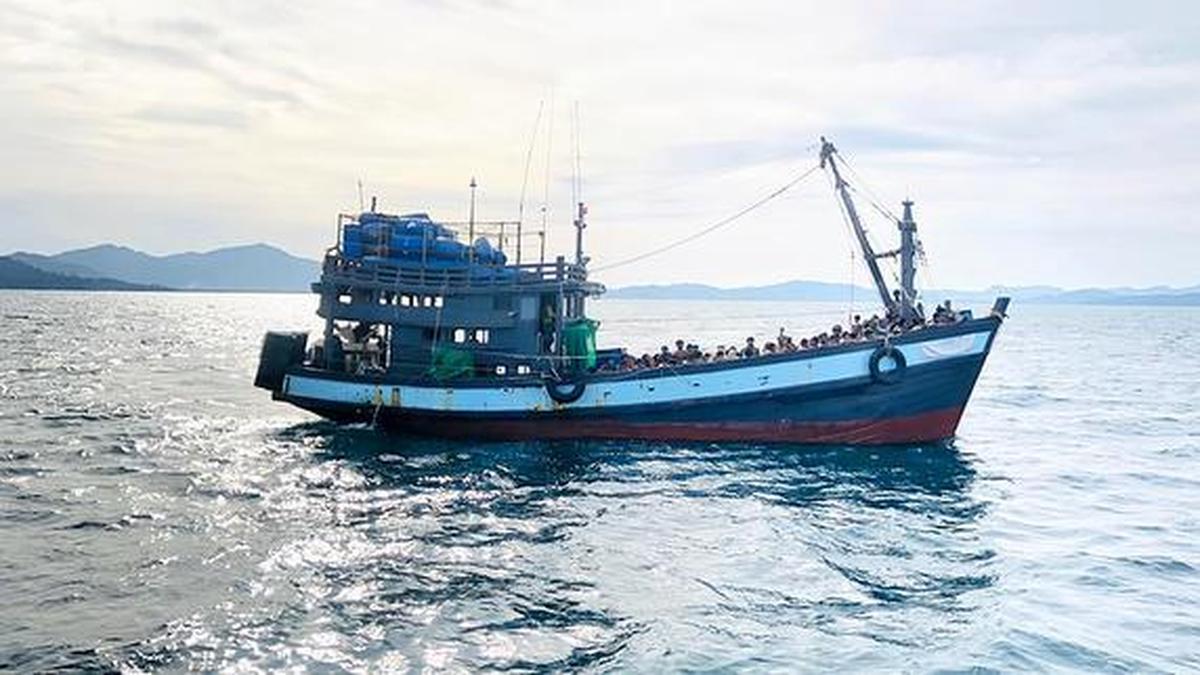
The Andaman Sea has recently witnessed one of the deadliest maritime disasters in recent years. Recently, an overcrowded trawler carrying approximately 250 individualscomprising Rohingya refugees and Bangladeshi nationalscapsized while en route to Malaysia. This incident, reported by the UNHCR and the International Organization for Migration (IOM), underscores the growing desperation of displaced communities and the complex humanitarian challenges in South and Southeast Asia.
I. Geography and Ecology of the Andaman Sea
- Location & Boundaries: It is a semi-enclosed marginal sea in the northeastern Indian Ocean.
- West: Bounded by the Andaman and Nicobar Islands (India) and the Bay of Bengal.
- East: Bordered by the Malay Peninsula and the Strait of Malacca.
- North: Bordered by the Irrawaddy Delta of Myanmar.
- South: Bordered by the Indonesian island of Sumatra.
- Geological Significance: The region is tectonically active, situated on the Sunda Plate. It is bordered by the Indian Plate to the northwest and the Australian Plate to the southeast, making it prone to underwater seismic activity.
- Climate: Dominated by a tropical monsoon climate. The Southwest Monsoon (May–September) and Northeast Monsoon (November–February) dictate maritime safety; the recent capsize was attributed to strong winds and rough seas typical of seasonal transitions.
- Biodiversity: The sea is a global biodiversity hotspot featuring extensive coral reefs, seagrass meadows, and mangrove forests, which serve as critical habitats for diverse marine life.
II. The Humanitarian Crisis: Context and Causes
The recent tragedy is not an isolated event but a symptom of a protracted humanitarian crisis involving the Rohingya—a stateless Indo-Aryan ethnic group from Myanmar’s Rakhine State.
- Push Factors from Bangladesh:
- Overcrowded Camps: Over one million Rohingya live in the Cox’s Bazar district (Teknaf).
- Socio-Economic Restrictions: Limited access to formal education, restricted movement, and lack of employment opportunities in the camps drive desperation.
- Security Concerns: Rising violence within refugee camps and dwindling international humanitarian aid (funding cuts) have made life unsustainable for many.
- Pull Factors and Human Trafficking:
- False Promises: Human traffickers lure vulnerable individuals with promises of high-paying jobs in Malaysia or Indonesia.
- Regional Instability: Ongoing conflict in Myanmar’s Rakhine State makes the "safe, voluntary, and dignified" return of refugees nearly impossible in the current geopolitical climate.
- The Perilous Journey:
- Refugees use "rickety" and overcrowded fishing trawlers to cross the Andaman Sea.
- Statistically: 2025 was recorded as one of the deadliest years for sea crossings, with nearly 900 deaths. In 2026, fatalities in the Andaman Sea and Bay of Bengal have reportedly increased by over 40% compared to previous years.
III. Strategic and Legal Dimensions
- The "Search and Rescue" Gap: In the recent incident, the Bangladesh Coast Guard rescued nine survivors from the M.T. Meghna Pride (a Bangladesh-flagged vessel), but official search operations were limited as the capsize occurred outside Bangladesh's territorial waters. This highlights the need for a regional maritime SAR (Search and Rescue) framework.
- International Obligations: While many regional countries are not signatories to the 1951 Refugee Convention, the principle of Non-Refoulement (not returning refugees to a place where they face persecution) and the UN Convention on the Law of the Sea (UNCLOS) mandate assistance to those in distress at sea.
- Human Trafficking Prevention: The survivors were handed over to the police in Teknaf, and cases were filed under the Human Trafficking Prevention Act, emphasizing the criminal dimension of these migrations.