
Woolly-Necked Stork
- 11 Apr 2026
In News:
The recent sighting of the Woolly-Necked Stork (Ciconia episcopus) in the paddy fields near Thanjavur, Tamil Nadu, has garnered significant attention from ornithologists and conservationists.
Biological Profile and Key Features
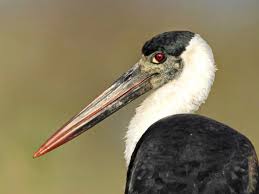
The Woolly-Necked Stork, colloquially known as the White-necked Stork or Bishop Stork, is a large wading bird belonging to the Ciconiidae family.
- Distinctive Morphology: It is characterized by its almost entirely black plumage, contrasted sharply by a white, "woolly" textured neck and a white lower belly. The upper body often exhibits a dark green gloss, while the breast and belly areas can display a subtle purple hue.
- Flight Dynamics: As a broad-winged soaring bird, it utilizes thermals (rising columns of hot air) to sustain long-distance flight with minimal energy expenditure.
- Dietary Habits: It is predominantly carnivorous. Its diet is diverse, including fish, amphibians (frogs and toads), reptiles (snakes and lizards), and a wide array of invertebrates such as large insects, crabs, and mollusks.
- Foraging Behavior: The species is a patient hunter, typically foraging by walking slowly through shallow water or dense vegetation, using its powerful bill to stab at prey.
Habitat and Global Distribution
The Woolly-Necked Stork is a widespread tropical species with a distribution range extending across Africa and Asia (from India to Indonesia).
- Ecosystem Preferences: It thrives in varied environments, including open grasslands, riverbanks, ponds, and freshwater wetlands.
- Agricultural Synergy: Interestingly, this species has shown a high degree of adaptability to man-made landscapes, particularly paddy fields. These fields act as artificial wetlands, providing a rich supply of aquatic prey, which explains the recent sightings in Thanjavur.
- Breeding: Unlike some other stork species that form massive colonies, the Woolly-Necked Stork tends to breed singly or in small, loose groups.
Conservation Status and Threats
- IUCN Red List: It is currently classified as 'Near Threatened'.
- Conservation Concerns: While the species is adaptable, it faces threats from habitat loss due to the drainage of wetlands, the intensification of agriculture (leading to a reduction in prey diversity), and the contamination of water bodies by pesticides.
- Importance of the Thanjavur Sighting: The presence of the bird in Tamil Nadu’s "rice bowl" underscores the ecological health of the region's traditional irrigation systems. It serves as an indicator species, suggesting that the local paddy ecosystem still supports a robust food chain.