
Naphthalene Diimide (NDI)
- 11 Apr 2026
In News:
In a significant breakthrough for the field of material science, researchers from the Centre for Nano and Soft Matter Sciences (CeNS) and the Jawaharlal Nehru Centre for Advanced Scientific Research (JNCASR)—both autonomous institutes under the Department of Science and Technology (DST)have pioneered a method to manipulate the structural and electrical properties of organic nanomaterials using temperature as a sole trigger. This discovery centers on the molecule Naphthalene Diimide (NDI) and leverages the principles of supramolecular self-assembly.
The Science of Naphthalene Diimide (NDI)
NDI is characterized as an amphiphilic molecule, a dual-natured chemical entity containing both hydrophilic (water-attracting) and hydrophobic (water-repelling) components. This unique "Janus-like" nature drives the molecule to organize itself into intricate architectures when introduced to an aqueous environment.
The Mechanism of Aqueous Assembly: The transformation is governed by noncovalent interactions (weaker than traditional chemical bonds), which allow for a reversible and dynamic "Lego-like" building process at the molecular level.
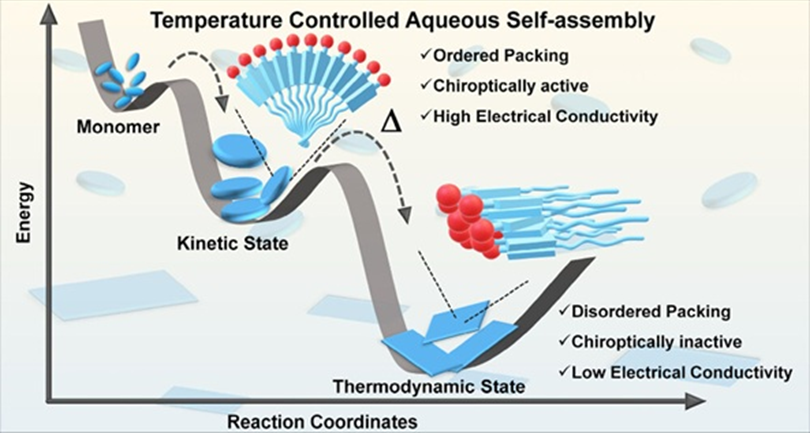
- Room Temperature (Phase 1): At standard temperatures, NDI molecules naturally group into circular nanodisks. In this state, the material is highly conductive and exhibits specific interactions with polarized light.
- Thermal Trigger (Phase 2): Upon heating, the molecules undergo a structural reorganization.
- State Switch (Phase 3): The circular nanodisks transform into two-dimensional nanosheets. This morphological shift results in the loss of light-interacting properties and a dramatic sevenfold drop in electrical conductivity.
Supramolecular Self-Assembly: Nature’s Engineering
The research highlights the potential of supramolecular self-assembly, a process where molecules spontaneously organize into well-defined structures without human intervention. By using environmental factors like temperature or solvent type as a "switch," scientists can dictate the final shape and functional behavior of the material. This mimics biological processes where nature builds complex systems using weak interactions to maintain flexibility and responsiveness.
Potential Applications and Significance
The ability to use temperature as an "electrical dimmer switch" for nanomaterials opens diverse avenues in technology and medicine:
- Next-Generation Electronics: Development of organic circuits where electrical flow can be precisely tuned or switched without mechanical parts.
- Smart Thermal Sensors: Creation of sensors that provide immediate optical or electrical feedback in response to minute thermal changes.
- Tunable Optoelectronics: Advancing photonics and display technologies by switching between different optical states.
- Bioelectronic Interfaces: Designing adaptive materials for medical monitoring that can respond dynamically to the biological environment.
- Adaptive Surfaces: Developing "smart" coatings that change their physical properties based on external environmental conditions.