
Kodaikanal Solar Observatory (KoSO)
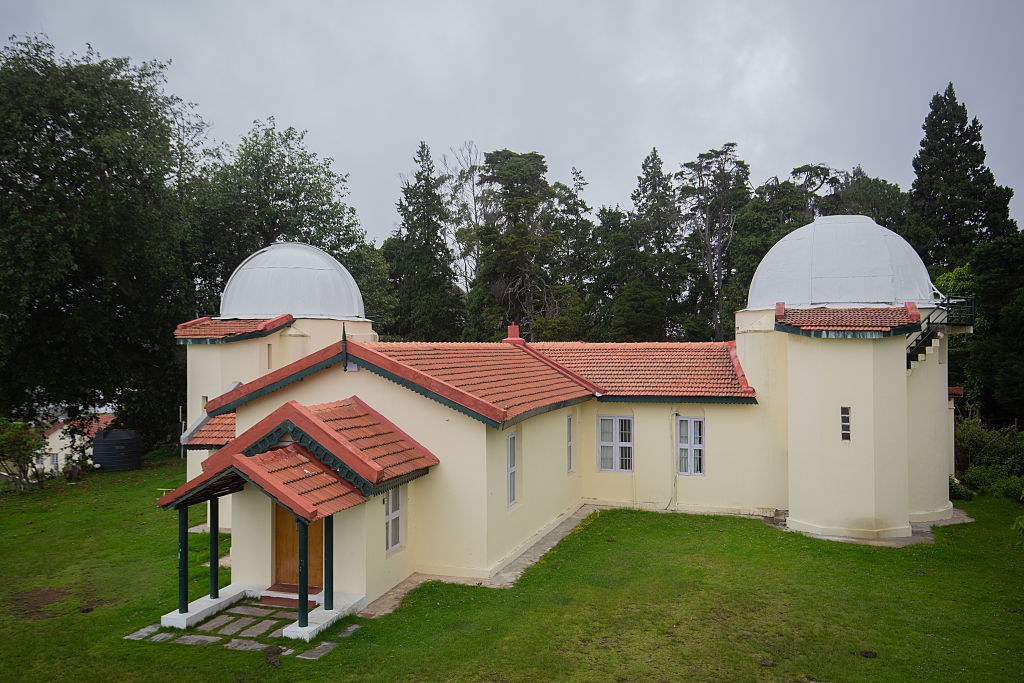
- 21 Nov 2025
In News:
Scientists led by Aryabhatta Research Institute of Observational Sciences (ARIES), along with Indian Institute of Astrophysics (IIA) and international collaborators, have reconstructed over 100 years (1904–2022) of the Sun’s polar magnetic history using archival observations from the Kodaikanal Solar Observatory (KoSO).
About Kodaikanal Solar Observatory (KoSO)
- What it is: One of the world’s oldest continuously operating solar observatories.
- Location: Palani Hills, Tamil Nadu; functions as a field station of IIA, Bengaluru.
- Established:1899.
- Unique Data Legacy:Systematic Ca II K solar imaging since 1904, creating among the longest uninterrupted solar datasets globally.
- Observations: Multi-wavelength views of the chromosphere, capturing plages, sunspot groups and magnetic networks.
- Access: Large portions of the digitised archive are publicly available for global research.
What is the Sun’s Magnetic Future?
- Refers to the behaviour of the Sun’s polar magnetic fields, which drive the 11-year solar cycle, sunspots, flares and geomagnetic storms affecting Earth.
- Challenge: Direct polar magnetic field measurements began only in 1976, leaving earlier decades undocumented.
Scientific Breakthrough
- Method: Researchers analysed KoSO’s Ca II K images and combined them with Rome-PSPT data using AI-based feature recognition.
- Key Proxy: Identification of faint bright structures near the poles—polar network—quantified through the Polar Network Index (PNI).
- Outcome:First reliable, century-long reconstruction of the Sun’s polar magnetic fields (1904–2022).
Why Ca II K Matters
- The Ca II K wavelength reveals chromospheric features tightly linked to magnetic activity.
- Plages and magnetic networks recorded in Ca II K act as historical fingerprints of solar magnetism, enabling reconstructions before direct measurements.
Significance
- Solar Cycle Prediction: Improves estimates of the strength of Solar Cycle 25 and future cycles.
- Space Weather Forecasting: Enhances prediction of solar storms that can disrupt GPS, communications, satellites, aviation and power grids.
- Open Science: Reconstructed datasets and PNI values are openly released (e.g., GitHub, Zenodo), accelerating global research.
Kodaikanal Solar Observatory (KOSO)
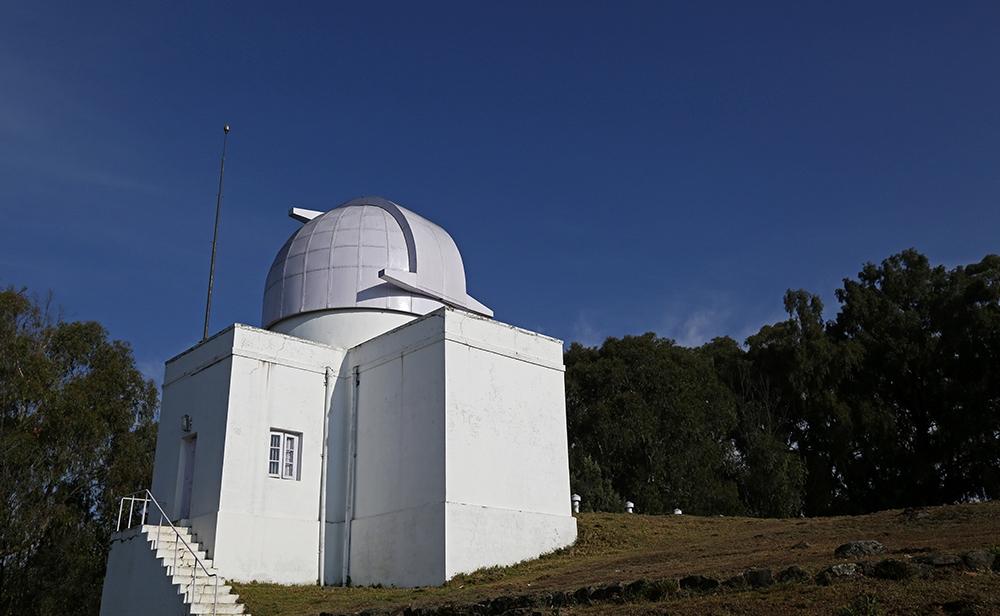
- 01 Apr 2024
Why is it in the News?
Since ancient times, seafarers, mathematicians, astronomers, and physicists have all diligently studied and tracked the Sun and its phenomena, with the establishment of the Madras Observatory by the British East India Company in 1792 marking a pioneering effort in this region.
About Kodaikanal Solar Observatory:
- The Kodaikanal Solar Observatory is a solar observatory owned and operated by the Indian Institute of Astrophysics (IIA), Bengaluru.
- It is on the southern tip of the Palani Hills 4 kilometers from Kodaikanal (Tamil Nadu).
- The Government of India separated Astrophysics from the India Meteorological Department (IMD) in April 1971.
- From solar data recorded on basic photographic plates or films, the 125-year-old KoSO boasts a mammoth digital repository containing 1.48 lakh digitized solar images of 10 terabytes.
- These include 33,500 white-light images (showing sunspots) and thousands of other images of the Sun recorded every day since the start of the 20th century.
- KoSO is the only observatory offering high-resolution digitized images for such a long period (with coverage of more than 75 percent).
- Today, it houses a spectrum of advanced instruments like the H-alpha telescope to perform full disc imaging, a White light Active Region Monitor (WARM) with calcium and sodium filters to make full disc simultaneous observations of the photosphere and chromosphere layers of the Sun, a solar tunnel telescope and more.
Links to the Great Drought:
- Scanty rainfall over south India during the winter monsoon of 1875 triggered one of the worst droughts the country had experienced till then.
- Multiple failed crops over the famine-stricken peninsular India killed 12.2 to 29.3 million people across the Madras and Mysore Provinces during 1875-1877.
- India, along with China, Egypt, Morocco, Ethiopia, southern Africa, Brazil, Columbia, and Venezuela, suffered concurrent multi-year droughts during 1876-1878, later named the Great Drought, and an associated global famine that killed nearly 50 million.
- The drought was thought to be due to multiple reasons:
- Solar activity
- Cool Pacific Ocean conditions followed by a record-breaking El Nino (1877-1878)
- Strong Indian Ocean Dipole and
- Warm North Atlantic Ocean conditions.
Solar Physics Observatory in Palani Hills:
- Established in response to the British Raj's acknowledgment of solar activity's link to India's weather patterns, the Palani Hills Solar Physics Observatory, also known as the Indian Solar Observatory, was founded to conduct systematic studies on solar phenomena and their correlation with Indian meteorology.
- Located in Kodaikanal, selected for its favorable atmospheric conditions after careful consideration by Charles Michie Smith (a Professor of Physics at the Madras Christian College), the observatory was officially sanctioned by the Government of India in August 1893 and inaugurated by Lord Wenlock (the then Governor of Madras) in 1895.
- Commencing systematic observations in 1901, it merged with the Madras Observatory, enriching its instrumentation.
- Notable discoveries ensued, including the identification of the Evershed Effect.
- Over time, the observatory expanded its research domains to encompass cosmic rays, radio astronomy, and ionospheric physics, among others, solidifying its status as a pioneering institution in the field of astrophysics.
- Notably, it initiated solar radio observations in 1952, marking a significant milestone in Indian solar research.
- Despite the closure of contemporaneous observatories, the Palani Hills Solar Physics Observatory has endured, continuing to contribute to our understanding of the Sun and its effects on Earth's climate and space weather.
Why Study the Sun?
- Being the primary source of energy, life on Earth is supported by the Sun.
- Any change on the solar surface or its periphery could significantly affect the Earth’s atmosphere.
- Powerful solar storms and solar flares can be potentially harmful to Earth’s satellite-based operations, power grids, and navigational networks.
- The KoSO (Kodaikanal Solar Observatory), which has been imaging the Sun for over a century now, has a rich repository of data.
- This is extremely useful not only to reconstruct the Sun’s historic past but also to link its behavioral changes to better understand and predict its future and its impact on life on Earth and Space weather.