
Indian Softshell Turtles
- 08 Apr 2026
In News:
The Indian Softshell Turtle (Nilssoniagangetica), a critical component of India’s freshwater ecosystems, has recently been in the spotlight following successful enforcement actions against illegal wildlife trafficking. In a significant operation, police in Greater Noida rescued 16 turtles from a smuggler during a routine check, highlighting the persistent threat of poaching to this endangered species.
Taxonomy and Biological Profile
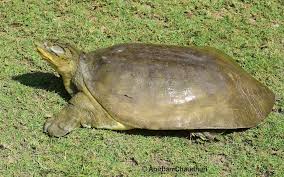
Commonly known as the Gangetic Softshell Turtle, this species belongs to the family Trionychidae. Unlike traditional turtles characterized by hard, bony scutes, these reptiles possess a flat, leathery carapace (upper shell) that lacks a keratinized cover.
- Distinctive Anatomy: They feature a large head with a prominent snout-like proboscis, an evolutionary adaptation that allows them to breathe while remaining almost entirely submerged.
- Size: They are among the largest freshwater turtles in the region, with carapaces reaching up to 94 cm in length.
- Diet: They are omnivorous scavengers. By feeding on mollusks, fish, frogs, and decaying organic matter, they act as natural "cleaners" of river systems.
Habitat and Distribution
The Indian Softshell Turtle is native to the major river systems of South Asia, specifically the Ganges, Indus, and Mahanadi.
- Range: Found across India, Pakistan, Nepal, and Bangladesh.
- Ecological Niche: They prefer deep, turbid (cloudy) waters including rivers, large canals, and lakes. They favor habitats with mud or sand bottoms, which allow them to bury themselves for camouflage and hunting.
Conservation Status and Legal Protection
Due to its dwindling population, the Indian Softshell Turtle is afforded the highest levels of legal protection, mirroring that of the Bengal Tiger.
- Wildlife Protection Act (1972): Listed under Schedule I, making any trade or harm to the species a non-bailable offense with rigorous punishment.
- IUCN Red List: Classified as Endangered.
- CITES: Included in Appendix I, which prohibits international commercial trade.
Threats: The "20-Claw" Myth and Trafficking
The primary drivers of the decline in their population are habitat loss, pollution, and illegal poaching. A unique and destructive driver is the "20-Claw Myth."
- Superstition: Poachers specifically target individuals with 20 claws (five on each limb). There is a deep-seated superstition in the black market that these specific turtles bring immense "good luck" or possess superior medicinal properties.
- Commercial Value: Beyond superstition, they are also trafficked for their meat and for the pet trade, often being transported in cramped, inhumane conditions across state borders.
Ecological Significance for India
From a conservation and civil services perspective, the health of the Indian Softshell Turtle population is a direct indicator of the health of the riverine ecosystem. As scavengers, they are vital to the Clean Ganga Mission (Namami Gange), as they help maintain water quality by consuming organic waste and carcasses that would otherwise pollute the river.