
Total Lunar Eclipse
- 02 Mar 2026
In News:
A total lunar eclipse is scheduled on 3 March 2026 (12 Phalguna 1947 Saka Era), offering a rare celestial spectacle visible from large parts of the globe including most regions of India. This astronomical event holds significance for both scientific observation and cultural discourse, coinciding with the traditional period of Holi festivities in North India.
What is a Lunar Eclipse?
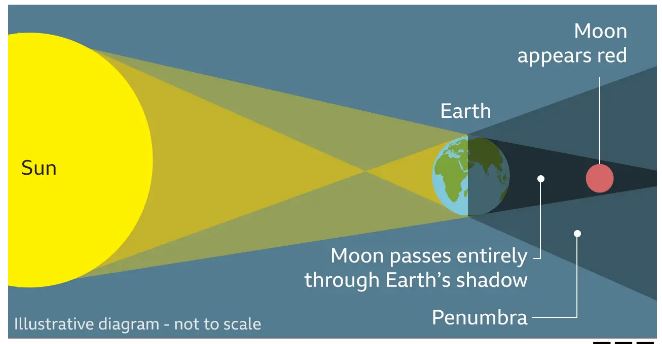
A lunar eclipse occurs when the Earth positions itself directly between the Sun and the Moon during the full Moon phase, such that the Earth’s shadow falls on the Moon. This alignment (known as syzygy) results in the Moon entering Earth’s shadow and becoming darkened.
The Earth’s shadow comprises two parts:
- Umbra – The central, darker region where the Sun’s rays are completely blocked.
- Penumbra – The outer, lighter region where sunlight is only partially obstructed.
Depending on how the Moon traverses these shadow zones, eclipses are categorised as:
- Penumbral Eclipse – Moon passes through the penumbra only; very subtle.
- Partial Eclipse – Part of the Moon enters the umbra.
- Total Eclipse – The whole lunar disk enters Earth’s umbra and undergoes complete darkening.
When totality occurs, the Moon often acquires a reddish or coppery hue — popularly known as the “Blood Moon” — due to Rayleigh scattering of sunlight in Earth’s atmosphere. Shorter wavelengths (blue/green light) scatter out, while longer red wavelengths bend into the shadowed region and illuminate the Moon indirectly.
Why Does the Moon Turn Red?
During totality, the Moon’s direct sunlight is completely blocked by the Earth. However, Earth’s atmosphere refracts sunlight, bending the longer red wavelengths into the umbra and onto the lunar surface. This indirect illumination produces the distinctive red or copper hue of the Moon during the peak eclipse phase. This optical effect is the same reason why sunrises and sunsets appear red on Earth.
Cultural and Observational Relevance
- Cultural Context: The eclipse occurs just a day before the festival of Holi in some regional calendars, creating conversations around tradition, auspiciousness, and ritual observances such as Sutak period (a traditional eclipse-related phase affecting religious practices).
- Scientific Observation: Since the entire sequence spans several hours and involves the full transition through penumbral and umbral shadows, it provides valuable opportunities for both amateur and professional astronomers to study Earth’s atmospheric effects and lunar motion.
- Public Skywatching: Skywatching events and public outreach programmes, such as planetarium viewings, encourage scientific literacy and appreciation of astronomy among students and the general public.