
Tar Balls Management
- 08 Apr 2026
In News:
Recently, the Ministry of Environment, Forest, and Climate Change (MoEFCC) introduced the Draft Tar Balls Management Rules, 2026. This marks India's first dedicated regulatory framework aimed at managing "tar balls"—a recurring environmental hazard that plagues the Indian coastline, particularly the western stretch from Gujarat to Goa.
Understanding Tar Balls: Origin and Characteristics
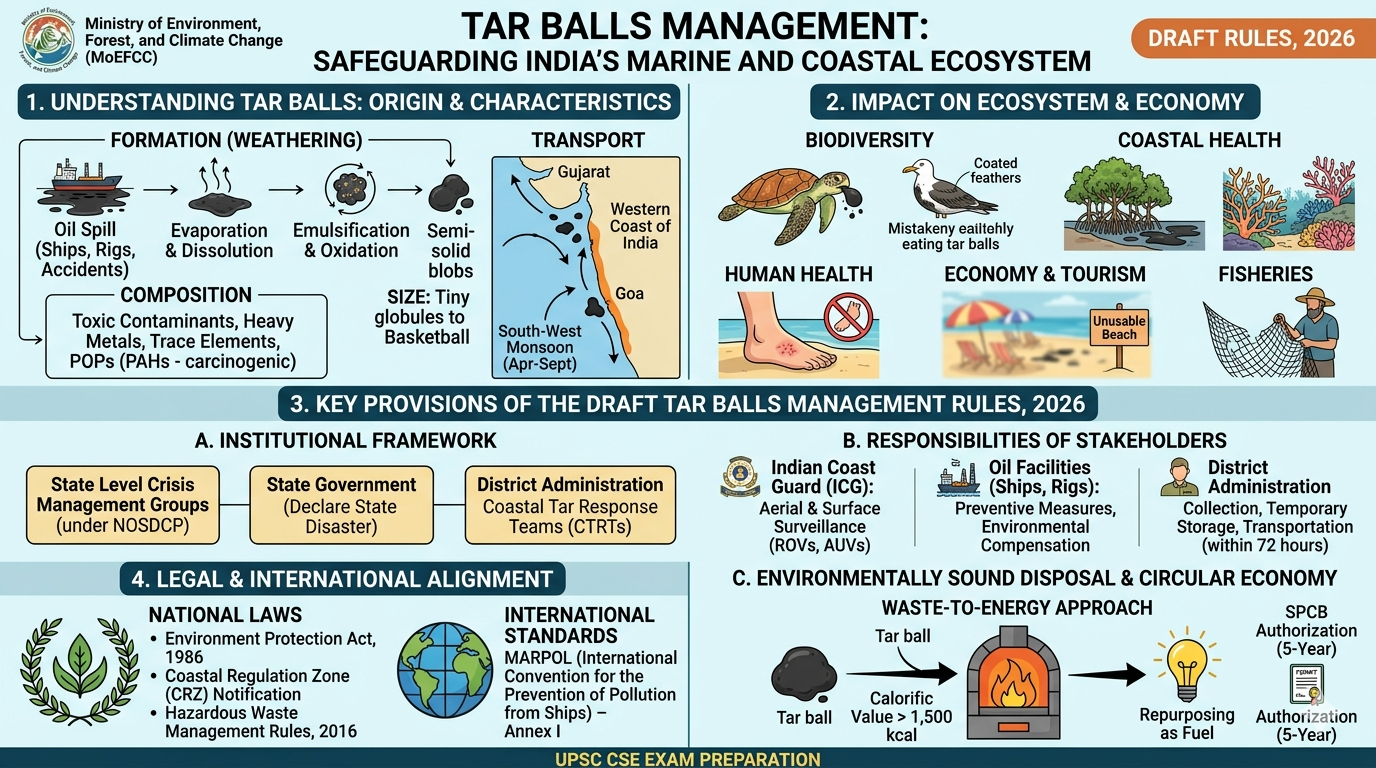
Tar balls are small, dark, sticky, and semi-solid blobs of weathered crude oil. They are the physical residue of oil spills or natural seeps that undergo various transformative processes in the ocean.
- Formation (Weathering): When oil is spilled (from ships, offshore rigs, or accidents), it undergoes physical, chemical, and biological changes. Lighter components evaporate or dissolve, while the heavier residue emulsifies with seawater and oxidizes, eventually hardening into lumps.
- Transport: These blobs are transported from the open sea to the shore by sea currents and waves.
- Size: They vary significantly in size, ranging from tiny globules to masses as large as a basketball.
- Composition: Tar balls are not just oil; they are concentrated reservoirs of toxic contaminants, including heavy metals, trace elements, and Persistent Organic Pollutants (POPs) like Polycyclic Aromatic Hydrocarbons (PAHs), which are carcinogenic.
Impact on Ecosystem and Economy
The seasonal appearance of tar balls, especially between April and September (linked to the South-West Monsoon), has severe multi-dimensional impacts:
- Biodiversity: Marine animals like sea turtles and fish often mistake tar balls for food, leading to ingestion and death. Seabirds get their feathers coated, hindering their ability to fly or regulate body temperature.
- Coastal Health: They contaminate intertidal zones, harming mangroves and coral reefs.
- Human Health: Exposure to tar balls on beaches can cause skin irritation and long-term health risks due to the presence of toxic contaminants.
- Economy & Tourism: India’s western coast is a global tourism hub. Tar ball deposition makes beaches unsightly and unusable, leading to significant revenue loss.
- Fisheries: Tar balls damage fishing nets and gear, impacting the livelihoods of coastal communities.
Key Provisions of the Draft Tar Balls Management Rules, 2026
The rules shift the approach from ad-hoc beach cleaning to a structured, institutionalized response based on the "Polluter Pays Principle."
A. Institutional Framework
- State Level Crisis Management Groups: To be formed under the National Oil Spill Disaster Contingency Plan (NOSDCP).
- Declaration of State Disaster: State governments are empowered to declare tar ball pollution as a "State Disaster" under the Disaster Management Act, ensuring a coordinated emergency response.
- Coastal Tar Response Teams (CTRTs): To be constituted by district administrations for rapid action.
B. Responsibilities of Stakeholders
- Indian Coast Guard (ICG): Tasked with aerial and surface surveillance using advanced technology like Remotely Operated Vehicles (ROVs) and Autonomous Underwater Vehicles (AUVs) to detect underwater oil plumes.
- Oil Facilities: Owners of ships, oil tankers, and offshore rigs are defined as "Oil Facilities." They must comply with the Merchant Shipping Act, 2025, and take preventive measures. Failure to do so attracts Environmental Compensation.
- District Administration: Responsible for the collection, temporary storage, and transportation of tar balls to treatment facilities within a 72-hour window of a sighting.
C. Environmentally Sound Disposal & Circular Economy
The rules emphasize a "waste-to-energy" approach:
- Repurposing as Fuel: Tar balls with a calorific value over 1,500 kcal can be used as an alternative fuel source in cement kilns.
- Authorization: Any entity handling or disposing of tar balls must obtain a 5-year authorization from the State Pollution Control Board (SPCB).
Legal and International Alignment
- National Laws: The rules derive authority from Section 3 of the Environment Protection Act, 1986. They also link with the Coastal Regulation Zone (CRZ) Notification and Hazardous Waste Management Rules, 2016.
- International Standards: The rules align India’s domestic policy with its obligations under MARPOL (International Convention for the Prevention of Pollution from Ships), specifically Annex I, which deals with oil pollution.
Challenges and Gaps
While the rules are a significant step forward, critics and experts point out certain gaps:
- Community Engagement: There is a lack of explicit provisions for "citizen science" or involving local fishing communities in monitoring.
- Digital Reporting: No mandated digital platform yet exists for real-time reporting by the public.
- Source Attribution: Identifying the exact vessel responsible for weathered tar balls remains a technical challenge, requiring advanced chemical fingerprinting.