
Mission MITRA
- 07 Apr 2026
In News:
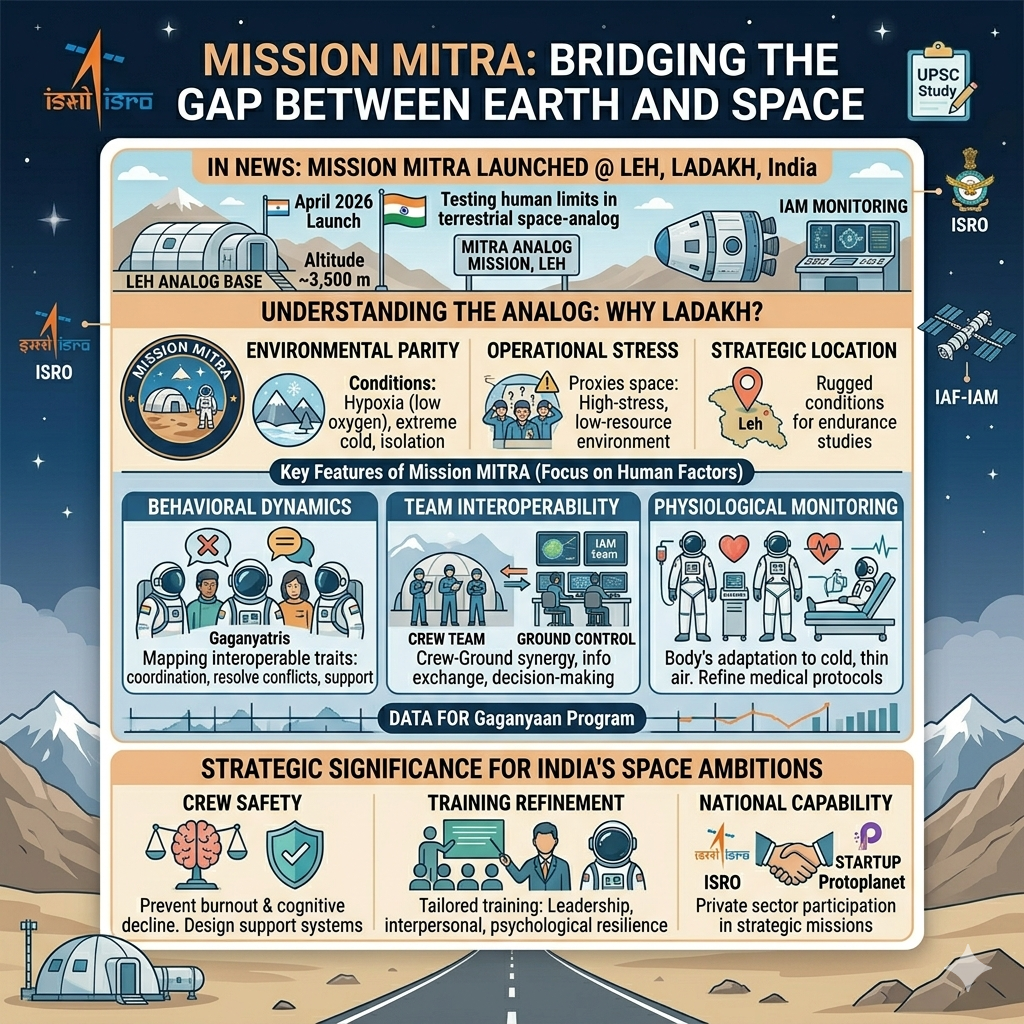
Recently, the Indian Space Research Organisation (ISRO) launched Mission MITRA (Mapping of Interoperable Traits and Response Assessment) in Leh, Ladakh. This pioneering study, conducted in collaboration with the IAF-Institute of Aerospace Medicine (IAM), marks a critical step in India’s Gaganyaan program by testing the behavioral and physiological limits of astronauts in a terrestrial space-analog environment.
The Terrestrial Analog: Why Ladakh?
Space exploration is as much a psychological challenge as it is a technological one. To prepare for the vacuum of space, scientists utilize terrestrial analogues—locations on Earth that mimic space-like stressors.
- Environmental Parity: Situated at an altitude of approximately 3,500 meters, Leh offers conditions of hypoxia (low oxygen), extreme cold, and geographical isolation.
- Operational Stress: These rugged conditions serve as a natural proxy for the high-stress, low-resource environment of a spacecraft, allowing researchers to study human endurance without leaving Earth's atmosphere.
Core Objectives and Design
Mission MITRA is a first-of-its-kind multidisciplinary study focused on the "Human Factor" of spaceflight. It involves India's four designated Gaganyatris (astronauts) and a supporting team of scientists, engineers, medical doctors, and psychologists.
- Behavioral Dynamics: The mission maps interoperable traits—the ability of crew members to coordinate, resolve conflicts, and support one another under pressure.
- Team Interoperability: A key focus is the synergy between the Crew and Ground Control Teams, assessing how information is exchanged and how decision-making holds up under operational stress.
- Physiological Monitoring: Scientists track how the body adapts to freezing temperatures and thin air, providing data that will refine medical protocols for actual spaceflight.
Strategic Significance for India’s Space Ambitions
As India prepares for its first human spaceflight and eyes future long-duration missions to a space station or the Moon, the data from Mission MITRA is invaluable.
- Crew Safety: Understanding psychological resilience helps in designing better support systems to prevent "burnout" or cognitive decline during isolation.
- Training Refinement: Insights from this study will help the Human Space Flight Centre (HSFC) tailor training modules that move beyond physical fitness to include specialized interpersonal and leadership training.
- National Capability: Collaborative efforts with Indian startups like Protoplanet Pvt. Ltd. for facility management signify the growing participation of the private sector in India’s strategic space missions.