
Macaques
- 28 Feb 2026
In News:
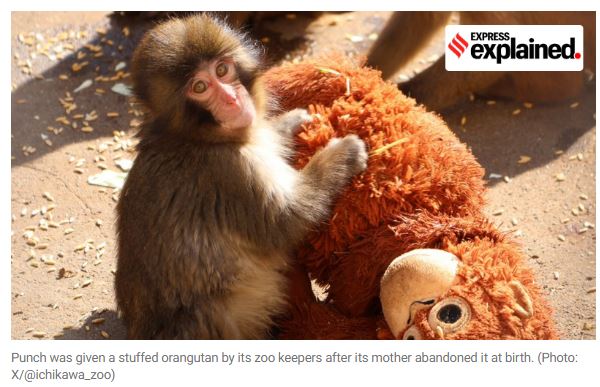
A recent viral story from a Japanese zoo involving an abandoned baby Japanese macaque (“Punch”) brought global attention to the complex emotional bonds and strict social hierarchies within macaque societies. Beyond public curiosity, the episode highlights important aspects of primate behaviour, evolutionary biology, and conservation — areas relevant to biodiversity studies and wildlife management.
About Macaques
Macaques belong to the genus Macaca under the family Cercopithecidae (Old World monkeys). They are among the most widespread and adaptable primates in the world.
Distribution and Diversity
- Over 20 species
- Found mainly across Asia and parts of North Africa
- Highly adaptable to diverse ecological conditions, including forests, mountains, and urban environments
Their adaptability has enabled certain species to thrive even in human-dominated landscapes.
Important Species
1. Japanese Macaque (Macaca fuscata)
- Native to Japan
- Known as the “Snow Monkey”
- Famous for surviving in cold climates and bathing in natural hot springs
- Displays highly structured matrilineal social systems
2. Rhesus Macaque (Macaca mulatta)
- Widely distributed in North India and Southeast Asia
- Frequently found in urban and semi-urban areas
- Extensively used in medical and biomedical research, including vaccine development
3. Lion-tailed Macaque (Macaca silenus)
- Endangered species
- Endemic to the Western Ghats (India)
- Recognised by its distinctive silver-white mane
- Threatened by habitat fragmentation and deforestation
4. Crested Black Macaque (Macaca nigra)
- Native to Sulawesi (Indonesia)
- Characterised by a dark crest
- Classified as Critically Endangered
Social Behaviour and Hierarchy
Macaques are highly gregarious animals, living in troops governed by strict dominance hierarchies. Their social organisation is complex and deeply structured.
Female Hierarchy
- Rank is typically matrilineal (inherited from the mother).
- Daughters generally rank close to their mother’s position.
- In species such as the Japanese macaque, the “youngest sister rule” applies — the youngest daughter ranks above older sisters.
- Female bonds are stable and form the core of troop structure.
Male Hierarchy
- Determined by physical strength, alliances, and fighting ability.
- Males often migrate between troops.
- Rank can fluctuate over time.
The viral incident involving the abandoned baby macaque illustrates how social rank and maternal position significantly affect offspring survival and acceptance within the troop.
Ecological and Evolutionary Significance
Macaques provide valuable insights into:
- Evolution of primate social systems
- Behavioural ecology
- Conflict resolution and cooperation
- Human–wildlife interaction
Their structured dominance systems resemble early social organisation patterns in primates, offering important evolutionary parallels.
Conservation and Human Interface
While some species like the rhesus macaque thrive near human settlements, others such as the lion-tailed macaque face severe threats due to:
- Habitat fragmentation
- Deforestation
- Infrastructure expansion
- Human–wildlife conflict
Urban macaque populations often lead to conflict, necessitating balanced wildlife management policies.