
India–EU ‘Most Favoured Nation’ (MFN) Status
- 02 Mar 2026
In News:
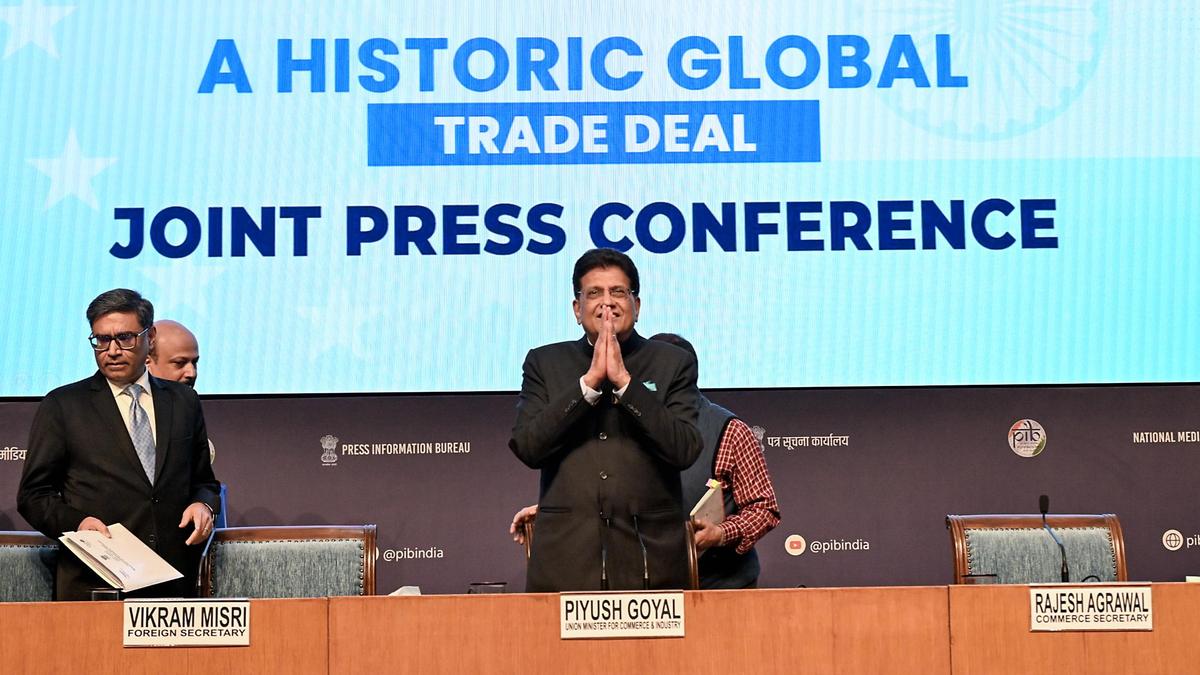
- India and the European Union (EU) are set to grant each other ‘Most Favoured Nation’ (MFN) status for a period of five years from the date the proposed Free Trade Agreement (FTA) comes into force.
- This move is part of broader efforts to deepen trade and investment ties between India and the EU, which is one of India’s largest trading partners.
What is ‘Most Favoured Nation’ (MFN) Status?
The Most Favoured Nation (MFN) principle is a foundational concept under the World Trade Organization (WTO) framework.
Core Principle
Under MFN:
- A country must treat all its trading partners equally.
- If it grants a special trade concession (such as lower tariffs or market access) to one country, it must extend the same benefit to all other WTO members.
- Discrimination between trading partners is generally prohibited.
Thus, despite the term “most favoured,” it actually means non-discriminatory treatment among WTO members.
Legal Basis in WTO Agreements
The MFN principle is embedded in major WTO agreements:
- GATT (Goods Trade): Enshrined in Article I of the General Agreement on Tariffs and Trade (GATT), 1994.
- GATS (Services Trade): Incorporated under Article II of the General Agreement on Trade in Services (GATS).
- TRIPS (Intellectual Property Rights): Reflected in Article 4 of the TRIPS Agreement.
Together, these provisions make MFN a central pillar of the multilateral trading system.
Objectives of the MFN Principle
MFN promotes:
- Equality in trade relations
- Predictability in tariff structures
- Transparency in trade rules
- Stability in global commerce
It reduces arbitrary discrimination and supports a rules-based trading order.
MFN and Free Trade Agreements (FTAs)
While MFN requires equal treatment, WTO rules permit exceptions, including:
- Free Trade Agreements (FTAs)
- Customs Unions
- Special preferences for developing countries under schemes like the Generalized System of Preferences (GSP)
FTAs allow member countries to provide preferential treatment among themselves without extending the same to all WTO members.
In the case of the India–EU FTA:
- MFN status within the agreement framework strengthens mutual trade commitments.
- It ensures reciprocal and predictable treatment in goods, services, and investment domains for the agreed period.
Significance of India–EU MFN Arrangement
1. Strengthening Bilateral Trade
The EU is one of India’s largest trading partners in goods and services. MFN status under the FTA framework:
- Enhances market access
- Improves tariff predictability
- Encourages long-term investment
2. Strategic and Economic Relevance
- Supports diversification of India’s trade partners amid global supply chain realignments.
- Aligns with India’s strategy of negotiating comprehensive trade agreements (e.g., UAE, Australia, UK under negotiation).
3. Boost to Rules-Based Trade
- Reinforces commitment to WTO principles.
- Signals support for a non-discriminatory multilateral trade order at a time of rising protectionism globally.