
Hydrogen Valley Innovation Clusters
- 16 Nov 2025
In News:
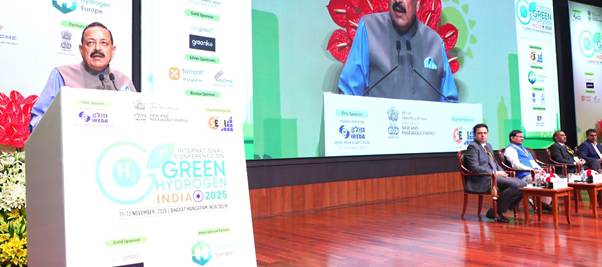
India has announced the development of four Hydrogen Valley Innovation Clusters (HVICs) as part of its transition toward a self-reliant hydrogen economy. The initiative was highlighted at the 3rd International Conference on Green Hydrogen (ICGH 2025) by the Union Minister of Science and Technology.
What are Hydrogen Valley Innovation Clusters?
- Hydrogen Valley Innovation Clusters are integrated ecosystems designed to demonstrate the complete green hydrogen value chain, including:production, storage, transport and utilization across industries, mobility, and energy systems
- Locations: Four HVICs are being developed at:Pune, Jodhpur, Bhubaneswar and Kerala.
- Funding Structure: Total investment: ?485 crore
- ?169.89 crore under the National Green Hydrogen Mission (NGHM)
- ?315.43 crore from industry and consortium partners
- Purpose of HVICs:
- Build a localized hydrogen economy linking supply and demand.
- Promote R&D, innovation, skill development, and technology validation.
- Serve as living laboratories for policy formulation and standardization.
- Support India’s drive toward energy security, industrial competitiveness, and clean mobility.
Originally conceptualized by the Department of Science and Technology (DST), they are now integrated under the Ministry of New and Renewable Energy (MNRE) through the National Green Hydrogen Mission.
National Vision for Green Hydrogen
India sees green hydrogen as a critical component of:
- Viksit Bharat 2047
- energy transition
- industrial decarbonization
- strategic technological leadership
The Minister emphasized that clean energy is an economic, technological, and strategic imperative, driven through collaboration between government, industry, and academia.
What is Green Hydrogen?
Green hydrogen is produced using renewable energy (solar/wind) for splitting water into hydrogen and oxygen via electrolysis.
Indian Standards
Hydrogen is classified as “green” when:
- Total emissions are ≤ 2 kg CO? equivalent per kg of hydrogen produced.
It can also be sourced from biomass (agri-waste) if it meets the same emission threshold.
Key National Initiatives:
1. RDI Scheme (2025)
- Launched in November 2025.
- Total corpus: ?1 lakh crore
- ?20,000 crore allocated to DST.
- Supports deep-tech, clean energy innovation, and start-up participation.
- Aims to close the gap between research and deployment.
2. Anusandhan National Research Foundation (ANRF)
- Integrates academia, industry, and government into a mission-oriented innovation system.
- Focuses on clean energy, advanced manufacturing, and sustainability.
3. MAHA–EV Mission
- Promotes indigenous innovation in:
- electric vehicles
- fuel cells
- battery technologies
- hydrogen mobility solutions
4. Mission Innovation 2.0
- India aims to reduce global clean hydrogen cost to USD 2/kg.
- Global replication of Hydrogen Valley model by 2030.