
Exercise Vayu Shakti-26
- 01 Mar 2026
In News:
Exercise Vayu Shakti-26 is a major biennial operational exercise conducted by the Indian Air Force (IAF) to demonstrate its readiness, combat potential, and integration of modern air power systems. Held recently at the Pokhran field firing range near Jaisalmer in Rajasthan, the exercise forms a critical part of India’s military preparedness framework against evolving multi-domain threats.
Objectives and Operational Focus
The primary aim of Vayu Shakti-26 was to validate the IAF’s ability to undertake complex, integrated air operations under realistic battlefield conditions. Built around the core values of “Achook, Abhedya aur Sateek” (Unerring, Invincible and Accurate), the exercise focused on:
- Enhancing operational preparedness in dynamic scenarios,
- Demonstrating tactical agility with rapid deployment and sustained operations,
- Integrating air defence, offensive air strikes, special operations, and support missions,
- Reassuring national security and deterrence postures.
For the first time, the exercise was conducted along a defined operational storyline, transforming static drills into a simulated live combat theatre, thereby enhancing realism and cohesive force application.
Scale and Platforms
Vayu Shakti-26 witnessed the participation of more than 130 aircraft representing a wide spectrum of IAF capabilities across different mission domains. This included:
- Combat aircraft: Rafale, Su-30MKI, Mirage-2000, MiG-29, Jaguar,
- Trainer and support platforms: Hawk aircraft,
- Transport and logistical support: C-130J Super Hercules, C-295, C-17 Globemaster III,
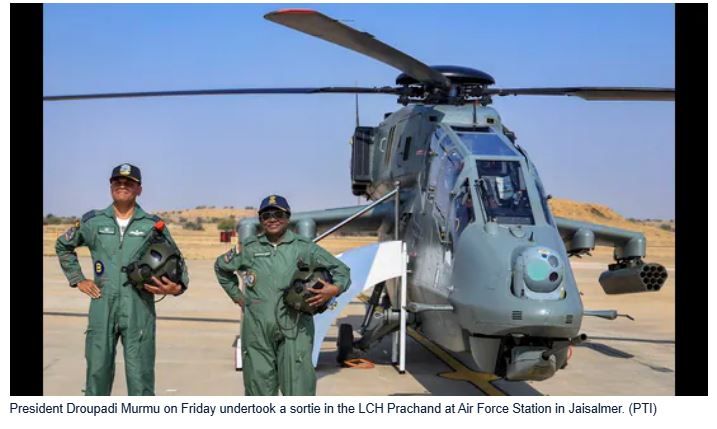
- Helicopter assets: Mi-17, indigenous Advanced Light Helicopter (ALH) Dhruv, and Light Combat Helicopter (LCH) Prachand.
Weapon Systems and Technological Integration
The exercise showcased several cutting-edge weapon systems and defensive technologies operationalised by the IAF:
- Short Range Loitering Munitions (SRLM) – providing precision strike options,
- Akash surface-to-air missile system – for medium-range air defence,
- SpyDer air defence system – capable of countering aerial threats at varied altitudes,
- Counter Unmanned Aerial Systems (CUAS) – designed to detect and neutralise hostile drones.
This integration underpins the IAF’s shift toward networked warfare capabilities, fusing sensors, shooters, and command systems for greater effectiveness.
Operational Themes and Key Demonstrations
A hallmark of Vayu Shakti-26 was the seamless synthesis of offensive and defensive air power with ground and special operations elements. Key components of the exercise included:
- Offensive air strikes against simulated high-value targets,
- Air defence operations ensuring integrity of friendly airspace,
- Special forces support missions, including insertion and extraction,
- Humanitarian assistance and disaster relief scenarios, reflecting operational versatility beyond conventional combat.
Such multi-role integration underscores the IAF’s role as both a deterrent and a force multiplier in national defence and crisis response.
Significance for National Security
In an era of heightened regional competition and technological transformation, Exercise Vayu Shakti-26 serves multiple strategic purposes:
- Reinforces the IAF’s operational readiness across the full spectrum of conflict,
- Demonstrates joint and integrated battle-space management capabilities,
- Validates the use of indigenous platforms alongside global systems,
- Signals resolve to adversaries while assuring domestic stakeholders of credible air power.
The exercise also offers valuable opportunities for learning and refinement of doctrines relevant to modern warfare, including multi-domain integration, high tempo operations, and adaptive command and control protocols.