
Coal Gasification Incentive Scheme
- 07 Apr 2026
In News:
India has unveiled an ambitious roadmap to reduce its dependency on imported petroleum, ammonia, and fertilizers through the promotion of coal gasification technology.
Overview and Objectives
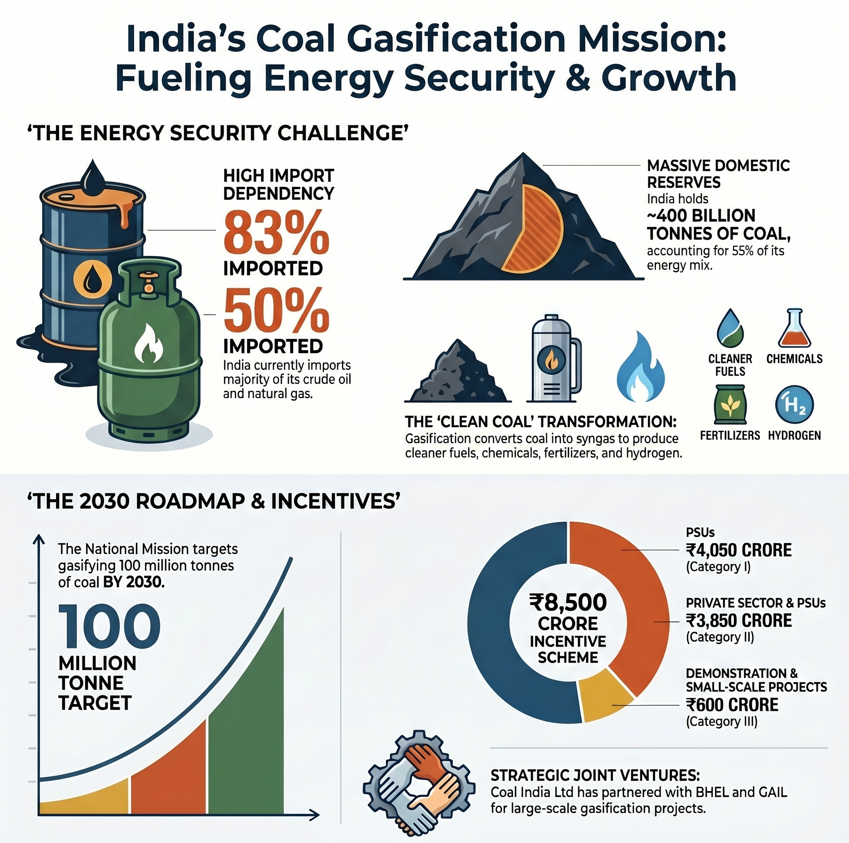
- Approved by the Union Cabinet, the Coal Gasification Incentive Scheme allocates ?8,500 crore to promote coal and lignite gasification projects involving both public sector undertakings (PSUs) and private players.
- The scheme's primary target is to achieve 100 million tonnes of coal gasification by 2030, positioning it as a key component of India's clean coal transition strategy.
Project Categories
The scheme classifies projects into three categories:
|
Category |
Deion |
|
Category I |
PSU-led projects |
|
Category II |
Private sector and PSU joint projects |
|
Category III |
Demonstration and small-scale projects |
This tiered structure encourages participation across the spectrum—from large-scale industrial ventures to pilot projects that test emerging technologies.
Understanding Coal Gasification
The Process
Coal gasification is a thermo-chemical process that converts coal into syngas (synthetic gas), composed primarily of:
- Carbon monoxide (CO)
- Hydrogen (H?)
- Carbon dioxide (CO?)
- Methane (CH?)
- Water vapour (H?O)
The process involves reacting coal at high temperatures (1000–1400°C) with controlled amounts of oxygen and steam.
Steps in Coal Gasification
- Preparation — Coal is finely crushed to increase surface area for efficient reaction
- Gasification reactor — Powdered coal enters a reactor with limited oxygen/air and steam
- Chemical reactions — Partial oxidation breaks coal down into syngas components
- Gas cleaning — Impurities such as tar, sulfur, and dust are removed from raw syngas
Strategic Significance for India
Energy Security
By leveraging domestic coal reserves, India can substantially reduce its reliance on imported petroleum and related products, insulating the economy from global price volatility and supply disruptions.
Industrial Applications
The syngas produced through coal gasification serves as feedstock for manufacturing:
- Ammonia and fertilizers
- Methanol and synthetic fuels
- Chemicals and petrochemical intermediates
This diversification supports the broader goal of Atmanirbhar Bharat in critical industrial sectors.
Environmental Considerations
While coal gasification is positioned within the "clean coal" framework, it represents an incremental improvement over direct coal combustion. The technology enables:
- More efficient capture of pollutants during gas cleaning
- Potential integration with carbon capture technologies
- Controlled emissions compared to conventional coal use