
Supreme Court on No-Fault Compensation for Covid-19 Vaccine Adverse Effects
- 15 Mar 2026
In News:
The Supreme Court of India has directed the Union Government to formulate a “no-fault liability compensation policy” for individuals who suffered serious adverse effects or deaths following Covid-19 vaccination during India’s nationwide immunisation programme. The Court held that victims or their families should receive compensation without having to prove negligence by the State or vaccine manufacturers.
Key Observations of the Supreme Court
1. Principle of No-Fault Liability
The Court invoked the no-fault liability principle, which allows compensation to victims without establishing fault or wrongdoing.
- The principle already exists in Indian law in areas such as motor vehicle accident compensation.
- Similar vaccine injury compensation schemes operate in countries such as Australia, the United Kingdom, and Japan.
This framework ensures speedy and equitable relief for victims of rare but serious vaccine side effects.
2. Rejection of Individual Litigation
The Union Government had argued that affected families could approach civil courts or consumer courts for damages against manufacturers or the State.
However, the Court rejected this argument, stating that:
- Individual litigation would lead to multiple legal battles.
- It could produce inconsistent outcomes and unequal access to justice.
- Such a situation may violate the Right to Equality under Article 14 of the Constitution.
3. State’s Positive Obligation
- Invoking Article 21 (Right to Life and Health), the Court emphasised that the State must act as an active guardian of citizens’ welfare and dignity.
- Since the vaccination drive was a State-led public health intervention, the government has a positive obligation to support those who suffer serious outcomes, even if such events are extremely rare.
- For instance, certain blood-clotting disorders associated with vaccines were reported at an estimated rate of about 0.001 per one lakh doses in India.
4. Compensation Beyond Surveillance
The Court observed that monitoring adverse events alone is insufficient. India already has a mechanism for investigating vaccine side effects through Adverse Events Following Immunisation (AEFI) committees.
The Court ruled that:
- These committees are adequate for medical assessment.
- However, the State’s responsibility cannot end with surveillance and investigation; it must extend to fair financial compensation.
5. Clarification on Liability
The Court clarified that creating a compensation policy does not amount to an admission of legal liability by the Union Government or vaccine manufacturers. Rather, it is a welfare-oriented public health measure.
Background: Earlier Judicial Interventions
1. Gaurav Kumar Bansal vs Union of India (2021)
The Supreme Court directed the National Disaster Management Authority (NDMA) to recommend guidelines for ex-gratia assistance for Covid-19 deaths.
Following this:
- NDMA fixed ?50,000 compensation per Covid-19 death.
- Payment was to be made by states through the State Disaster Response Fund (SDRF).
- A simplified procedure recognised deaths occurring within 30 days of a positive test as Covid-19 deaths.
- District-level grievance redressal committees were established to resolve disputes related to death certificates.
2. Jacob Puliyel vs Union of India (2022)
In this case, the Supreme Court:
- Upheld the validity of the Covid-19 vaccine approval process and the government’s AEFI monitoring system.
- Recognised bodily autonomy under Article 21, stating that no individual can be forcibly vaccinated.
Significance of the Judgment
- Strengthens public health governance: Encourages trust in vaccination programmes by ensuring protection for rare adverse outcomes.
- Ensures equitable relief: Avoids lengthy and costly litigation for affected families.
- Balances public interest and individual rights: Recognises both the importance of mass vaccination and the rights of individuals who suffer harm.
- Aligns India with global practices: Many countries already operate vaccine injury compensation programmes.
World Happiness Report 2025
- 23 Mar 2025
In News:
The World Happiness Report (WHR) 2025 was released on 20th March (World Happiness Day) by the Wellbeing Research Centre at the University of Oxford, in collaboration with Gallup and the UN Sustainable Development Solutions Network (UNSDSN).
India’s Performance:
- India’s Rank (2025):118th out of 147 countries (Improved from 126th in 2024).
- Sub-Indicator Performance:
- Donations: 57th
- Volunteering: 10th
- Helping a Stranger: 74th
- Wallet Return Probability:
- 115th (by neighbor)
- 86th (by stranger)
- 93rd (by police)
- Sub-Indicator Performance:
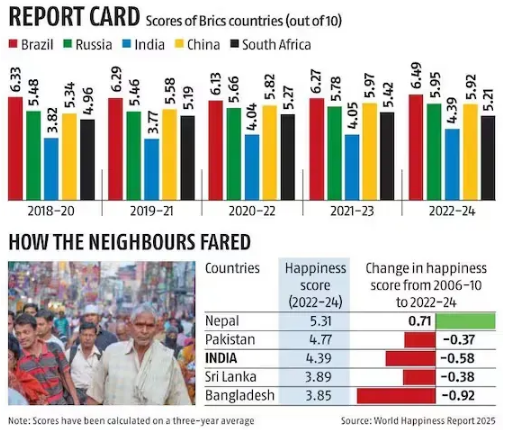
- Happiness Score: Increased from 4.054 (2021–23) to 4.389 (2022–24).
- Rank among Neighbors:
- Nepal: 92nd
- Pakistan: 109th
- Myanmar: 126th
- Sri Lanka: 133rd
- Bangladesh: 134th
Top 10 Happiest Countries (2025):
- Finland (8th consecutive year)
- Denmark
- Iceland
- Sweden
- Israel
- Costa Rica (new entrant)
- Netherlands
- Norway
- Luxembourg
- Mexico(new entrant)
Least Happy Countries (Bottom 5):
- 147th: Afghanistan (4th consecutive year as lowest)
- 146th: Sierra Leone
- 145th: Lebanon
- 144th: Malawi
- 143rd: Zimbabwe
About the Report:
- Purpose: Measures global well-being through life evaluations and promotes policy focus on happiness, mental health, and quality of life over mere economic growth.
- Methodology:
- Based on Gallup World Poll (2022–2024 data).
- Uses Cantril Ladder Scale (0–10) for life evaluation.
- Six Key Indicators:
- GDP per capita
- Healthy life expectancy
- Social support
- Freedom to make life choices
- Generosity
- Perception of corruption
Global Trends in Happiness (2025):
- Nordic Dominance: Finland, Denmark, Iceland, and Sweden occupy top ranks.
- Decline in Western Countries:
- USA: 24th (down from 11th in 2012)
- UK: 23rd (lowest since 2017)
- Rising loneliness and social isolation major causes.
- Israel (5th): Maintained high rank despite ongoing conflict.
- Social Support Decline: 19% of young adults globally report having no one to rely on.
Special Focus: India vs Pakistan – The Paradox
Despite India’s:
- Higher GDP per capita ($2,480.8 vs Pakistan’s $1,365.3),
- Better health indicators (life expectancy: 58.1 vs 56.9),
- Better corruption perception rank (India: 96th, Pakistan: 135th),
India still ranks lower in happiness.
Reason: Low scores in perceived freedom and individual life satisfaction.
World Happiness Day:
- Observed on: 20th March
- Initiated by: Bhutan, which pioneered the concept of Gross National Happiness (GNH).
- Adopted by UNGA: July 2012
- Theme 2025:"Caring and Sharing"