
National Pest Surveillance System (NPSS)
- 12 Nov 2025
In News:
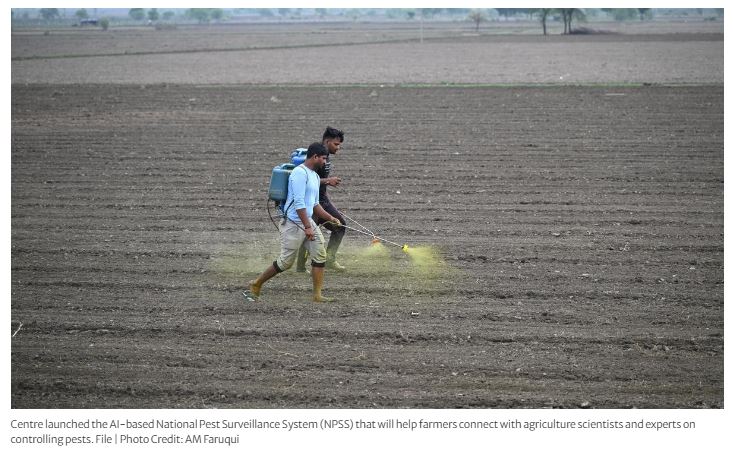
The National Pest Surveillance System (NPSS) is a digital, AI-driven initiative launched by the Ministry of Agriculture and Farmers Welfare to modernise pest management practices and strengthen decision-making at the farm level. Introduced in August 2024, NPSS aims to provide timely, scientific, and location-specific pest advisories to farmers across India.
What is NPSS?
- NPSS is a technology-based pest monitoring and advisory platform that leverages Artificial Intelligence (AI) and Machine Learning (ML).
- It comprises a user-friendly mobile application and a web portal, ensuring accessibility even for small and marginal farmers.
- The platform enables direct interaction between farmers and agricultural scientists/experts, including advisory support over phone.
Objectives
- Reduce farmers’ dependence on pesticide retailers, who often promote excessive or inappropriate chemical use.
- Promote a scientific and evidence-based approach to pest and disease management.
- Minimise crop losses due to pest attacks and improve overall agricultural productivity.
- Encourage judicious pesticide use, supporting sustainable and environmentally responsible farming.
Key Features
- AI/ML-based pest identification using real-time field data.
- Continuous pest surveillance and monitoring across agro-climatic zones.
- Automated and customised advisories based on crop type, pest incidence, and local conditions.
- Real-time analytics and dashboards to track pest trends and outbreaks.
- Seamless connectivity between farmers, scientists, and extension services.
How the System Works
- Farmers upload field information (such as crop stage and pest symptoms) via the app or portal.
- AI and ML algorithms analyse data to detect patterns and predict pest outbreaks.
- Expert-validated advisories are generated and communicated promptly, enabling early and preventive action.
Benefits to Farmers
- Quick response to pest and disease outbreaks, reducing yield losses.
- Actionable insights for timely spraying, biological control, or cultural practices.
- Improved cost efficiency by avoiding unnecessary pesticide use.
- Enhanced confidence and autonomy in farm-level decision-making.
Significance
- Aligns with India’s goals of Digital Agriculture and technology-led extension services.
- Strengthens food security by mitigating pest-induced crop losses.
- Supports sustainable agriculture by promoting precise and need-based pest control.
- Enhances last-mile delivery of scientific knowledge to farmers.