
Earthquake Lights
- 05 Apr 2026
In News:
Recent seismic activity in the Aegean Sea (late March to early April 2026), affecting parts of Turkey and Greece, has brought global attention to a rare atmospheric phenomenon known as Earthquake Lights (EQL).
What are Earthquake Lights?
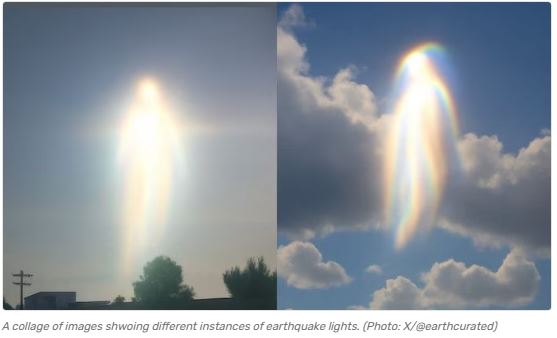
Earthquake Lights are luminous atmospheric displays that appear in various forms—flashes, streaks, balls, or tall iridescent pillars. They can manifest before, during, or shortly after an earthquake.
- Forms: Luminous spheres, vertical beams, sheet lightning, or steady glows.
- Colors: Often pale blue (attributed to Rayleigh Scattering) but can include red, green, or white hues.
- Heat: These are "cold" lights; they produce visible plasma but no fire or heat.
The Science of Formation: From Tectonic Stress to Plasma
While scientists have debated the exact physical mechanisms for centuries, the most widely accepted theory involves the release of electrical energy from the Earth's crust:
- Lithospheric Stress: During an earthquake, tectonic plates grind together, exerting immense pressure on rocksparticularly those rich in quartz or igneous minerals.
- Activation of "P-Holes": This stress activates "p-holes" (charge carriers/positive holes). The rocks act like a natural battery, generating high-voltage electric charges.
- Upward Propagation: These charges travel rapidly toward the surface through geological conduits, specifically straight, vertical faults common in rift zones.
- Atmospheric Ionization: Upon reaching the surface, the charges interact with air molecules, stripping away electrons and ionizing the air.
- Plasma Discharge: This ionization creates a glowing plasma discharge in the atmosphere, similar to the gas in a neon sign or the Auroras, though triggered by terrestrial rather than solar energy.
Geological Context and Fault Systems
Research published in Seismological Research Letters highlights that approximately 97% of EQL cases occur in or near rift zone environments.
- Rift Zones: Areas where tectonic plates are pulling apart, creating sub-vertical faults.
- Conduits: These vertical faults act as "high-speed pathways" for electrical pulses to reach the surface.
- Precursors: Because the stress builds up before the actual slip of the fault, EQL can serve as a rare, visible pre-seismic warning signal.
Modern Monitoring and Research
- Satellite Tracking: NASA and the International Union of Radio Science (URSI) now use satellite sensors to track "energetic coupling", the process where electrical potentials from the crust couple with the lower atmosphere and ionosphere.
- Laboratory Verification: Scientists have successfully replicated these electrical effects by squeezing granite and other igneous rocks in controlled lab settings.