
Solar Radio Burst
- 01 Apr 2026
In News:
In a major advancement for heliophysics, researchers from the Indian Institute of Astrophysics (IIA), an autonomous body under the Department of Science and Technology (DST)have recently solved a decades-old mystery regarding Solar Radio Bursts (SRBs). This breakthrough, published in early 2026, significantly enhances our ability to predict space weather and protect critical technological infrastructure.
Understanding Solar Radio Bursts (SRBs)
Solar Radio Bursts are intense emissions of radio waves from the Sun, typically triggered by solar transients such as Solar Flares and Coronal Mass Ejections (CMEs).
- Scientific Nature: They serve as direct signatures of accelerated electrons moving through the solar atmosphere.
- Wavelength Diversity: SRBs are observed across a massive spectrum, from millimeters (GHz range) to kilometers (kHz range).
- Short wavelengths indicate activity near the solar surface.
- Long wavelengths reflect activity occurring at greater distances from the Sun as shocks travel outward.
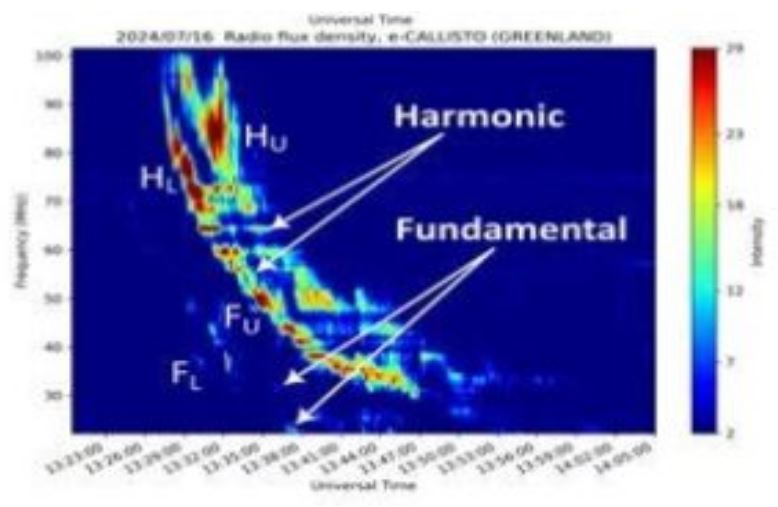
- Classification: Morphologically, SRBs are divided into five categories (Types I through V). Among these, Type II bursts are "slow-drifting" emissions that track shock waves moving through the solar corona at speeds of approximately 1,000 km/s.
The IIA Breakthrough: The "Fundamental vs. Harmonic" Puzzle
For years, scientists were puzzled by the varying relative strengths of the two components of Type II bursts: the Fundamental emission (the base frequency) and the Harmonic emission (the overtone). While theory suggests the fundamental should be stronger, observations often showed the opposite.
The Discovery
The IIA team, led by Dr. K. Sasikumar Raja, analyzed 58 Type II bursts using the global CALLISTO (Compound Astronomical Low Frequency Low Cost Instrument for Spectroscopy and Transportable Observatory) network and the Gauribidanur Low Frequency Solar Spectrograph (GLOSS).
- The Longitude Factor: The study found that the location of the solar active region (heliographic longitude) determines which emission reaches Earth more strongly.
- The 75° Rule: * Events < 75° (Disk Center): Exhibit stronger Fundamental emissions.
- Events > 75° (Solar Limb/Edges): Exhibit stronger Harmonic emissions.
- The Mechanism: This is due to refractive effects in the solar corona and "viewing angles." Fundamental emissions have narrow "cone angles" and get blocked or weakened when originating from the Sun's edges. Harmonic emissions have broader angles, allowing them to bypass these obstacles and reach Earth effectively.
Implications for Space Weather and Technology
- GNSS Interference: SRBs reduce the signal-to-noise ratio of Global Navigation Satellite Systems (like GPS and India’s NavIC), potentially causing a "loss of lock" and affecting aviation and maritime navigation.
- Satellite Health: Understanding these bursts helps in predicting the arrival of solar storms that can damage satellite electronics and solar panels.
- Communication Hubs: High-intensity bursts can disrupt high-frequency (HF) radio communications used by emergency services and the military.
- Forecasting Models: By understanding how these waves propagate, scientists can now develop more accurate models to provide earlier warnings for geomagnetic storms.
The Path Ahead: AI and Machine Learning
The IIA researchers have indicated that the next phase of this study involves applying Machine Learning (ML) to the vast datasets collected by spectrometers like CALLISTO. This will help automate the detection of solar shocks and further refine the accuracy of space weather alerts.