
CALM-Brain
- 30 Mar 2026
In News:
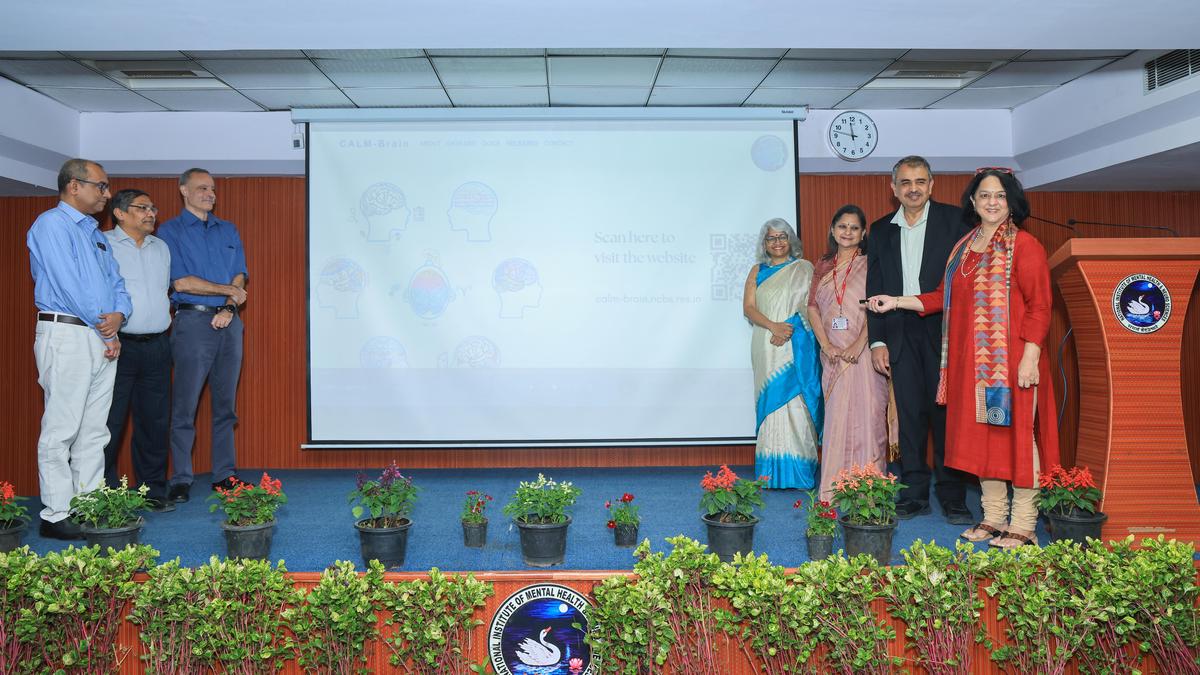
Recently, the Rohini Nilekani Centre for Brain and Mind (CBM), a collaboration between the National Institute of Mental Health and Neuro Sciences (NIMHANS) and the National Centre for Biological Sciences (NCBS-TIFR)launched CALM-Brain in Bengaluru. It marks a milestone in India's neuroscientific research by creating the country’s first open-source digital repository for major psychiatric disorders.
What is CALM-Brain?
CALM-Brain (Comprehensive Assessment of Longitudinal Modal-Brain) is a first-of-its-kind digital storehouse of multidimensional data focused on the structure and function of the human brain.
- Objective: To provide a systematic, data-driven framework to understand the onset, progression, and biological markers of severe mental illnesses.
- Target Population: It currently hosts data from over 2,000 participants across 900 families, including both affected and unaffected members (a "family-based" approach).
- Open Source: The repository will be made available to clinicians and researchers globally to foster collaborative breakthroughs.
Core Features and Scope
The repository integrates data across five major neuropsychiatric disorders:
- Addiction
- Bipolar Disorder
- Dementia
- Obsessive-Compulsive Disorder (OCD)
- Schizophrenia
Multi-modal Data Types:
The platform does not rely on a single parameter but collects a "longitudinal" (time-series) dataset including:
- Neuro-imaging: High-resolution scans (fMRI, MRI).
- Clinical &Behavioural: Detailed patient histories and cognitive assessments.
- Genetic & Biological: Genetic analysis from blood samples and eye-tracking data.
- Biorepository Linkage: Crucially, the data is linked to a biorepository of stem cells, allowing scientists to grow "mini-brains" (organoids) in labs to study disease mechanisms at a cellular level.
Institutional Framework and Funding
- Origin: The initiative was conceived in 2016 under the Accelerator program for Discovery in Brain disorders using Stem cells (ADBS project).
- Funding: Jointly supported by the Department of Biotechnology (DBT), Government of India, and the Pratiksha Trust.
- Philanthropic Support: Launched and supported by Rohini Nilekani Philanthropies (RNP).
Significance for India
- Addressing Data Under-representation: Most global psychiatric studies are centric to Europe and North America. CALM-Brain provides a South Asian/Indian-specific dataset, which is vital because genetic and environmental factors affecting mental health vary across ethnicities.
- Precision Psychiatry: By identifying neurocognitive biomarkers, clinicians can move away from "one-size-fits-all" treatments toward personalized medicine (tailoring treatments based on a patient’s unique genetic and biological profile).
- Bridging the Treatment Gap: According to the National Mental Health Survey (2015-16), nearly 10.6% of Indian adults suffer from mental illnesses. CALM-Brain helps in early diagnosis, potentially reducing the massive economic loss (estimated by WHO at $1.03 trillion for India between 2012–2030).
- Shift to Biological Markers: Traditionally, psychiatry relies on observing symptoms. CALM-Brain aims to identify biological markers that cut across traditional diagnostic categories, leading to more accurate clinical interventions.
The launch of CALM-Brain aligns with the government's focus on mental health, as seen in the Union Budget 2026-27 proposal for NIMHANS-2 and the upgrading of regional institutes like the Central Institute of Psychiatry, Ranchi. The integration of such repositories with the National Digital Health Mission (NDHM) could further streamline mental healthcare delivery in India.