
Balirajgarh site
- 01 Apr 2026
In News:
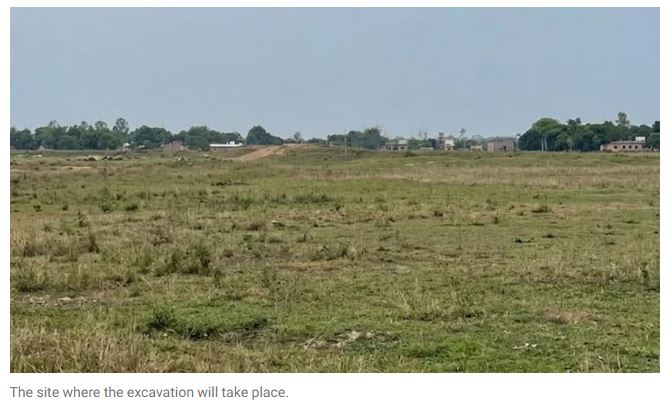
The Archaeological Survey of India (ASI) officially commenced a large-scale scientific excavation at the historic Balirajgarh site in Bihar’s Madhubani district in March 2026. This project seeks to bridge the gap between ancient Indian mythology and material history, potentially pushing back the timeline of urban civilization in the Mithila region to the Iron Age.
The Balirajgarh Site: Gateway to Ancient Mithila
Located in the Babubarhi block of Madhubani, Balirajgarh (officially the "Remains of Ancient Fort of Garh") is a centrally protected monument of national importance.
- Mythological Roots: Local folklore identifies the site as the capital of the legendary King Bali.
- Historical Identity: It is widely believed to have been a major administrative and political hub of the ancient Videha Kingdom (associated with King Janaka in Vedic texts).
- Physical Scale: The site spans approximately 176 acres and features a massive brick fortification and over 20 archaeological mounds.
Chronology of Habitation (Five-Fold Sequence)
Previous excavations conducted between 1962 and 2014 established that Balirajgarh was a site of continuous habitation for over 1,500 years. The discovered layers correspond to:
- Northern Black Polished Ware (NBPW) Phase (c. 700–200 BCE): Represents the earliest urban layer, characterized by high-quality deluxe pottery.
- Sunga Period (c. 2nd Century BCE): Notable for the construction of massive brick fortifications.
- Kushan Period: Evidence of trade and sustained urban life.
- Gupta Period: Represents the "Classical Age" of settlement.
- Pala Period (c. 8th–12th Century CE): Marks the later medieval stages before the site’s eventual decline.
Objectives of the 2026 Excavation
The current phase of excavation, led by the ASI Patna Circle, employs modern archaeological tools to answer specific historical questions:
- The "Virgin Soil" Quest: Archaeologists aim to reach the deepest, undisturbed layers of soil to determine if settlement predates the NBPW phase, possibly linking it directly to the early Iron Age Videha tribe.
- Advanced Technology: To overcome previous challenges like the high water table, the ASI is using Satellite Imagery, Ground Penetrating Radar (GPR), and systematic 3D mapping.
- Mithila Civilization: The overarching goal is to reconstruct the "early Mithila civilization" and its socio-economic networks.
Institutional Profile: Archaeological Survey of India (ASI)
- Genesis: Founded in 1861 by Sir Alexander Cunningham (the "Father of Indian Archaeology").
- Statutory Status: Post-independence, it became a statutory body under the Ancient Monuments and Archaeological Sites and Remains (AMASR) Act, 1958.
- Nodal Ministry: Functions under the Ministry of Culture, Government of India.
- Key Responsibilities: * Maintenance of over 3,600 monuments of national importance.
- Regulation of the Antiquities and Art Treasure Act, 1972.
- Conducting scientific research, excavations, and chemical preservation of heritage.