
BHASHINI National Infrastructure
- 20 Feb 2026
In News:
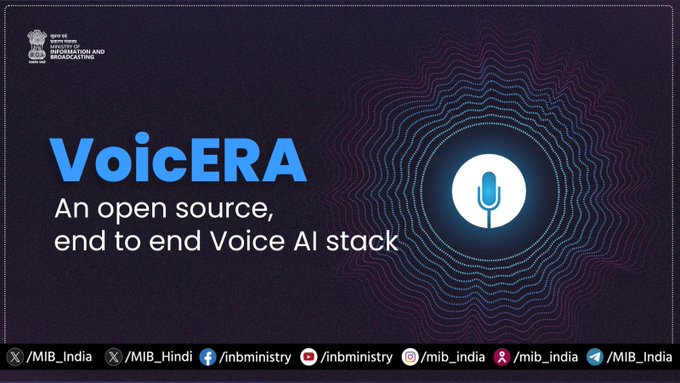
- VoicERA, an open-source end-to-end Voice AI stack, was launched at the India AI Impact Summit 2026 on the BHASHINI National Language Infrastructure, marking a major expansion of India’s Digital Public Infrastructure (DPI).
- The initiative was launched by the Digital India BHASHINI Division (DIBD) under the Digital India Corporation (DIC), Ministry of Electronics and Information Technology (MeitY).
What is VoicERA?
- VoicERA is an open-source, end-to-end Voice AI execution stack deployed on BHASHINI (National Language Infrastructure).
- It functions as a national execution layer for multilingual Voice and Language AI, enabling scalable and secure deployment of speech-based systems across government and research ecosystems.
Institutional Framework
- Launched at: India AI Impact Summit 2026
- Developed by:
- Digital India BHASHINI Division (MeitY)
- EkStep Foundation
- COSS
- IIIT Bengaluru
- AI4Bharat
Objectives
- Enable citizens to access government services through natural speech interfaces across Indian languages.
- Provide an interoperable and open-standard framework to reduce duplication and vendor lock-in.
- Ensure secure, scalable deployment of multilingual Voice AI systems for governance and innovation.
Key Features
1. Open-Source & Digital Public Good
- Modular design for easy adoption and integration.
- Reduces dependency on proprietary systems.
2. Pluggable & Interoperable Architecture
- Compatible with existing government applications and APIs.
- Supports seamless integration across departments.
3. Cloud & On-Premise Deployment
- Flexible hosting options depending on security and operational needs.
4. Multilingual Voice AI
- Real-time speech recognition.
- Conversational AI systems.
- Multilingual telephony support at population scale.
5. Secure Execution Layer
- Ensures safe processing of voice data.
- Enables scalable citizen engagement.
Expansion of BHASHINI’s Role
With VoicERA integration, BHASHINI’s capabilities expand from:
- Translation services
- Language technology tools
to:
- Real-time speech systems
- Conversational AI
- Voice-enabled citizen service delivery
This marks a shift toward voice as a primary interface for governance, especially for non-textual and non-English-speaking users.
Governance Applications
Departments can rapidly deploy voice-enabled services in:
- Agriculture advisories
- Education support
- Livelihood services
- Grievance redressal
- Citizen feedback systems
- Government scheme discovery