
WTO MC14 Conference
- 02 Apr 2026
In News:
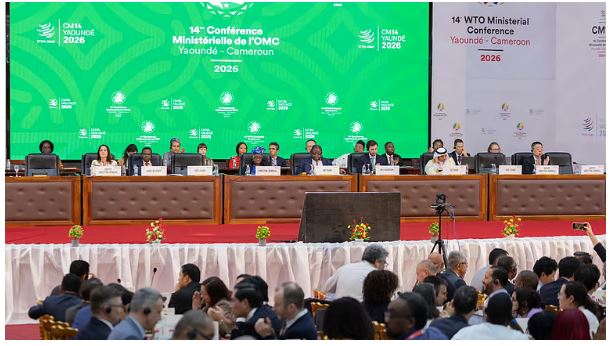
The 14th Ministerial Conference (MC14) of the World Trade Organization (WTO) concluded in Yaoundé, Cameroon (March 2026). As the highest decision-making body of the WTO, the conference aimed to modernize global trade rules, reform the dispute settlement mechanism, and address the digital economy. While it introduced a more "nimble" working methoddubbed the Yaoundé Way, the meeting ended without a final consensus on critical issues like e-commerce duties and agricultural reforms.
The "Yaoundé Package" and Key Outcomes
Although no final legally binding agreement was reached, the Yaoundé Package was developed as a draft ministerial declaration to serve as a roadmap for finalization at the General Council in Geneva.
A. Fisheries Subsidies
Ministers reached a crucial agreement to continue negotiations aimed at implementing comprehensive disciplines on harmful subsidies. The objective is to present final recommendations at MC15 to eliminate subsidies that contribute to overcapacity and overfishing, as outlined in the Agreement on Fisheries Subsidies.
B. Trade and Climate Agenda
Significant progress was noted through the Integrated Forum on Climate Change and Trade (IFCCT), which will launch a three-year work programme in June 2026.
- Fossil Fuel Subsidy Reform: Member nations reaffirmed their commitment to reform subsidies that distort trade and harm the environment.
- Voluntary Climate Actions: A communiqué was adopted, outlining a menu of voluntary actions to better align trade policies with global climate goals.
C. Small Economies and Least Developed Countries (LDCs)
- LDC Package: Dedicated support measures for the world's poorest nations were advanced, serving as a core component for finalization in Geneva.
- Inclusivity: Decisions were adopted to enhance the integration of small economies into the multilateral trading system, specifically targeting Sanitary and Phytosanitary (SPS) and Technical Barriers to Trade (TBT) agreements to aid developing nations.
Major Stalestales and Failures
A. The E-commerce Deadlock
A major disappointment was the failure to extend the E-commerce Moratorium on customs duties for digital transmissions (software, e-books, and digital music).
- The Conflict: The United States pushed for a permanent extension of the moratorium to ensure a free digital market, while Brazil opposed it, seeking the right to levy duties.
- Implication: This poses a significant risk of disrupting global digital trade if the moratorium expires before the Geneva General Council meeting.
B. TRIPS and Intellectual Property
No agreement was reached on the TRIPS Non-Violation Complaint Moratorium, which is scheduled to expire at the end of March 2026. This lapse could lead to increased litigation over intellectual property rights between member states.
C. Agriculture and Dispute Settlement
- Agriculture Impasse: Negotiations between the US and Brazil remained deadlocked over domestic support and market access, mirroring long-standing disputes that have stalled WTO progress for decades.
- Dispute Settlement Reform: Despite discussions, there was no convergence on restoring the WTO’s Appellate Body, which has been non-functional since 2019.
D. Investment Facilitation: The Role of India and South Africa
India and South Africa successfully blocked the inclusion of the Investment Facilitation for Development (IFD) agreement into the formal WTO legal framework. They argued that such agreements fall outside the WTO’s trade-centric mandate and should not be negotiated as plurilateral agreements under the WTO umbrella.
Solid Waste Management (SWM) Rules, 2026
- 02 Apr 2026
In News:
In a decisive step toward achieving a "Zero Waste to Landfill" goal, the Ministry of Environment, Forest and Climate Change (MoEFCC) has notified the Solid Waste Management Rules, 2026. Set to replace the decade-old 2016 framework starting April 1, 2026, these rules shift India's urban governance from a "collect-and-dump" model to a robust Circular Economy approach.
The rules are issued under the statutory powers of the Environment (Protection) Act, 1986, and aim to formalize the waste management sector through digital tracking and enhanced generator accountability.
Key Pillars of the 2026 Framework
A. Mandatory Four-Stream Segregation
Unlike the previous three-stream model, the 2026 rules mandate source segregation into four distinct categories to improve the efficiency of processing:
- Wet Waste: Organic and food waste for composting or bio-methanation.
- Dry Waste: Recyclables like plastic, paper, and metal destined for Material Recovery Facilities (MRFs).
- Sanitary Waste: Diapers and napkins must now be wrapped securely for specialized handling.
- Special Care Waste: Domestic hazardous items, including expired medicines, paint cans, and bulbs.
B. Extended Bulk Waste Generator Responsibility (EBWGR)
The rules tighten the definition and responsibility of "Bulk Generators." Entities generating over 100 kg/day, consuming 40,000 liters of water/day, or occupying 20,000 sq.m. must:
- Process organic waste on-site.
- Or, purchase EBWGR certificates to ensure their waste is managed scientifically elsewhere.
C. Digital Governance & Transparency
A Centralised Online Portal will be established to track the waste lifecycle. All stakeholdersfrom municipal bodies to private recyclersmust register, report data, and undergo digital audits. This aims to eliminate "leakage" where waste is illegally dumped.
D. Industrial Integration & RDF
To reduce the burden on landfills, the rules promote Refuse-Derived Fuel (RDF). Industries such as cement plants are mandated to increase their use of RDF as a fuel substitute from the current 5% to 15% over the next six years.
Remediation and Regional Provisions
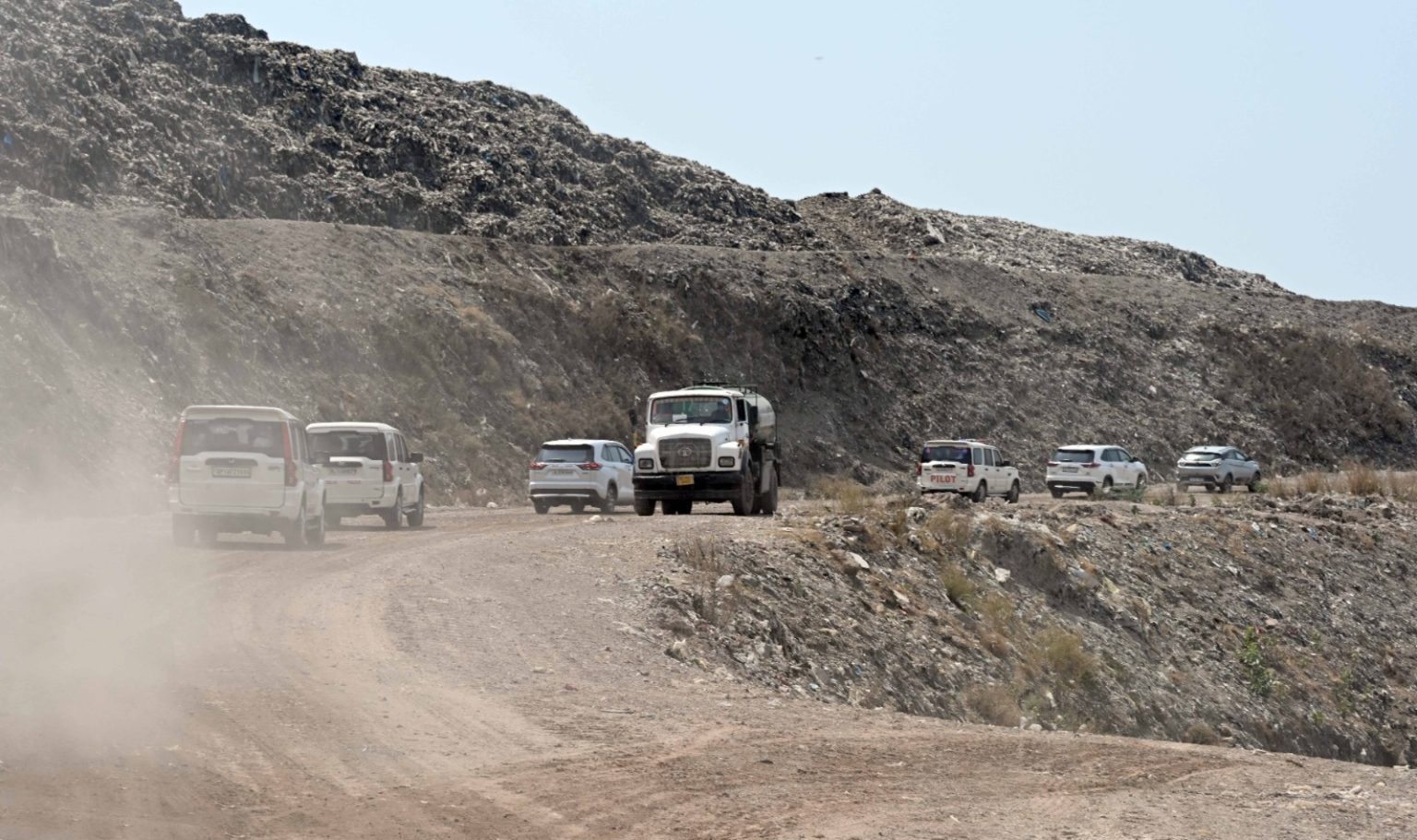
- Legacy Waste: The rules mandate time-bound biomining and bioremediation of existing dumpsites (legacy waste) to reclaim land and prevent leachate contamination.
- Landfill Restrictions: Landfills are strictly limited to non-recyclable, non-combustible, and inert waste only.
- Hilly and Island Regions: Acknowledging the ecological sensitivity of these areas, local bodies are empowered to levy user fees on tourists and can regulate tourist inflow based on the local waste-processing capacity.
- Buffer Zones: New facilities must maintain mandatory buffer zones, with graded criteria to expedite land allocation for waste processing units.
Enforcement: The "Polluter Pays" Principle
The 2026 Rules introduce a stringent Environmental Compensation regime. Penalties will be levied for:
- Operating without mandatory registration.
- Submission of fraudulent data on the centralized portal.
- Failure to adhere to segregation or processing timelines.
The SWM Rules 2026 complement the Swachh Bharat Mission (Urban) 2.0 and India’s commitments under the UN Sustainable Development Goals (SDG 11 & 12) regarding sustainable cities and responsible consumption.
Bonn Convention & COP15
- 02 Apr 2026
In News:
Recently, at 15th Conference of Parties (COP15) to the Convention on the Conservation of Migratory Species of Wild Animals (CMS) forty new species were added to the protected list category.
Key Details:
The Convention on the Conservation of Migratory Species of Wild Animals (CMS), widely known as the Bonn Convention, is the only global intergovernmental treaty dedicated exclusively to the conservation of terrestrial, aquatic, and avian migratory species.
- Genesis: Signed in Bonn, Germany, on June 23, 1979.
- Aegis: It operates under the United Nations Environment Programme (UNEP).
- Core Philosophy: Recognizes that migratory species do not respect political borders and their survival depends on international cooperation across their entire migratory range ("Range States").
Statutory Structure: Appendices and Agreements
The Convention provides for varying degrees of protection through two primary Appendices:
- Appendix I (Endangered Species): Lists migratory species in danger of extinction. Parties that are Range States of these species must strictly prohibit the "taking" (hunting, fishing, capturing) of these animals.
- Appendix II (Unfavourable Conservation Status): Lists species that would benefit significantly from international cooperation. It encourages Range States to conclude global or regional Agreements or less formal Memoranda of Understanding (MoUs).
Milestone Outcomes of COP15 (Campo Grande, Brazil, 2026)
The 15th Conference of Parties (COP15), held in March 2026 under the theme "Connecting Nature to Sustain Life," marked a pivotal moment for global biodiversity.
A. Expanded Protection for 40 New Species
Governments agreed to grant new or enhanced protection to 40 species facing steep population declines. Significant additions include:
- Terrestrial: The Cheetah (Zimbabwe population), Striped Hyena, and Giant Otter.
- Avian: The Snowy Owl, Hudsonian Godwit, and several Gadfly petrels.
- Aquatic: The Great Hammerhead Shark, Scalloped Hammerhead, and the Amazonian Migratory Catfish (Dourada and Piramutaba).
B. The "State of the World’s Migratory Species" Interim Report (2026)
The conference highlighted alarming scientific data:
- 49% of CMS-listed species are currently experiencing population declines.
- 24% of these species are now at risk of extinction.
- Primary Threats: Habitat loss/fragmentation, overexploitation (illegal hunting and bycatch), and infrastructure barriers (such as dams and wind turbines).
C. Key Resolutions and Initiatives
- Atlas of Migratory Routes of the Americas: A first-of-its-kind scientific tool consolidating data on 622 species to guide integrated environmental policies.
- Amazonian Multi-Species Plans: Specific conservation frameworks were approved for the Amazon region, focusing on freshwater connectivity.
- Emerging Threats: Resolutions were passed to address deep-sea mining, underwater noise, and plastic pollution.
- Multilateralism: Brazil assumed the CMS COP Presidency, emphasizing that "ecological connectivity" is essential for achieving the Kunming-Montreal Global Biodiversity Framework.
India’s 1st National Repository for Deep-Sea Fauna
- 02 Apr 2026
In News:
In a significant boost to India’s marine conservation framework and the Blue Economy mission, the Ministry of Environment, Forest and Climate Change (MoEFCC) has officially designated the "Bhavasagara" Referral Centre at Kochi as a National Repository for Deep-Sea Fauna.
This designation was conferred under Section 39 of the Biological Diversity Act, 2002, recognizing the facility as a critical hub for preserving India’s deep-sea biological heritage.
About the Bhavasagara Referral Centre
Located within the campus of the Center for Marine Living Resources & Ecology (CMLRE) in Kochi, Kerala, "Bhavasagara" serves as a specialized scientific repository.
- Current Holdings: It houses over 3,560 taxonomically identified and geo-referenced voucher specimens.
- Biological Diversity: The collection includes a vast range of marine life:
- Invertebrates: Cnidarians (corals/jellyfish), molluscs, arthropods (crabs/shrimp), annelids, and echinoderms.
- Vertebrates: Elasmobranchs (sharks/rays) and teleostean (bony) fishes.
- Coverage: Over 70% of the specimens represent deep-water and open-ocean species collected from the Indian Exclusive Economic Zone (EEZ) and adjacent high seas.
Key Responsibilities & Statutory Powers
Under the Biological Diversity Act, 2002, the repository is mandated with the following:
- Secure Custody: Maintaining physical biological samples (voucher specimens) alongside their DNA sequences and genetic data.
- Official Custodian of New Species: It is the mandatory repository for any new deep-sea species (Type Specimens) discovered within Indian waters.
- Capacity Building: Acting as a training hub for deep-sea taxonomy, directly aligning with the UN Decade of Ocean Science for Sustainable Development (2021–2030).
- Digital Documentation: Integration with databases like the Indian Ocean Biodiversity Information System (IndOBIS) for global and regional knowledge sharing.
The Institutional Framework: CMLRE
The Center for Marine Living Resources & Ecology (CMLRE) is a premier research institute under the Ministry of Earth Sciences (MoES).
- Mandate: Exploration, management, and conservation of living resources within the Indian EEZ.
- Research Pillars:
- Fishery Resource Assessment: Utilizing research cruises (e.g., in the Arabian Sea and Bay of Bengal) to map biodiversity hotspots and spawning grounds.
- Advanced Technology: Employing environmental DNA (eDNA) metabarcoding and genomic analysis for non-invasive biodiversity assessment.
- Community Engagement: Development of the "Ocean Eyes" mobile app, a citizen-science initiative to record marine species sightings
IONS Maritime Exercise (IMEX)
- 01 Apr 2026
In News:
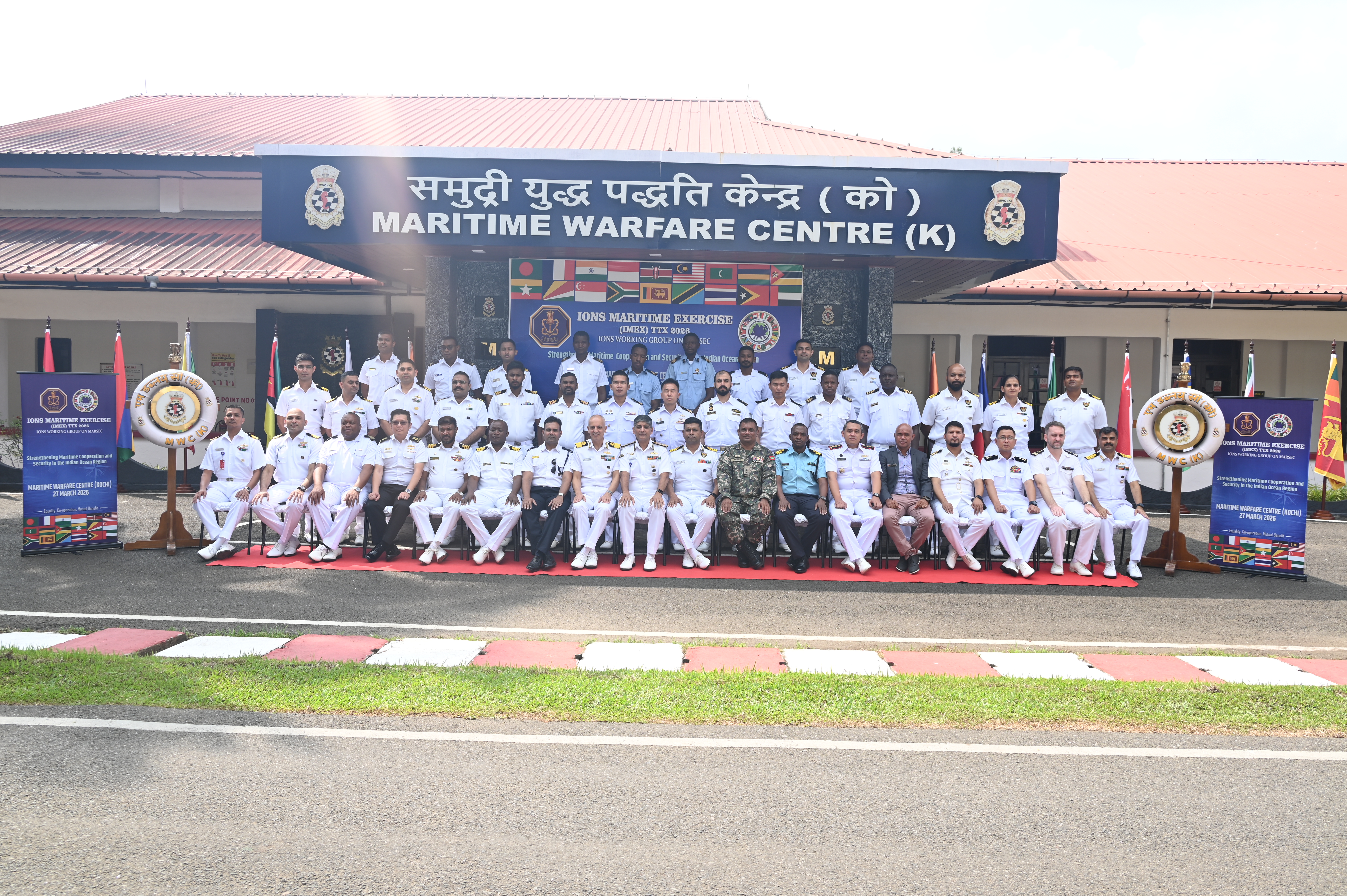
In a significant stride toward regional maritime stability, the Indian Navy recently hosted the IONS Maritime Exercise (IMEX) Table Top Exercise (TTX) 2026. Held at the Maritime Warfare Centre under the Southern Naval Command in Kochi, the exercise underscores India’s proactive role in the Indian Ocean Region (IOR) under the vision of SAGAR (Security and Growth for All in the Region).
Key Highlights
The 2026 edition of IMEX was designed as a Table Top Exercise (TTX), providing a simulated environment to refine strategic responses without the deployment of actual fleet assets.
- Core Focus: The exercise prioritized non-traditional maritime security threats, including maritime terrorism, piracy, illegal fishing (IUU), and humanitarian crises.
- Objectives:
- Enhancing interoperability and coordination among diverse navies.
- Streamlining real-time information sharing and collective decision-making.
- Validating existing maritime security frameworks to ensure they are robust enough for complex, multi-dimensional scenarios.
- Participating Nations: A diverse group of 12 littoral states participated, including Bangladesh, France, Indonesia, Kenya, Maldives, Mauritius, Myanmar, Seychelles, Singapore, Sri Lanka, Tanzania, and Timor-Leste.
Understanding the Indian Ocean Naval Symposium (IONS)
The IONS is a cornerstone of India’s naval diplomacy and serves as a vital "Track 1.5" or formal diplomatic initiative for the Indian Ocean.
Genesis and Structure
- Inception: Conceived and launched by the Indian Navy in 2008. The inaugural edition was held in New Delhi, with India serving as the first Chair (2008–2010).
- Nature: A voluntary and inclusive initiative that brings together the navies of the littoral states of the IOR.
- Operational Framework: It functions through a rotating chairmanship, biennial Conclaves of Chiefs (CoC), and specialized Working Groups (WGs) focusing on areas like HADR and Maritime Security.
Geographic Scope
The IONS membership is divided into four sub-regions to ensure equitable representation:
- South Asian Littorals (e.g., India, Bangladesh, Sri Lanka)
- West Asian Littorals (e.g., UAE, Oman, Iran)
- East African Littorals (e.g., Kenya, South Africa, Mauritius)
- South East Asian & Australian Littorals (e.g., Australia, Indonesia, Singapore)
Balirajgarh site
- 01 Apr 2026
In News:
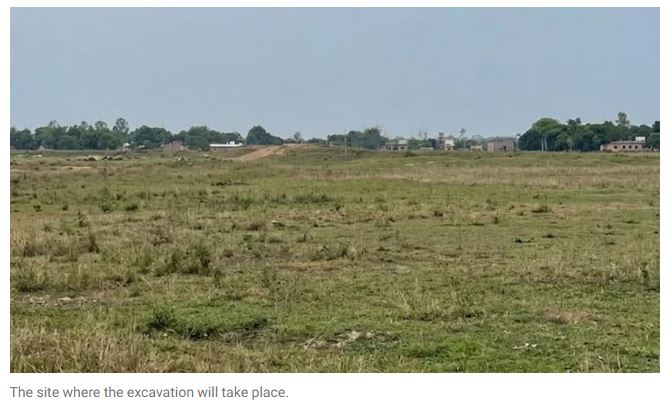
The Archaeological Survey of India (ASI) officially commenced a large-scale scientific excavation at the historic Balirajgarh site in Bihar’s Madhubani district in March 2026. This project seeks to bridge the gap between ancient Indian mythology and material history, potentially pushing back the timeline of urban civilization in the Mithila region to the Iron Age.
The Balirajgarh Site: Gateway to Ancient Mithila
Located in the Babubarhi block of Madhubani, Balirajgarh (officially the "Remains of Ancient Fort of Garh") is a centrally protected monument of national importance.
- Mythological Roots: Local folklore identifies the site as the capital of the legendary King Bali.
- Historical Identity: It is widely believed to have been a major administrative and political hub of the ancient Videha Kingdom (associated with King Janaka in Vedic texts).
- Physical Scale: The site spans approximately 176 acres and features a massive brick fortification and over 20 archaeological mounds.
Chronology of Habitation (Five-Fold Sequence)
Previous excavations conducted between 1962 and 2014 established that Balirajgarh was a site of continuous habitation for over 1,500 years. The discovered layers correspond to:
- Northern Black Polished Ware (NBPW) Phase (c. 700–200 BCE): Represents the earliest urban layer, characterized by high-quality deluxe pottery.
- Sunga Period (c. 2nd Century BCE): Notable for the construction of massive brick fortifications.
- Kushan Period: Evidence of trade and sustained urban life.
- Gupta Period: Represents the "Classical Age" of settlement.
- Pala Period (c. 8th–12th Century CE): Marks the later medieval stages before the site’s eventual decline.
Objectives of the 2026 Excavation
The current phase of excavation, led by the ASI Patna Circle, employs modern archaeological tools to answer specific historical questions:
- The "Virgin Soil" Quest: Archaeologists aim to reach the deepest, undisturbed layers of soil to determine if settlement predates the NBPW phase, possibly linking it directly to the early Iron Age Videha tribe.
- Advanced Technology: To overcome previous challenges like the high water table, the ASI is using Satellite Imagery, Ground Penetrating Radar (GPR), and systematic 3D mapping.
- Mithila Civilization: The overarching goal is to reconstruct the "early Mithila civilization" and its socio-economic networks.
Institutional Profile: Archaeological Survey of India (ASI)
- Genesis: Founded in 1861 by Sir Alexander Cunningham (the "Father of Indian Archaeology").
- Statutory Status: Post-independence, it became a statutory body under the Ancient Monuments and Archaeological Sites and Remains (AMASR) Act, 1958.
- Nodal Ministry: Functions under the Ministry of Culture, Government of India.
- Key Responsibilities: * Maintenance of over 3,600 monuments of national importance.
- Regulation of the Antiquities and Art Treasure Act, 1972.
- Conducting scientific research, excavations, and chemical preservation of heritage.
Solar Radio Burst
- 01 Apr 2026
In News:
In a major advancement for heliophysics, researchers from the Indian Institute of Astrophysics (IIA), an autonomous body under the Department of Science and Technology (DST)have recently solved a decades-old mystery regarding Solar Radio Bursts (SRBs). This breakthrough, published in early 2026, significantly enhances our ability to predict space weather and protect critical technological infrastructure.
Understanding Solar Radio Bursts (SRBs)
Solar Radio Bursts are intense emissions of radio waves from the Sun, typically triggered by solar transients such as Solar Flares and Coronal Mass Ejections (CMEs).
- Scientific Nature: They serve as direct signatures of accelerated electrons moving through the solar atmosphere.
- Wavelength Diversity: SRBs are observed across a massive spectrum, from millimeters (GHz range) to kilometers (kHz range).
- Short wavelengths indicate activity near the solar surface.
- Long wavelengths reflect activity occurring at greater distances from the Sun as shocks travel outward.
- Classification: Morphologically, SRBs are divided into five categories (Types I through V). Among these, Type II bursts are "slow-drifting" emissions that track shock waves moving through the solar corona at speeds of approximately 1,000 km/s.
The IIA Breakthrough: The "Fundamental vs. Harmonic" Puzzle
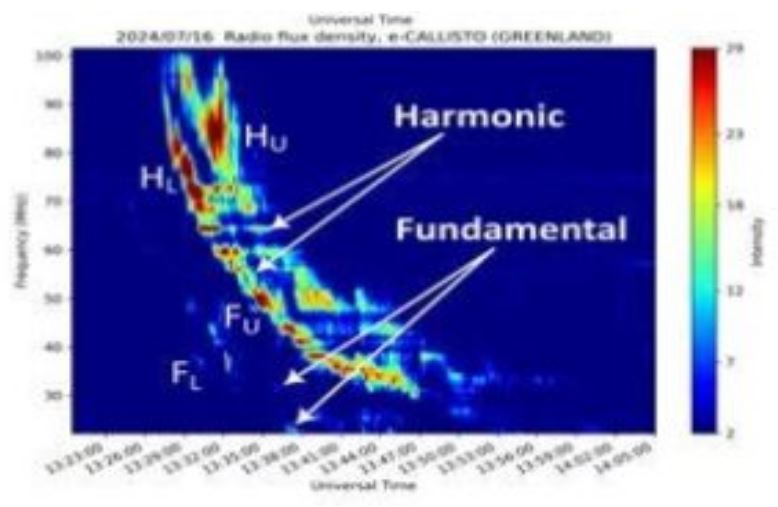
For years, scientists were puzzled by the varying relative strengths of the two components of Type II bursts: the Fundamental emission (the base frequency) and the Harmonic emission (the overtone). While theory suggests the fundamental should be stronger, observations often showed the opposite.
The Discovery
The IIA team, led by Dr. K. Sasikumar Raja, analyzed 58 Type II bursts using the global CALLISTO (Compound Astronomical Low Frequency Low Cost Instrument for Spectroscopy and Transportable Observatory) network and the Gauribidanur Low Frequency Solar Spectrograph (GLOSS).
- The Longitude Factor: The study found that the location of the solar active region (heliographic longitude) determines which emission reaches Earth more strongly.
- The 75° Rule: * Events < 75° (Disk Center): Exhibit stronger Fundamental emissions.
- Events > 75° (Solar Limb/Edges): Exhibit stronger Harmonic emissions.
- The Mechanism: This is due to refractive effects in the solar corona and "viewing angles." Fundamental emissions have narrow "cone angles" and get blocked or weakened when originating from the Sun's edges. Harmonic emissions have broader angles, allowing them to bypass these obstacles and reach Earth effectively.
Implications for Space Weather and Technology
- GNSS Interference: SRBs reduce the signal-to-noise ratio of Global Navigation Satellite Systems (like GPS and India’s NavIC), potentially causing a "loss of lock" and affecting aviation and maritime navigation.
- Satellite Health: Understanding these bursts helps in predicting the arrival of solar storms that can damage satellite electronics and solar panels.
- Communication Hubs: High-intensity bursts can disrupt high-frequency (HF) radio communications used by emergency services and the military.
- Forecasting Models: By understanding how these waves propagate, scientists can now develop more accurate models to provide earlier warnings for geomagnetic storms.
The Path Ahead: AI and Machine Learning
The IIA researchers have indicated that the next phase of this study involves applying Machine Learning (ML) to the vast datasets collected by spectrometers like CALLISTO. This will help automate the detection of solar shocks and further refine the accuracy of space weather alerts.
Government Revises PM e-DRIVE Scheme

- 01 Apr 2026
In News:
The Ministry of Heavy Industries (MHI) recently revised the PM Electric Drive Revolution in Innovative Vehicle Enhancement (PM e-DRIVE) scheme. This recalibration introduces strict "terminal dates" and unit-specific caps to manage the transition from a subsidy-led market to a self-sustaining EV ecosystem.
Context and Evolution
- Launched in October 2024 with a total outlay of ?10,900 crore, the PM e-DRIVE scheme replaces the earlier FAME (Faster Adoption and Manufacturing of Hybrid and Electric Vehicles) phases.
- It aims to synchronize India’s transport sector with the Aatmanirbhar Bharat vision and the Panchamrit climate goals.
Revised Timelines and Deadlines
The government has established clear cut-off dates for vehicle registrations to qualify for incentives:
- Electric Two-Wheelers (e-2W): Subsidy extended until 31st July 2026.
- Electric Three-Wheelers (e-3W): Incentives for e-rickshaws and e-carts extended until 31st March 2028.
- L5 Category (High-speed e-3W): This sub-component was officially closed on 26th December 2025 after achieving its target volume.
Key Components and Targets
The scheme operates on a "first-come, first-served" basis and is fund-limited. If the budget is exhausted before the terminal dates, the portal will close automatically.
A. Demand Incentives and Caps
To ensure support reaches the mass market, the scheme imposes ex-factory price ceilings:
Vehicle Category Ex-Factory Price Cap Unit Support Cap
Electric 2-Wheelers ?1.5 Lakh ~24.79 Lakh units
Electric 3-Wheelers ?2.5 Lakh ~3.16 Lakh units*
e-Rickshaws & e-Carts - 39,034 units
Note on Incentives: The subsidy has been recalibrated to approximately ?2,500 per kWh, with a maximum cap of ?5,000 for e-2Ws and ?12,500 for e-3Ws.
B. Infrastructure & Specialized Segments
- Public Transport: Allocation of ?4,391 crore for the procurement of 14,028 e-buses across nine major cities (including Delhi, Mumbai, and Bengaluru).
- e-Ambulances & e-Trucks: A combined fund of ?1,000 crore is dedicated to these emerging segments. For e-trucks, incentives are linked to scrapping certificates from MoRTH-approved centers.
- Charging Infrastructure: A budget of ?2,000 crore to install 72,300 public fast chargers (including 22,100 for e-4Ws and 48,400 for e-2Ws/3Ws).
Technology and Quality Standards
- Advanced Batteries: Only vehicles equipped with advanced battery chemistry (e.g., Lithium-ion) qualify. Outdated lead-acid batteries are excluded.
- The "Super App": Developed by BHEL, this digital platform will allow users to locate chargers, check real-time availability, and make payments seamlessly.
- Testing Agencies:?780 crore allocated to modernize MHI testing agencies to ensure high safety and performance standards for domestic EV manufacturing.
1st Inter-State Initiative for Great Indian Bustard (GIB)
- 01 Apr 2026
In News:
The Great Indian Bustard (Ardeotis nigriceps), a flagship species of the Indian grasslands and the state bird of Rajasthan, is currently at the center of one of India’s most complex conservation battles. Recent breakthroughs in "jumpstart" technology and legal interventions have provided a renewed glimmer of hope for a species that was once on the verge of extinction.
The "Jumpstart" Breakthrough: A Milestone in Kutch
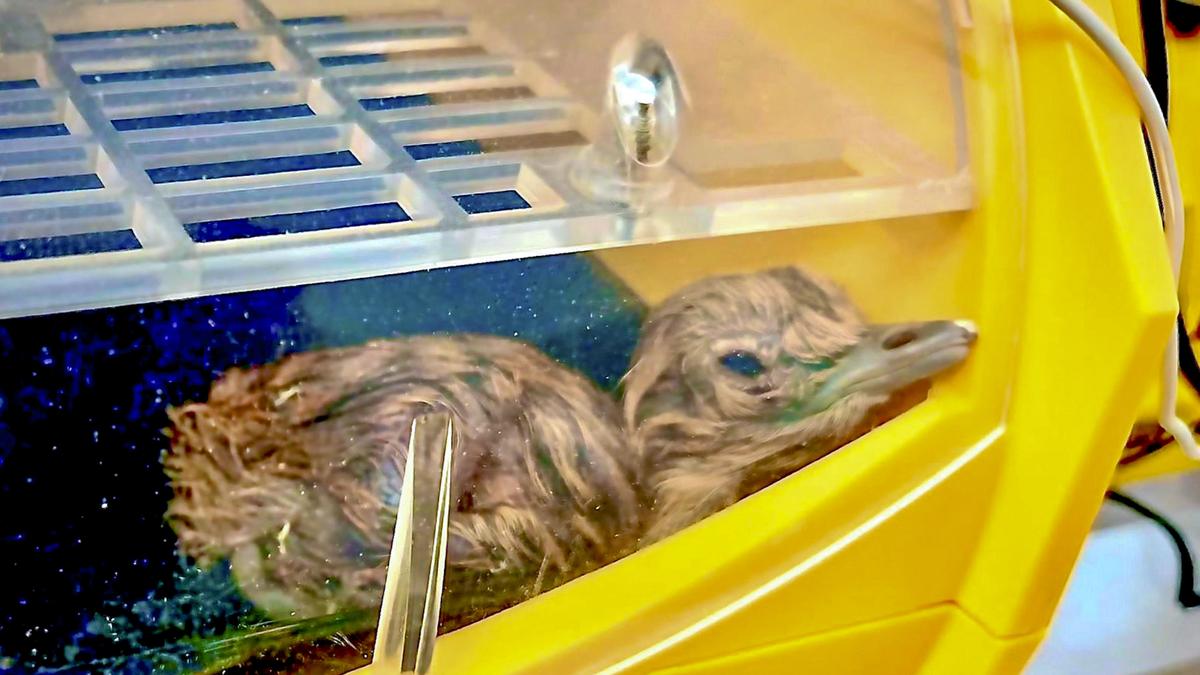
In March 2026, a Great Indian Bustard chick was hatched in Gujarat’s Kutch region for the first time in over a decade. This was achieved through the “Jumpstart” Approach, a sophisticated conservation method coordinated by the Ministry of Environment, Forest and Climate Change (MoEFCC), the Wildlife Institute of India (WII), and the Forest Departments of Rajasthan and Gujarat.
- The Mechanism: The process involved identifying a wild female in Gujarat that had laid an infertile egg (due to the absence of wild males in the region). A fertile, captive-bred egg from Rajasthan’s breeding center was transported 770 km over a 19-hour road journey in a portable incubator.
- The Outcome: The fertile egg was placed in the wild nest. The female GIB accepted the egg, completed the incubation, and is currently rearing the chick in the wild.
- Significance: This is the first inter-state trans-location of its kind, ensuring the chick grows up with natural survival instincts under a foster mother, rather than being reared in a lab.
Species Profile and Ecological Role
The GIB is an indicator species for the health of grassland ecosystems. Its presence ensures that the "barren" looking grasslands are actually vibrant, functional biomes.
- Physical Traits: One of the heaviest flying birds in the world; lacks a preen gland and has poor frontal vision (making it prone to collisions).
- Diet: Omnivorous (insects, rodents, seeds).
- Current Range: Primarily the Thar Desert (Rajasthan). Small, fragmented populations exist in Gujarat (Kutch), Maharashtra, Karnataka, and Andhra Pradesh.
Conservation Status and Legal Framework
The GIB enjoys the highest level of legal protection both nationally and internationally:
- IUCN Red List: Critically Endangered.
- Wildlife (Protection) Act, 1972: Schedule I.
- CITES & CMS: Appendix I.
- Project GIB (2016): Launched to create breeding enclosures and mitigate human pressure.