
Agri-Photovoltaics
- 27 Mar 2026
In News:
Union Budget 2026–27 nearly doubled the PM-KUSUM allocation to Rs. 5,000 crore, and the government is considering a National AgriPV Mission (10 GW target) under PM-KUSUM 2.0.
About Agri-Photovoltaics (AgriPV)
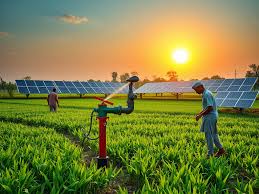
Agri-Photovoltaics (AgriPV), or Agrivoltaics, is the simultaneous dual use of agricultural land for both solar power generation and crop cultivation. Instead of clearing farmland for solar parks, panels are elevated above or spaced between crops — creating a symbiotic system where plants and panels mutually enhance each other's performance.
How It Works
Solar panels installed above crops provide partial shade, reducing heat stress and water evaporation. In return, plant transpiration cools the panels from below, improving their photovoltaic efficiency by 2–5%. The result: one plot of land produces both food and clean electricity.
· Elevated Systems: Panels mounted ~3m high. Crops grow below; machinery can operate freely. Best for large-scale mechanised farms.
· Row-Based Systems: Panels in rows with wide gaps. Sun-loving crops in gaps; shade-tolerant crops directly below. Most common in India.
· Vertical (Bifacial): Panels installed upright like fences, capturing sunlight from both faces. Minimises land coverage.
· Greenhouse-Integrated: Panels built into greenhouse roofs. Combines controlled-environment agriculture with power generation.
Why India Needs AgriPV
India faces a structural contradiction: its 300 GW solar target by 2030 requires 4–5 acres per MW, but over 55% of India's land is agricultural (156 million hectares), sustaining 60% of the workforce. Mass diversion of farmland for solar is neither viable nor acceptable.
AgriPV resolves this by transforming the food-energy relationship from competition to complementarity — achieving solar targets without displacing a single farmer or clearing a single forest. With over 300 days of sunshine annually across India's agricultural heartland, the natural conditions for AgriPV are exceptional.
Key Benefits
For Farmers
· Income diversification — sell surplus electricity to DISCOMs or earn lease/revenue from developers
· Lower input costs — solar replaces expensive diesel pumps for irrigation
· Example: A Maharashtra farmer earns fixed developer rent while harvesting chillies or brinjal beneath the panels
For Agriculture
· Water conservation — panel shade reduces evapotranspiration; fewer irrigation cycles needed in arid Rajasthan and Gujarat
· Climate resilience — panels shield crops from heatwaves, hailstorms, and erratic rainfall
· Stronger value chains — decentralised power runs cold storage, chaff cutters, and food processing locally
For the Environment
· Cuts diesel-based agricultural emissions
· Reduces transmission losses through distributed generation
· Avoids large-scale land clearance compared to conventional solar parks
Suitable Crops by Region
|
State/Region |
Suitable Crops under AgriPV |
|
Madhya Pradesh |
Tomato, onion, turmeric, tulsi |
|
Karnataka & Maharashtra |
Ragi, jowar, grapes, banana, brinjal |
|
Rajasthan & Gujarat (arid) |
Garlic, onion — benefit from reduced watering under shade |
Policy & Current Status
PM-KUSUM Scheme (2019, MNRE)
· Component A: Solar plants (up to 2 MW) on barren/fallow/cultivable land
· Component B: Standalone solar-powered irrigation pumps
· Component C: Solarisation of grid-connected agricultural pumps
· Budget 2026–27: Allocation nearly doubled to Rs. 5,000 crore
· Proposed PM-KUSUM 2.0: AgriPV as a dedicated 10 GW component
State Initiatives
|
State |
Scheme |
Key Feature |
|
Maharashtra |
MSKVY |
13.65 GW target; tariff Rs. 3.10/kWh for farmers |
|
Gujarat |
Suryashakti Kisan Yojana |
60% financial support; Rs. 7/kWh tariff for 7 years |
|
Odisha |
— |
Rs. 20,000 per acre/year for participating farmers |
|
Delhi |
MKAB Solar Yojana |
Lease income from Rs. 8,333/acre/month |
Current Status (2026): ~50 pilot AgriPV installations are active across India (including ICAR-CAZRI, Jodhpur). The India Agrivoltaics Alliance (IAA), anchored by NSEFI, is a 40 member platform working with MNRE, Agriculture, and Rural Development ministries. Large-scale commercial replication has not yet begun. The global AgriPV market is projected to grow at 8.3% CAGR, reaching USD 7.61 billion by 2031.