
Variable Rate Repo (VRR) Auctions
- 26 Mar 2026
In News:
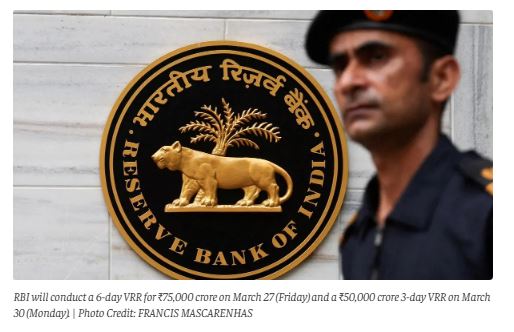
Liquidity management remains a cornerstone of the Reserve Bank of India's (RBI) monetary policy operations. Recently, the RBI injected substantial liquidityincluding a specific instance of ?55,837 crore via a 3-day auctionto counter tightening cash conditions in the banking system. By utilizing tools like the Variable Rate Repo (VRR), the central bank ensures that the credit flow to the economy remains uninterrupted and short-term interest rates stay aligned with the policy repo rate.
What is a Variable Rate Repo (VRR)?
The Variable Rate Repo is a flexible monetary tool under the Liquidity Adjustment Facility (LAF) used by the RBI to inject "transient" (temporary) liquidity into the banking system. Unlike the standard Fixed Rate Repo, where the interest rate is pre-determined by the RBI, the VRR allows the market to determine the cost of funds through a competitive bidding process.
Operational Mechanism
- Notification: The RBI announces an auction with a "notified amount" and a specific tenor (ranging from overnight to 14 days).
- Competitive Bidding: Commercial banks submit bids specifying the amount they require and the interest rate they are willing to pay.
- Cut-off Rate: The RBI accepts bids starting from the highest interest rate offered down to a "cut-off rate." This ensures that funds are allocated to those with the highest demand/valuation.
- Collateralization: As with all repo transactions, banks must provide Government Securities (G-Secs) as collateral, which they agree to repurchase at the end of the term.
Triggers for Liquidity Deficits
The banking system often transitions from a surplus to a deficit mode due to several seasonal and structural factors:
- Advance Tax Outflows: Significant quarterly payments by corporates to the government lead to a temporary migration of funds from the banking system to the government's account with the RBI.
- GST Payments: Monthly Goods and Services Tax collections typically drain liquidity toward the end of the month.
- Festival Demand: Increased physical currency circulation during festive seasons reduces the "currency with the public," thereby lowering bank deposits.
- Year-End Requirements: In March, banks often face heightened demand for funds to meet regulatory requirements and balance sheet closures.
VRR vs. Open Market Operations (OMO)
It is essential to distinguish between tools used for temporary versus durable liquidity:
|
Feature |
Variable Rate Repo (VRR) |
Open Market Operations (OMO) |
|
Nature of Liquidity |
Transient/Temporary (Short-term) |
Durable (Long-term) |
|
Instrument |
Lending against collateral |
Outright purchase/sale of G-Secs |
|
Primary Goal |
Fine-tuning daily liquidity |
Managing long-term money supply |
|
Recent Example |
?55,837 Cr 3-day injection |
?3.50 lakh Cr G-Sec purchase (Jan 2026) |
Macroeconomic Implications for India
- Interest Rate Stability: By preventing the Weighted Average Call Rate (WACR) from spiking above the policy repo rate, the RBI ensures "stability in the corridor." This is crucial for the effective transmission of monetary policy.
- Support for Credit Growth: Adequate liquidity ensures that commercial banks do not tighten lending norms for MSMEs and retail consumers due to temporary cash crunches.
- Market Signaling: High demand in VRR auctions serves as a vital signal to the RBI regarding the underlying stress in the money markets, prompting further intervention if necessary.
- Fiscal Coordination: The RBI’s auctions often coincide with government borrowing schedules (e.g., the H1 FY 2026-27 borrowing target of ?8.20 lakh crore) to ensure that government bond yields remain stable.