
Periodic Labour Force Survey (PLFS) Annual Report, 2025
- 29 Mar 2026
In News:
The Ministry of Statistics and Programme Implementation released the PLFS Annual Report 2025, prepared by the National Statistical Office. This is the first report based on the calendar year (Jan–Dec 2025) with a revised methodology.
About PLFS
Launched in 2017, the Periodic Labour Force Survey provides comprehensive data on employment and unemployment in India. It uses two key approaches—Usual Status (ps ss) (365-day reference) and Current Weekly Status (CWS) (7-day reference)—to capture labour market dynamics.
Key indicators include:
- LFPR: Share of population working or seeking work
- WPR: Share of employed population
- UR: Share of unemployed in labour force
Key Trends in PLFS 2025
India’s labour market in 2025 shows stability with gradual improvement in employment conditions. The Labour Force Participation Rate (LFPR) remained stable at 59.3%, while the Worker Population Ratio (WPR) stood at 57.4%, indicating sustained employment levels. The Unemployment Rate (UR) declined to 3.1%, reflecting better labour absorption.
- Youth unemployment (15–29 years) fell to 9.9%
- Rural unemployment remained low (~2.4%), while urban unemployment stood at ~4.8%
Structural Changes in Employment
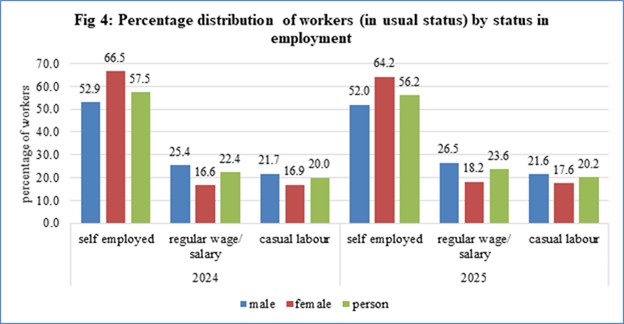
There is a slow shift towards better-quality jobs. The share of regular wage/salaried employment increased to 23.6%, while self-employment declined to 56.2%, indicating gradual formalisation.
Sectorally:
- Agriculture continues to dominate but declined to 43.0%
- Manufacturing increased to 12.1%
- Services also expanded
Gender and Social Dimensions
Despite improvements, gender disparities remain significant. Female LFPR is still low at 40.0%, and social factors continue to influence participation.
- Many men stay out of labour force for education (69.8%)
- Women cite childcare and domestic responsibilities (44.4%)
However, a positive trend is visible in rising female wages:
- Self-employed: 8.8%
- Salaried: 7.2%
A notable work-hour gap persists, with men working significantly longer hours than women.
Education, Skills and Challenges
The average years of schooling reached 10 years, and a majority of the population has at least secondary education. However, skill development remains weak, with only 4.2% of individuals receiving formal vocational training.
A major concern is the NEET category, with about 25% of youth (15–29 years) not in employment, education, or training—posing a risk to India’s demographic dividend.
Methodological Changes
From 2025 onwards:
· Survey cycle shifted to calendar year
· Sample size significantly increased
· Higher-frequency estimates introduced
Due to these changes, comparisons with earlier PLFS reports should be made cautiously.