
Minor Planet Centre
- 26 Mar 2026
In News:
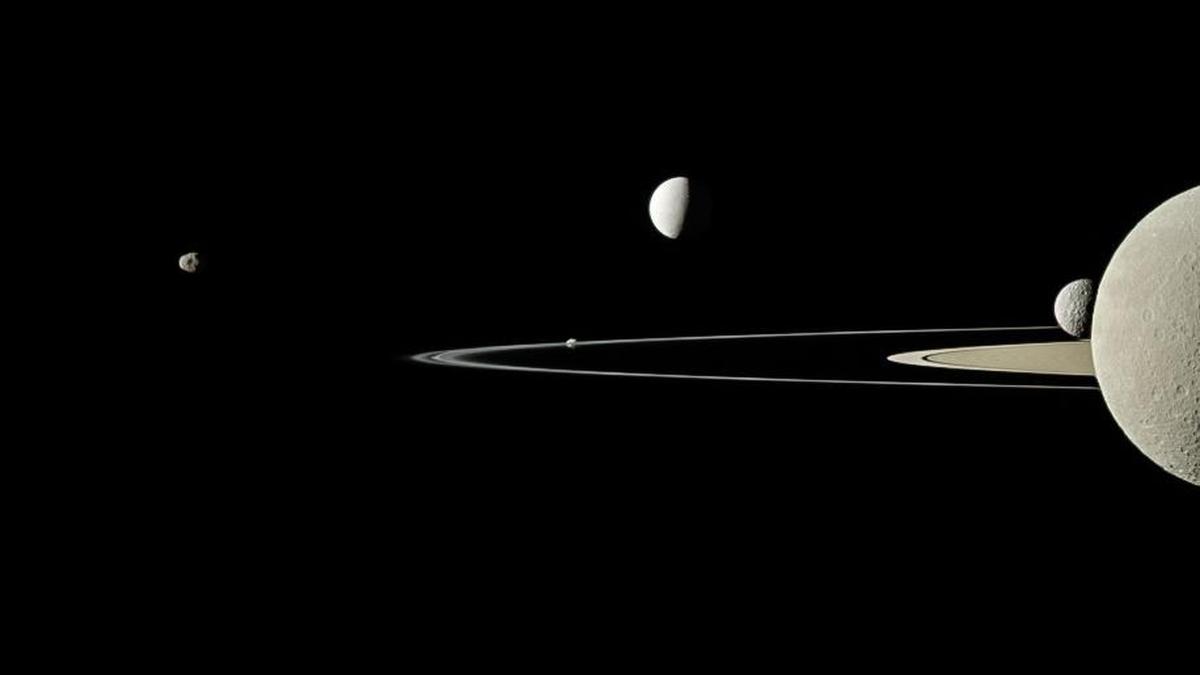
In March 2026, the Minor Planet Centre (MPC) announced the discovery of 15 new natural satellites: four orbiting Jupiter and 11 orbiting Saturn. This discovery has pushed Saturn’s total moon count to 285 and Jupiter’s to 101, further intensifying the "moon race" between the two gas giants.
About the Minor Planet Centre (MPC)
The MPC is the single worldwide location for the receipt and distribution of positional measurements for "minor planets" (asteroids), comets, and outer irregular natural satellites.
- Location & Affiliation: Based in Cambridge, Massachusetts, it operates at the Smithsonian Astrophysical Observatory (SAO).
- Governance: It functions under the auspices of Division F of the International Astronomical Union (IAU).
- Funding: It is primarily supported by a grant from NASA’s Near-Earth Object Observations (NEOO) program.
Core Functions and Operational Process
The MPC serves as the international clearinghouse for all data related to small solar system bodies.
- Data Verification: When astronomers detect a moving object, they submit coordinates to the MPC. Experts use these to verify observations and calculate the object’s orbit.
- Designation & Cataloging: If an object is confirmed as new, the MPC assigns it an official designation (e.g., S/2024 J 1). Once an orbit is precisely determined, it receives a permanent Roman numeral designation.
- Near-Earth Object (NEO) Monitoring: One of its most critical roles is tracking space rocks that could potentially threaten Earth. By maintaining a massive database, it allows scientists to predict "close approaches."
- Global Coordination: The MPC publishes Minor Planet Electronic Circulars (MPECs). These alert the global scientific community to new discoveries, allowing observatories worldwide to coordinate follow-up observations.
Case Study: The 2026 Jovian and Saturnian Discoveries
The recent discoveries highlight the increasing capability of terrestrial telescopes (located in Chile and Hawaii) to detect "irregular" moons.
- Physical Characteristics: These moons are typically small (1–3 km in diameter) and extremely faint, with magnitudes between 25 and 27 (roughly 100 million times fainter than what the naked eye can see).
- Orbital Mechanics: Many of these new satellites exhibit retrograde orbits (moving in the opposite direction of the planet’s rotation) and are highly elliptical, suggesting they may be captured asteroids rather than bodies formed alongside the planet.
- Naming Conventions: Under IAU rules, these small irregular satellites are only given proper names (drawn from Gallic, Inuit, or Norse mythology) if they are of significant scientific interest; otherwise, they remain known by their alphanumeric designations.