
Randomization of EVM-VVPATs
- 23 Mar 2026
In News:
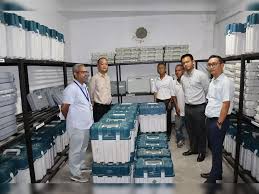
The Election Commission of India (ECI) has completed the first stage of randomisation of EVM-VVPATs for the upcoming Assembly elections in Assam, Kerala and Puducherry, along with by-elections in several states. This process is a crucial administrative step to ensure free, fair, and transparent elections.
What is EVM–VVPAT Randomisation?
- EVM–VVPAT randomisation is a software-driven allocation process through which voting machines are assigned to constituencies and polling stations in a completely unpredictable manner.
- The process is conducted using the EVM Management System (EMS), ensuring minimal human intervention and eliminating any scope for bias or manipulation.
Process of Randomisation
The allocation of machines follows a two-stage randomisation mechanism, designed to enhance transparency and security.
- In the first stage, machines that have successfully undergone First Level Checking (FLC) are randomly distributed from district warehouses to Assembly Constituencies. This stage has already been completed for the current elections.
- In the second stage, after the finalisation of contesting candidates, machines are further randomised and allocated to individual polling stations within each constituency. This ensures that the exact deployment of machines remains unknown until the final stage.
Key Features of the System
- The process is characterised by strong institutional safeguards. It is conducted by District Election Officers in the presence of representatives of recognised political parties, ensuring multi-stakeholder oversight.
- The details of allocated machines, including serial numbers, are shared transparently with political parties and candidates at each stage. Following the first randomisation, machines are stored in secure strong rooms under continuous surveillance, maintaining their integrity until deployment.
- The use of EMS ensures that the allocation is mathematical, automated, and free from discretionary interference.
Significance
The randomisation process plays a critical role in strengthening the credibility of India’s electoral system. By ensuring that no stakeholder knows in advance which machine will be used at a particular polling station, it effectively prevents any possibility of targeted manipulation.
The presence of political party representatives and the sharing of detailed lists enhance transparency and trust among stakeholders.
Overall, the process contributes to institutional integrity, electoral neutrality, and public confidence, which are essential for a robust democratic framework.
Vibrant Villages Programme–II (VVP–II)

- 21 Feb 2026
In News:
The Union Home Minister Amit Shah launched the Vibrant Villages Programme–II (VVP–II) at Nathanpur village in Cachar district of Assam, marking an expansion of the government’s border area development strategy in line with the vision of Viksit Bharat @2047.
About Vibrant Villages Programme–II
- Type of Scheme: Central Sector Scheme (100% funded by the Union Government)
- Total Outlay: ?6,839 crore
- Implementation Period: Up to FY 2028–29
- Approach: Saturation-based and convergence-driven
- Coverage: 15 States and 2 Union Territories
- Exclusion: Northern border villages already covered under VVP–I
Objectives
- Comprehensive Development: Improve living standards in border villages through infrastructure and service delivery.
- Livelihood Generation: Create sustainable and diversified livelihood opportunities.
- Border Security Strengthening: Enable residents to act as the “eyes and ears” of the nation.
- Prevention of Trans-border Crimes: Strengthen vigilance and community participation.
- National Integration: Assimilate border populations into the mainstream national framework.
Key Features
1. Infrastructure Development
- Education infrastructure including SMART classrooms
- Development of tourism circuits
- Village-level infrastructure in clusters
- Improved access to essential services
2. Livelihood & Value Chain Development
- Promotion of Self-Help Groups (SHGs)
- Strengthening cooperatives
- Focus on value chain development in agriculture and allied sectors
- Diversification of income sources in border areas
3. Social & Cultural Vibrancy
- Organisation of fairs and festivals
- Celebration of National Days
- Awareness campaigns
- Community mobilisation initiatives
These efforts aim to enhance the “vibrancy” of villages, reduce migration, and foster a sense of belonging.
Strategic Significance
- Internal Security: Strengthened community participation improves intelligence gathering and vigilance.
- Border Management: Acts as a socio-economic complement to physical border infrastructure.
- Balanced Regional Development: Reduces regional disparities.
- Vision 2047 Alignment: Supports the broader goal of building a developed and secure India by 2047.
Saturation-Based & Convergence Approach
- Saturation-based: Ensures all eligible beneficiaries and villages receive full scheme benefits.
- Convergence-driven: Integrates multiple Central and State schemes for optimal resource utilization.
Vibrant Village Programme (VVP)

- 13 May 2024
Why is it in the News?
The government is likely to spend over ?2 crore on each kilometre of road to be constructed along the China border in Uttarakhand and Sikkim under the Vibrant Village Programme (VVP), according to the project’s details.
What is the Vibrant Villages Programme (VVP)?
- Vibrant Villages Programme (VVP) is a Centrally Sponsored Scheme approved on 15th February 2023 for the financial years 2022-23 to 2025-26.
Objective:
- For comprehensive development of the select villages in 46 blocks in 19 districts abutting the northern border in the States of Arunachal Pradesh, Himachal Pradesh, Sikkim, Uttarakhand and UT of Ladakh.
- It will aid in raising the standard of living for residents of designated border communities and encouraging them to remain there, reversing the outmigration from these villages and enhancing border security.
- Action plans for identified villages would be prepared by the district administration with assistance from the proper mechanisms at the block and panchayat levels, in order to guarantee complete saturation of federal and state programmes.
- Road connectivity, drinking water, power (including solar and wind energy), mobile and internet access, tourist attractions, multipurpose facilities, healthcare infrastructure, and wellness centres are the intervention areas with the highest priority for village development.
Scheme implementation:
- Scheme implementation involves identifying and fostering economic drivers in border villages along the northern border, following a "Hub and Spoke Model" to establish growth centres.
- This includes promoting social entrepreneurship, empowering youth and women through skill development and entrepreneurship, leveraging local tourism potential, preserving cultural heritage, and fostering sustainable eco-agribusinesses.
- Vibrant Village Action Plans will be developed by district administrations in collaboration with Gram Panchayats, ensuring full coverage of Central and state schemes.
Expected outcomes:
- Key outcomes that have been attempted are connectivity with all-weather roads, drinking water, 24x7 electricity – Solar and wind energy to be given focussed attention, and mobile and internet connectivity.
- Tourist centres, multi-purpose centres and health and wellness Centers.
Voter Verifiable Paper Audit Trail (VVPAT)
- 02 Apr 2024
Why is it in the News?
The Congress has hailed as an “important first step” the Supreme Court’s notice to the Election Commission and the Centre on a plea seeking a complete count of VVPAT slips and said the matter should be decided before the Lok Sabha polls commence.
What is the Voter Verifiable Paper Audit Trail (VVPAT)?
- The Voter Verifiable Paper Audit Trail, or VVPAT system, was first introduced in 2014 for the first time during the 2014 Lok Sabha Elections.
- The ECI conducted pilot tests of VVPAT systems in a few constituencies in 2011, and after successful trials, VVPAT was gradually deployed across all polling stations in subsequent elections.
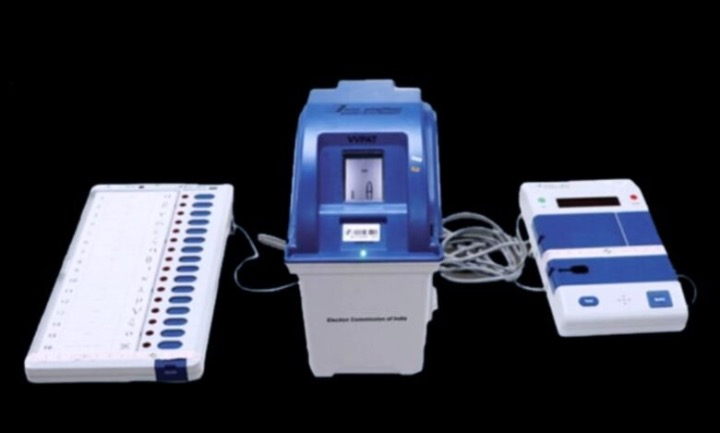
- It is connected to Electronic Voting Machines (EVM) and enables voters to confirm that their votes were cast as intended.
- The concept of VVPAT was to enhance the credibility and transparency of EVMs.
What are VVPAT Slips?
- VVPAT slips are an integral part of the EVMs used in elections.
- It provides a physical paper trail for voters to verify that their vote has been correctly recorded by the EVM.
- It ensures transparency and accountability in the electoral process by allowing voters to verify their vote before casting it finally.
- The VVPAT produces a paper slip that permits the voter to confirm the accuracy of their vote on the EVM.
- This slip displays the name and symbol of the party chosen by the voter.
- Additionally, the machine features a transparent window through which the voter can observe the printed slip.
- Subsequently, the slip is securely deposited into a sealed compartment within the machine.
- However, in the event of a dispute, this sealed box can be opened for further examination.
Controversies Surrounding VVPAT:
- Despite its intended purpose of enhancing transparency, VVPAT has been subject to several controversies over the years.
- Some critics have raised concerns about the reliability of VVPAT systems, citing instances of malfunctioning printers, paper jams, and discrepancies between electronic and paper records.
- The Opposition parties within the INDIA bloc have been advocating for the full counting of VVPATs, to bolster public trust in the EVMs, which itself has been subjected to intense scrutiny recently.
- Their concern has mostly stemmed from allegations of delay in the printing and displaying of VVPAT slips for every vote, which they claim can significantly increase the time required for vote counting.
Supreme Court’s intervention in VVPATs:
- In April 2019, the SC asked the poll panel to increase the number of EVMs that undergo VVPAT physical verification from one to five per assembly segment in a parliamentary constituency.
- In the month of May the same year, the Supreme Court dismissed a writ petition seeking 100 percent counting of VVPAT in the 2019 Lok Sabha elections.
- Earlier in the same month, the Supreme Court had also dismissed the review petition filed by opposition parties to increase verification of VVPAT-EVM to 50 percent.