
Infrastructure Financing in India
- 21 Mar 2026
In News:
India’s approach to infrastructure financing has evolved from a state-dominated model to a diversified and market-linked system. This transition is critical for sustaining high economic growth and achieving the ambition of becoming a USD 7 trillion economy by 2030.
Changing Nature of Infrastructure Financing
In the past, infrastructure development in India depended largely on government budgetary allocations, which limited expansion due to fiscal constraints. Over time, the financing architecture has broadened to include public-private partnerships, institutional funding mechanisms, and innovative financial instruments.
Despite this diversification, the government continues to act as a key driver, evident from the substantial rise in capital expenditure—from about ?2 lakh crore in 2014–15 to ?12.2 lakh crore in 2026–27 (BE)—thereby stimulating investment and economic activity.
Drivers of the Transformation
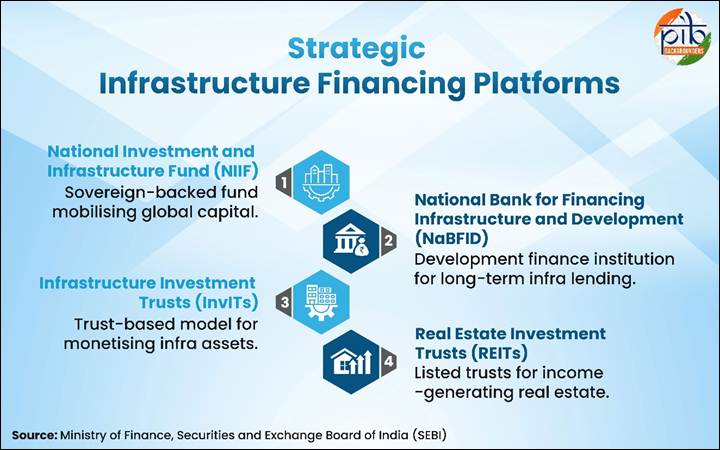
A major factor behind this shift has been the creation of dedicated financial institutions. Bodies such as the National Investment and Infrastructure Fund and the National Bank for Financing Infrastructure and Development have facilitated long-term funding and attracted global investors, while the Indian Railway Finance Corporation has strengthened sector-specific financing.
Parallelly, mechanisms like Infrastructure Investment Trusts (InvITs) and Real Estate Investment Trusts (REITs) have enabled monetisation of existing assets, freeing up capital for new investments. The development of green bonds and credit enhancement tools has further deepened financial markets and aligned infrastructure growth with sustainability goals.
Additionally, initiatives such as City Economic Regions (CERs) reflect a shift towards region-based development, especially in emerging urban centres.
Current Status of Infrastructure Development
The impact of these reforms is visible across multiple sectors. India has significantly expanded its road network, alongside improvements in construction speed and connectivity. The railway system has progressed towards complete electrification and introduced modern services like the Vande Bharat Express, with plans for high-speed corridors.
The aviation sector has witnessed rapid growth in airport infrastructure under schemes such as the UDAN Scheme, enhancing regional access. Similarly, port capacity and inland waterways have been strengthened to support trade.
Emerging sectors like data centres and energy storage systems are also gaining prominence, supported by policy incentives and recognition as infrastructure.
Key Challenges
Notwithstanding the progress, several structural issues remain. Infrastructure financing continues to rely heavily on public expenditure, while private investment is constrained by concerns over risk and returns. Land acquisition remains a significant hurdle, often leading to project delays and increased costs.
The banking sector faces a mismatch between short-term liabilities and long-term infrastructure financing needs, limiting its ability to support large projects. Investors also show a preference for operational assets rather than new projects, reducing capital inflow into greenfield development.
Urban financing is another weak area, as municipal bodies often lack the financial strength and credibility to raise resources independently. In addition, inadequate project preparation affects the viability and attractiveness of infrastructure investments.
Way Forward
To sustain momentum, India needs to deepen asset monetisation strategies so that resources from existing projects can be reinvested into new ones. Strengthening risk-sharing mechanisms and improving credit enhancement frameworks will be essential to attract private and institutional investors.
There is also a need to scale up green and sustainable financing instruments, ensuring that infrastructure growth aligns with environmental objectives. Strengthening urban financial systems and promoting reforms in municipal governance can help cities emerge as engines of growth.
Further, improving project planning, transparency, and regulatory certainty will enhance investor confidence. Leveraging platforms such as GIFT City can also facilitate greater integration with global capital markets.