
Bharat Electricity Summit 2026
- 25 Mar 2026
In News:
The Bharat Electricity Summit 2026, recently held in New Delhi under the theme “Electrifying Growth. Empowering Sustainability. Connecting Globally,” served as a testament to India’s journey from a power-deficit nation to a renewable-led energy surplus economy. With a projected investment potential of ?50 lakh crore by 2032, the summit positioned India as a global hub for international energy cooperation and technological innovation.
Current Landscape of India's Power Sector (2025-26)
India has witnessed a paradigm shift in its energy mix, moving toward low-carbon pathways while ensuring energy security.
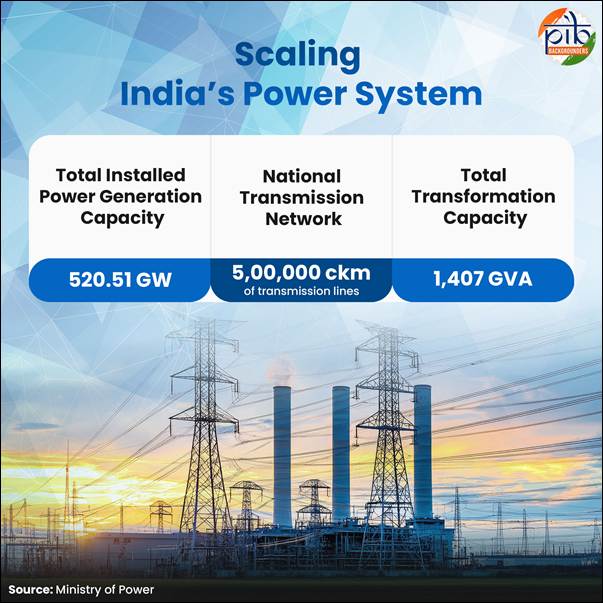
- Capacity Expansion: As of January 2026, the total installed power capacity reached 520 GW. Notably, in FY 2025–26, India added a record 52,537 MW, with Renewable Energy (RE) accounting for 75% of this addition.
- Renewable Energy Dominance: Solar energy has seen exponential growth, rising from 3 GW in 2014 to 140 GW by early 2026. According to IRENA (2025), India now ranks 4th globally in total installed RE capacity.
- A Landmark Achievement: On July 29, 2025, renewable sources met 51.5% of the country's total electricity demand for the first time, driven by a synergistic mix of Solar (44.5 GW), Wind (29.89 GW), and Hydro (30.29 GW).
- Deficit Eradication: The national power shortage has been decimated from 4.2% in FY 2013–14 to a marginal 0.03% in late 2025, successfully meeting a peak demand of 242 GW.
Structural and Financial Reforms: The Turnaround
The transition has been supported by aggressive fiscal discipline and infrastructural modernization.
1. Financial Viability of DISCOMs
For decades, the Distribution Companies (DISCOMs) were the "leaking bucket" of the power sector.
- From Loss to Profit: Distribution utilities recorded a profit of ?2,701 crore in FY 2024–25, a historic recovery from the ?67,962 crore loss in FY 2013-14.
- LPS Rules & Debt Reduction: The Late Payment Surcharge (LPS) Rules, 2022, and the Revamped Distribution Sector Scheme (RDSS) helped slash outstanding dues from ?1.4 lakh crore (2022) to just ?4,109 crore by February 2026.
- Smart Metering: The installation of 5.62 crore smart meters has enhanced billing efficiency and transparency.
2. National Grid and Universal Access
- World’s Largest Synchronous Grid: India’s national grid now exceeds 5 lakh circuit kilometers (ckm). Under the National Electricity Plan (2023–2032), this is set to expand to 6.48 lakh ckm with an investment of ?9.15 lakh crore.
- Rural Empowerment: Through schemes like Saubhagya and DDUGJY, 18,374 villages were electrified. Average daily power supply in rural areas rose significantly from 12.5 hours (2014) to 22.6 hours (2025).
Key Policy Initiatives and Future Outlook
|
Scheme/Policy |
Objective & Impact |
|
PM Surya Ghar Yojana |
A ?75,021 crore initiative aiming for 1 crore residential rooftop solar installations by FY 2026–27. |
|
Electricity (Amendment) Bill, 2026 |
Aims to rationalize cross-subsidies, promote cost-reflective tariffs, and enable direct power procurement for industries to boost "Make in India." |
|
RDSS (?3.03 Lakh Cr) |
Focuses on reducing AT&C (Aggregate Technical & Commercial) losses and improving operational efficiencies. |
|
POWERGRID Empowerment |
Increased investment delegation (equity limit per subsidiary raised to ?7,500 crore) to accelerate transmission infrastructure. |
Challenges and Way Forward
While the transition is robust, the roadmap to 458 GW peak demand by 2032 requires addressing:
- Grid Stability: Managing the intermittency of high-penetration renewables through advanced Battery Energy Storage Systems (BESS).
- Supply Chain Resilience: Reducing dependency on imports for solar cells and critical minerals.
- Technological Integration: Leveraging the startup ecosystem (100 startups featured at the Summit) for R&D in smart grids and Green Hydrogen.