
Smog-Eating Photocatalytic Coating
- 24 Mar 2026
In News:
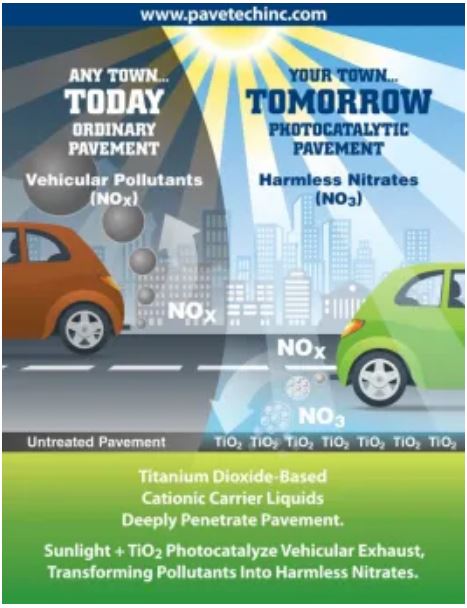
In a strategic move to address the perennial air quality crisis in the National Capital Region, the Delhi Government has partnered with the Indian Institute of Technology (IIT) Madras to pilot and study "smog-eating" photocatalytic coatings. This experimental technology, applied directly to road surfaces, aims to neutralize tailpipe emissions at the source, transforming gray infrastructure into active air purification systems.
Understanding the Technology: Photocatalytic Depollution
Photocatalytic coatings represent a frontier in "green" civil engineering. They utilize light energy to accelerate natural chemical reactions that decompose pollutants.
- Primary Compound: The technology predominantly employs Titanium Dioxide (TiO?).
- Why TiO?? It is favored for its chemical stability, cost-effectiveness, and seamless compatibility with traditional construction materials like bitumen and concrete.
- The Mechanism: * Activation: When UV rays from sunlight hit the TiO?-coated surface, it creates highly reactive oxidizing agents.
- Neutralization: These agents break down harmful gases—specifically Nitrogen Dioxide (NO?) and Volatile Organic Compounds (VOCs)—into harmless substances like water-soluble nitrates or CO?, which are then washed away by rain.
Contextualizing the Crisis: The Nature of Smog
The term "smog" (a portmanteau of smoke and fog) refers to a complex mixture of primary and secondary air pollutants. To understand the efficacy of these coatings, it is essential to distinguish between the two primary types of smog:
|
Type of Smog |
Primary Cause |
Key Characteristics |
|
Sulfurous (London) Smog |
Combustion of sulfur-bearing fossil fuels (e.g., Coal). |
High concentration of sulfur oxides; common in damp, cold climates. |
|
Photochemical (Los Angeles) Smog |
Interaction of sunlight with Nitrogen Oxides (NOx) and VOCs. |
Prevalent in sunny, urban areas with high automobile density; contains ground-level ozone. |
The IIT Madras study specifically targets Photochemical Smog, as road coatings are most effective where vehicular density and sunlight exposure are highest.
Strategic Significance for Urban Governance
The adoption of "smog-eating" roads aligns with India's National Clean Air Programme (NCAP) and offers several strategic advantages:
- Source-Point Treatment: By coating roads, the technology tackles emissions exactly where they are most concentrated—at the tire-to-pavement interface.
- Multi-Functional Infrastructure: It converts existing passive assets (roads) into environmental cleaning tools without requiring additional land or energy-intensive machinery.
- Passive Operation: Unlike "Smog Towers" which require massive fans and electricity, photocatalytic coatings work autonomously using solar energy.