
Sahiwal Cattle
- 24 Mar 2026
In News:
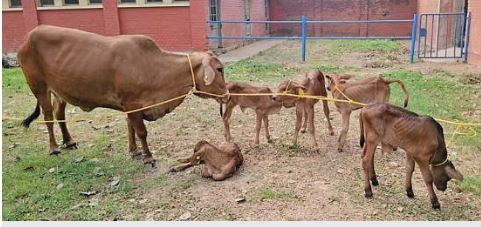
In a significant boost to India’s Rashtriya Gokul Mission, the ICAR-Indian Veterinary Research Institute (IVRI), Izatnagar, has successfully produced indigenous Sahiwal cattle calves using a sophisticated suite of reproductive biotechnologies. The process integrated Ultrasound-Guided Ovum Pick-Up (OPU), In Vitro Fertilization (IVF), and Embryo Transfer (ET), marking a leap in the rapid multiplication of high-yielding indigenous germplasm.
Profile of the Sahiwal Breed: The "Golden" Milch Cow
The Sahiwal is globally recognized as one of the premier dairy (milch) breeds of the Indian subcontinent.
- Origin and Nomenclature: The breed originates from the Sahiwal area in the Montgomery district (now in Punjab, Pakistan). It is known by various local names, including Lola (due to its loose skin), Montgomery, Multani, and Teli.
- Physical Characteristics: * Typically brownish-red in color, ranging from mahogany to greyish-red.
- Bulls often exhibit darker extremities compared to cows.
- Performance Metrics:
- Lactation Yield: Average yield is approximately 2,325 kg, with a high-performance range of 1,600 kg to 2,750 kg.
- Resilience Traits: The Sahiwal is prized for its heat tolerance, tick resistance, and high immunity against both internal and external parasites. These traits have led to its successful export to Africa, the Caribbean, and other Asian nations to improve local hardy stocks.
Deciphering the Technology: OPU–IVF–ET
The success at IVRI relies on a multi-stage biotechnological intervention designed to bypass the limitations of natural breeding.
|
Technology Stage |
Process Deion |
|
Ovum Pick-Up (OPU) |
Ovarian follicles in a live donor cow are visualized via ultrasonography and punctured using a needle attached to a vacuum pump to collect oocytes (eggs). |
|
In Vitro Processing |
The collected oocytes undergo In Vitro Maturation (IVM) and In Vitro Fertilization (IVF) with high-quality semen in a laboratory environment. |
|
In Vitro Culture (IVC) |
Fertilized eggs are cultured until they reach the embryo stage. |
|
Embryo Transfer (ET) |
The viable embryos are transferred into synchronized recipient cows (surrogates) to carry the pregnancy to term. |
Key Advantages of OPU-IVF:
- Reduced Generation Interval: Allows for faster multiplication of elite animals.
- Pedigree Preservation: Enables offspring production from known, high-yielding lineages.
- Flexibility: The procedure can even be performed on pregnant animals (up to 100 days of gestation).
Strategic Significance for India
- Aatmanirbharta in Agriculture: Reducing dependence on imported exotic breeds (like Holstein Friesian) by enhancing the productivity of climate-resilient indigenous breeds.
- Climate Change Adaptation: As global temperatures rise, the heat-tolerant genes of Sahiwal cattle provide a sustainable solution for food security in the tropics.
- Socio-Economic Impact: High-yielding indigenous cattle improve the income of small and marginal farmers while producing milk with potentially higher A2 beta-casein content, which has a growing niche market.