
National Productivity Council
- 22 Mar 2026
In News:
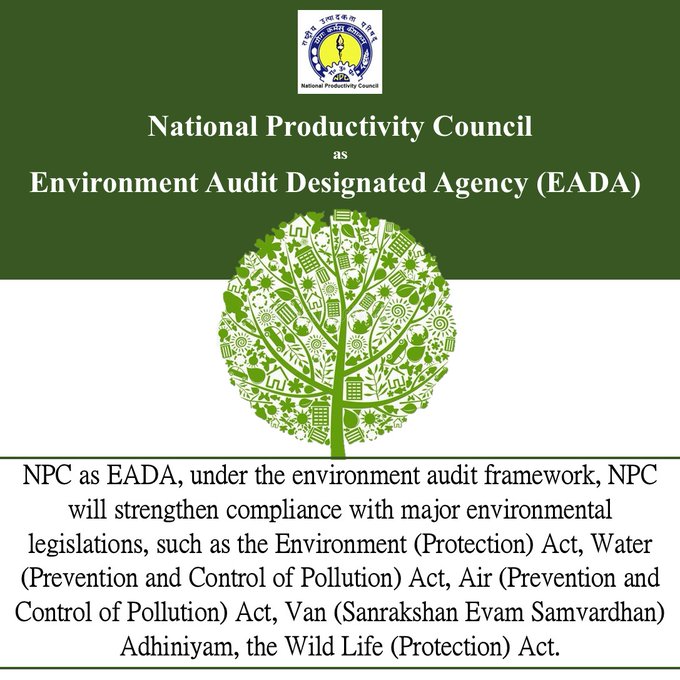
- The National Productivity Council (NPC) has recently been designated as the Environment Audit Designated Agency (EADA) through an agreement with the Ministry of Environment, Forest and Climate Change under the Environment Audit Rules, 2025.
- This development marks an important step towards institutionalising environmental auditing and strengthening regulatory compliance mechanisms in India.
About National Productivity Council (NPC)
- Established in 1958, the NPC is an autonomous, non-profit and tripartite organisation functioning under the Department for Promotion of Industry and Internal Trade, Ministry of Commerce and Industry.
- It has representation from government, industry, labour organisations, and technical institutions, reflecting a multi-stakeholder approach to productivity enhancement.
- Headquartered in New Delhi, NPC is also a member of the Asian Productivity Organisation, highlighting its international engagement. Over the years, it has evolved into a think tank and capacity-building institution, offering consultancy, training, research, and project monitoring services across sectors.
Environment Audit Framework: Key Features
- Under the new mandate, NPC will function as the central agency responsible for designing, implementing, and overseeing the environmental audit ecosystem in India.
- The framework aims to standardise environmental auditing practices and ensure better compliance with environmental laws.
- The audit system is linked with major legislations such as the Environment (Protection) Act, 1986, Water (Prevention and Control of Pollution) Act, 1974, Air (Prevention and Control of Pollution) Act, 1981, Wild Life (Protection) Act, 1972 and forest conservation laws.
- It also supports regulatory processes such as Environmental Clearance (EC), Consent to Establish (CTE), and Consent to Operate (CTO).
Role of NPC as EADA
- NPC has been entrusted with comprehensive responsibilities covering the entire audit lifecycle. It will develop eligibility criteria and conduct certification processes for environmental auditors, including Certified Environmental Auditors (CEA) and Registered Environmental Auditors (REA).
- Further, it will manage the registration, monitoring, and disciplinary oversight of auditors, ensuring accountability and professional standards. NPC will also establish digital platforms for audit processes, maintain a publicly accessible registry of auditors, and promote capacity building through training programmes and awareness initiatives.
- Through these functions, NPC is expected to create a robust, transparent, and standardised environmental audit system across the country.
Significance of the Initiative
The designation of NPC as EADA has multiple policy implications. It strengthens environmental governance by improving monitoring, reporting accuracy, and compliance with environmental regulations.
At the same time, it promotes sustainable industrial development, as industries will be required to adhere to standardised environmental audit norms. The initiative also reflects a shift towards institutional and data-driven regulation, enhancing transparency and accountability.
Moreover, by integrating capacity building with regulatory oversight, it addresses the gap between policy design and on-ground implementation.