
Iran-Pakistan-India (IPI) Pipeline
- 23 Mar 2026
In News:
The ongoing geopolitical tensions in West Asia have disrupted global energy supply chains, exposing India’s high dependence on imported hydrocarbons, particularly natural gas. This has revived discussions around stalled transnational pipeline projects such as the Iran–Pakistan–India (IPI) and Turkmenistan–Afghanistan–Pakistan–India (TAPI) pipelines as alternatives to ensure long-term energy security.
Background: India’s Energy Vulnerability
India is heavily reliant on imports to meet its energy needs, especially for natural gas. Disruptions in maritime routes and geopolitical instability in West Asia increase price volatility and supply risks, highlighting the need for diversified and secure energy sources.
Pipeline-based supply was envisioned as a cost-effective and stable alternative to Liquefied Natural Gas (LNG), reducing dependence on sea routes and global spot markets.
Iran–Pakistan–India (IPI) Pipeline
- The IPI pipeline, often referred to as the “Peace Pipeline,” was conceptualised in the 1990s to transport natural gas from Iran’s South Pars field to South Asia.
- The project envisaged a 2,775 km pipeline supplying around 60 mmscmd of gas each to India and Pakistan, offering a relatively cheaper alternative to LNG imports. It also carried the promise of regional cooperation through economic interdependence.
- However, the project lost momentum and India withdrew in 2007 due to multiple concerns. These included U.S.-led sanctions on Iran, pricing disagreements, and security risks, particularly regarding the pipeline’s passage through Pakistan’s Balochistan region. As a result, the project remains effectively dormant.
Turkmenistan–Afghanistan–Pakistan–India (TAPI) Pipeline
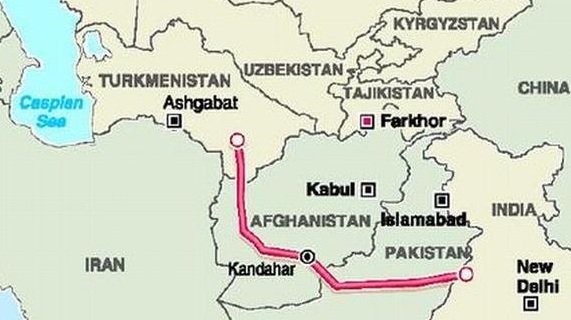
- Following the stagnation of IPI, India shifted its focus to the TAPI pipeline, which aimed to bring natural gas from the Galkynysh gas field in Turkmenistan, one of the world’s largest reserves.
- Spanning about 1,814 km, the pipeline is designed to transport 33 billion cubic meters (bcm) of gas annually. It received support from the Asian Development Bank and was seen as part of broader efforts to integrate Central and South Asia economically.
- While progress has been made in parts of the project—particularly the Turkmenistan-Afghanistan section—the extension into Pakistan and India remains stalled due to security challenges in Afghanistan, financing constraints, and geopolitical uncertainties.
Comparative Analysis
The IPI and TAPI pipelines reflect two different strategic approaches to energy security. While IPI relied on West Asian resources with shorter routes, it faced geopolitical constraints. TAPI, on the other hand, sought to diversify supply through Central Asia, but has struggled due to instability along its transit route.
Both projects highlight the complexity of cross-border energy infrastructure, where geopolitics, security, and economic viability intersect.