
Hudsonian Godwit
- 25 Mar 2026
In News:
In March 2026, scientific reports revealed a catastrophic 95% decline in the population of the Hudsonian Godwit (Limosa haemastica) over the last four decades. This drastic plunge has positioned the shorebird as a primary focus at the UN Convention on the Conservation of Migratory Species of Wild Animals (CMS COP15) held in Campo Grande, Brazil. The species is now among 42 migratory animals proposed for enhanced international protection under the Bonn Convention.
About the Hudsonian Godwit
The Hudsonian Godwit is a large shorebird belonging to the sandpiper family (Scolopacidae), celebrated for its extraordinary physiological endurance and migratory precision.
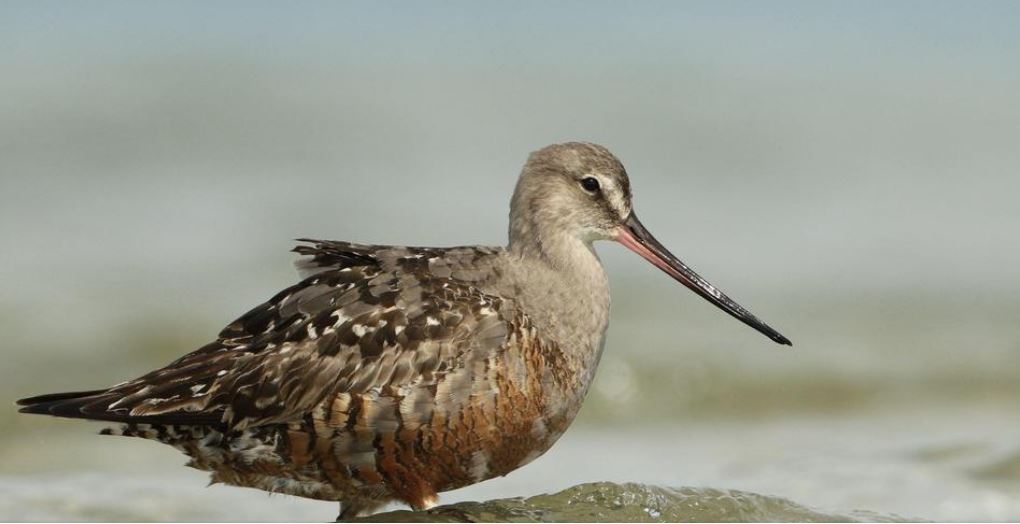
- Physical Characteristics: Distinguishable by a long, slightly upturned bill and long legs. During the breeding season, it displays a vibrant plumage of gold, brown, and brick-red, which transitions to a subtle gray-brown during the non-breeding period.
- Ecological Niche: It breeds in sub-Arctic and Boreal wetlands (muskeg and sedge meadows) and winters in the southern reaches of South America, primarily Patagonia and Chiloé Island.
- Feeding Behavior: As a probing feeder, it consumes insects, crustaceans, and small invertebrates in shallow water and intertidal zones.
The "Marathon" Migration: A Feat of Endurance
The Hudsonian Godwit is a "hemispheric traveler," undertaking an annual round-trip of nearly 30,000 km.
- Non-stop Capability: It can fly up to 11,000 km in a single stretch without eating, drinking, or sleeping, relying entirely on stored fat reserves.
- Migratory Connectivity: Its survival depends on a series of highly predictable wetland "stopover sites" across North and Central America to refuel.
Drivers of Decline: A Multi-Continental Crisis
The 95% population collapse is attributed to a "polycrisis" where environmental stressors across three continents intersect simultaneously.
- Arctic Ecological Mismatch (Climate Change): Shifting spring timelines in the Arctic have disrupted the synchrony between hatching and food availability. Chicks now hatch after the peak emergence of insects, leading to high starvation rates.
- Infrastructure Boom in South America: In southern Chile, the expansion of salmon and oyster farming has led to heavy industrialization of intertidal zones. This has degraded the primary feeding grounds the birds rely on during the southern summer.
- Wetland Loss in North America: In the United States, changes in agricultural land use and drainage practices have made shallow-water wetlands increasingly rare. This forces the birds to spend more time searching for stopover sites, depleting the energy reserves needed for their trans-oceanic flights.
- Disrupted Migration Cues: Research indicates that the birds are now migrating roughly six days later than a decade ago, suggesting a breakdown in the "geological clock" or environmental cues they use to time their journeys.
Conservation Status and Policy Implications
|
Category |
Status/Details |
|
IUCN Red List |
Vulnerable |
|
Legal Framework |
Proposed for CMS Appendix I (Strict protection for endangered migratory species). |
|
Global Trend |
49% of all migratory species are currently in decline. |