
Bura Chapori Wildlife Sanctuary
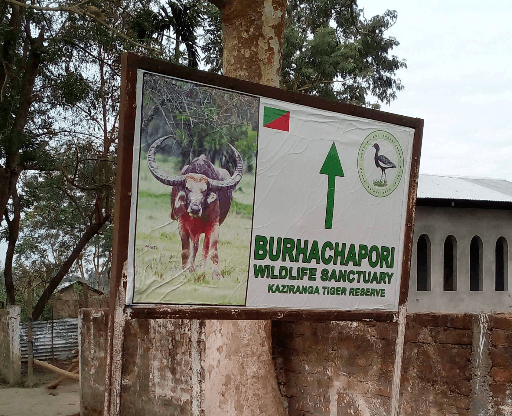
- 25 Mar 2026
In News:
In a significant move to bolster the conservation landscape of Central Assam, the State Government has proposed the creation of a new Reserved Forest, tentatively named Burhachapori No. 5, in the Sonitpur district.
Spanning approximately 224.32 hectares, this initiative is primarily driven by Compensatory Afforestation (CA) requirements under the Van Sanrakshan Evam Samvardhan Rules, 2023. The land, situated in the Dhania Range, will compensate for forest diversions necessitated by critical infrastructure projects, including National Highway expansion (NHAI/NHIDCL), oil exploration (ONGC/OIL), and power transmission (AEGCL).
The Laokhowa-Burhachapori Eco-system
The Burhachapori Wildlife Sanctuary (WLS) is not an isolated entity but a vital cog in the Laokhowa-Burhachapori ecosystem.
- Geographic Setting: Located on the south bank of the Brahmaputra River, it acts as a crucial "stepping stone" for wildlife movement between Kaziranga National Park (East) and Orang National Park (West/North bank).
- Buffer Status: It is a notified buffer zone of the Kaziranga Tiger Reserve, providing additional habitat for dispersing populations of tigers and rhinos.
- Topography: The sanctuary is characterized by chaporis (riverine islands), wetlands, and alluvial floodplains that undergo seasonal transformations due to the Brahmaputra’s flood cycle.
Ecological Profile: Flora and Fauna
The region represents a classic Brahmaputra Valley semi-evergreen forest mosaic, essential for megaherbivores and endangered avifauna.
1. Vegetation and Flora
The sanctuary comprises a mix of wet alluvial grasslands, riparian forests, and semi-evergreen patches.
- Key Tree Species: Hollong (Assam's State Tree), Mekai, Dhuna, Udiyam, Nahar, and Samkothal.
- Grasslands: These are rich in medicinal herbs and provide the primary fodder for the Greater One-horned Rhinoceros.
2. Faunal Diversity
- Mammals: Home to the Greater One-horned Rhinoceros, Royal Bengal Tiger, Leopard, Asiatic Wild Buffalo, Hog Deer, and Asian Elephant.
- Avifauna: It is a critical habitat for the Bengal Florican (Critically Endangered). Other significant species include the Black-necked Stork, Open-billed Stork, Mallard, Teal, and Whistling Duck.
Significance of the New Reserved Forest
The proposal to notify adjacent land as a Reserved Forest serves multiple strategic objectives:
- Corridor Connectivity: By expanding the protected area, the government aims to reduce habitat fragmentation, allowing safer passage for animals moving between Kaziranga and Orang.
- Legal Protection: Upgrading land status to "Reserved Forest" under the Assam Forest Regulation, 1891, provides higher legal safeguards against encroachment and unauthorized land use.
- Restoration & Reintroduction: The area has historically been a site for rhino reintroduction. Strengthening the buffer helps in stabilizing these populations and reducing human-wildlife conflict in the Sonitpur-Nagaon belt.
- Environmental Compliance: It fulfills the "land for land" and "tree for tree" principle of the Union Ministry of Environment, Forest & Climate Change (MoEFCC) for developmental projects.