
ASI Excavations in Tamil Nadu
- 21 Mar 2026
In News:
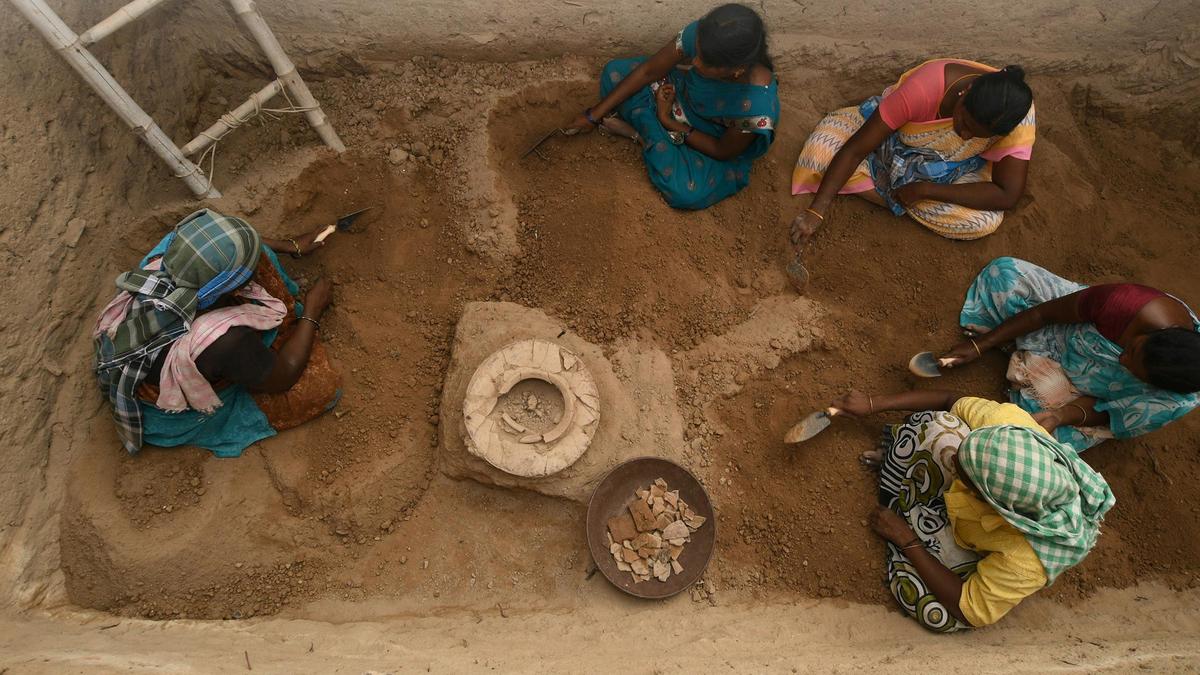
- The Archaeological Survey of India (ASI), under the provisions of the Ancient Monuments and Archaeological Sites and Remains Rules, 1959, has approved excavations at eight significant archaeological sites in Tamil Nadu.
- These excavations are expected to provide a continuous cultural sequence from the Iron Age to early historic urbanisation, offering crucial insights into South India’s socio-economic evolution and its linkages with global trade networks.
Significance of the Excavation Initiative
The identified sites collectively represent:
- Transition from Iron Age societies to urban settlements
- Emergence of early Tamil civilisation and literacy (Tamil-Brahmi )
- Integration of South India into Indian Ocean and trans-regional trade networks
This initiative may help bridge historical gaps between indigenous urbanisation processes and external commercial interactions, including links with the Mediterranean and Southeast Asia.
Key Archaeological Sites and Their Importance
Urban and Cultural Centres
- Keeladi: Located in the Vaigai basin, it reveals an advanced urban settlement, with evidence of Tamil-Brahmi , planned habitation, and drainage systems, indicating a literate and organised society.
Burial and Iron Age Sites
- Adichanallur and Karivalamvanthanallur: Prominent burial sites that shed light on mortuary practices, social stratification, and Iron Age material culture.
- Thelunganur: Suggests early iron technology, pointing to technological advancement and early metallurgical knowledge.
Trade and Economic Centres
- Vellalore: Indicates trade links with the Roman Empire, supported by findings such as coins and ornaments.
- Nagapattinam and Pattinamarudur: Associated with Chola-period maritime activity, Buddhist influence, and participation in Indian Ocean trade networks.
- Manikollai: A centre for glass bead production, connected to long-distance trade with Southeast Asia.
Scientific Methods in Archaeology
The excavation process incorporates advanced scientific techniques:
DNA Analysis (Ancient DNA Studies)
- Helps trace genetic lineage, migration patterns, and ancestry
- Enables reconstruction of population history and biological relationships
Optically Stimulated Luminescence (OSL) Dating
- Determines the last exposure of mineral grains to sunlight
- Useful for dating soil layers and artefacts where organic material is absent
Role of the State Government
The Government of Tamil Nadu has demonstrated proactive commitment by allocating ?7 crore in the 2025–26 budget for archaeological research.
The emphasis is on integrating modern scientific tools with traditional excavation methods to ensure more accurate historical reconstruction.