
Ladakh Magmatic Arc
- 19 Mar 2026
In News:
Recent scientific studies have traced the evolution of the Ladakh Magmatic Arc (LMA) in the north-western Himalaya, providing new insights into the geological history of the Indian subcontinent and plate tectonic processes.
About Ladakh Magmatic Arc (LMA)
- The Ladakh Magmatic Arc is a belt of igneous rocks located in the Trans-Himalayan region. It represents a long-extinct volcanic arc system formed due to tectonic activity associated with the closure of the Neo-Tethys Ocean.
- Time Period: Formed between the Jurassic and Eocene periods (~201 million years ago to ~34 million years ago)
Geological Formation Process
Role of Plate Tectonics
- The region was once part of the Neo-Tethys Ocean.
- The Indian Plate moved northwards and subducted beneath the Eurasian Plate.
- This subduction led to melting in the mantle, generating magma.
- The rising magma formed a chain of volcanic features, giving rise to the magmatic arc.
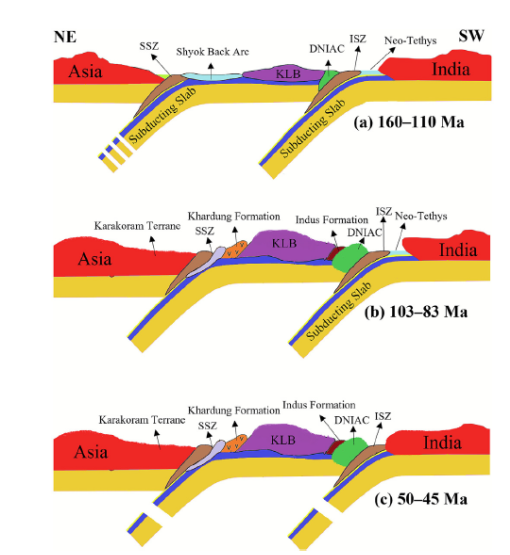
Phases of Evolution of LMA
1. Early Island Arc Formation (160–110 Ma)
- Ladakh initially resembled a chain of volcanic islands.
- Represented by the Dras–Nidar Island Arc Complex (DNIAC).
- Magma was primarily derived from the mantle, with minimal sediment contribution.
2. Crustal Enrichment & Batholith Formation (103–45 Ma)
- Occurred during intensified convergence between the Indian and Eurasian plates.
- Formation of large granitic bodies known as the Ladakh Batholith.
- Increased contribution from:
- Continental crust
- Subducted sediments
- Indicates magma mixing and deep crustal processes.
- This phase coincided with the approaching continental collision.
3. Post-Collisional Magmatism (<45 Ma)
- Continued tectonic activity even after the closure of the Neo-Tethys Ocean.
- Formation of mafic dykes (vertical intrusions of magma).
- Magma sourced from an enriched mantle.
- Suggests lingering magmatic activity post-collision.
Key Geological Features
- Ladakh Batholith: Large granitic intrusions indicating crustal melting.
- Mafic Dykes: Evidence of late-stage magmatic activity.
- DNIAC: Represents early volcanic island arc phase.