
Floating LiDAR Buoy System
- 19 Mar 2026
In News:
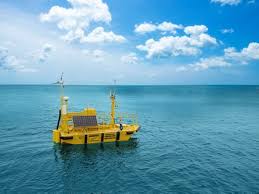
The National Institute of Ocean Technology (NIOT) has successfully tested an indigenously developed Floating LiDAR Buoy System off the coast of Muttom, Tamil Nadu. The development marks a significant step in enhancing India’s ocean-based meteorological and renewable energy assessment capabilities.
About Floating LiDAR Buoy System
The Floating LiDAR Buoy System is a state-of-the-art oceanographic instrument designed to measure wind and atmospheric conditions over the sea.
Key Features
- Combines a floating buoy platform with LiDAR (Light Detection and Ranging) technology.
- Uses laser pulses to capture highly accurate atmospheric data.
- Capable of measuring wind speed, direction, and vertical wind profiles.
- Can collect data up to 300 metres above sea level, surpassing many conventional instruments.
Working Mechanism
- The buoy is deployed on the ocean surface and remains stable under marine conditions.
- It emits laser pulses into the atmosphere.
- These pulses reflect off airborne particles such as aerosols.
- The returned signals are analysed to determine:
- Wind speed
- Wind direction
- Variations at different altitudes
This enables real-time, high-resolution data collection, even in remote offshore regions where traditional meteorological tools face limitations.
Significance
1. Improved Weather Forecasting
- Enhances accuracy of marine weather predictions.
- Supports better storm and cyclone tracking, crucial for coastal safety.
2. Boost to Offshore Wind Energy
- Provides precise wind data necessary for site assessment of offshore wind farms.
- Reduces uncertainty in renewable energy planning and investments.
3. Climate Change Studies
- Helps monitor long-term atmospheric and oceanic interactions.
- Contributes to understanding the impact of climate change on marine systems.
4. Indigenous Technological Advancement
- Reflects India’s progress in developing advanced ocean observation systems.
- Reduces reliance on imported technologies.
About National Institute of Ocean Technology (NIOT)
- It operates under the Ministry of Earth Sciences.
- It focuses on ocean engineering, resource exploration, and marine technology development.
- Plays a key role in initiatives like deep-sea exploration and offshore energy.