
Prambanan Temple Restoration
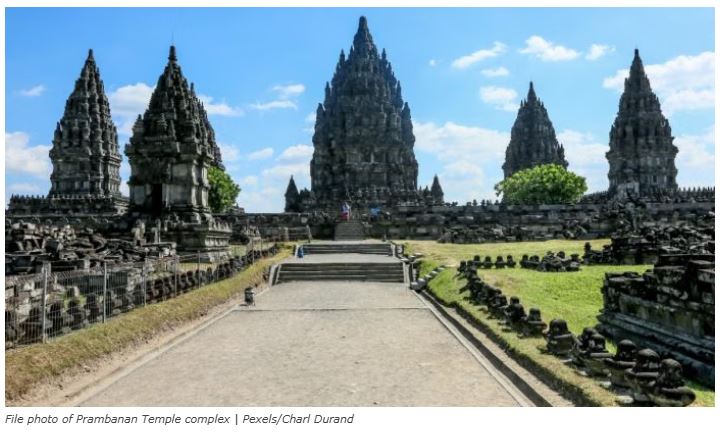
- 18 Mar 2026
In News:
India and Indonesia have recently partnered for the restoration of the Prambanan Temple complex in the Special Region of Yogyakarta, Java. This initiative reflects deep-rooted civilizational ties, cultural diplomacy, and shared heritage between the two nations, while also highlighting India’s growing role in global heritage conservation.
About Prambanan Temple
- The Prambanan Temple is the largest Hindu temple complex in Indonesia, located in Sleman, Yogyakarta (Central Java).
- Built in the 9th century by the Sanjaya dynasty, it represents the flourishing of Hindu culture in Southeast Asia.
- Locally known as Roro Jonggrang (Temple of the Slender Virgin), the complex is dedicated to the Hindu Trimurti—Shiva, Vishnu, and Brahma.
- After being buried and neglected for centuries, it was rediscovered and restored during the 19th century, and later recognised as a UNESCO World Heritage Site in 1991.
Architectural Features
Prambanan reflects a remarkable fusion of indigenous Javanese and South Indian (Pallava) architectural styles, showcasing cultural exchange across regions.
- The complex comprises 240 temples, arranged in concentric layouts
- The central compound includes eight main and eight minor temples built on an elevated platform
- The Shiva Temple, standing at 47 metres, is the tallest and most prominent structure
- Other major temples are dedicated to Brahma and Vishnu
- The walls are adorned with intricate carvings depicting the Ramayana and other Hindu epics, reflecting advanced craftsmanship
Interestingly, while primarily a Hindu complex, the surrounding area also contains Buddhist shrines, indicating religious coexistence and syncretism in ancient Java.