
India China Trade Deficit
- 18 Mar 2026
In News:
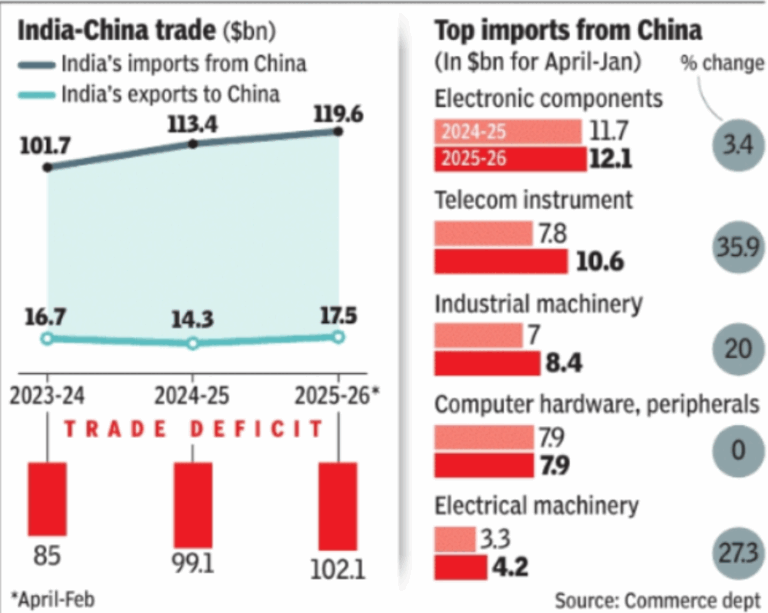
India’s trade deficit with China has crossed a historic threshold, reaching approximately $102 billion during April–February FY2025–26. This marks the first time the deficit has exceeded $100 billion, underscoring deep structural imbalances in bilateral trade and raising concerns about economic resilience and strategic dependence.
Understanding Trade Deficit
- A trade deficit occurs when the value of a country’s imports exceeds its exports over a given period.
- In the India–China context, the imbalance is driven by high-value imports from China vis-à-vis relatively low-value Indian exports.
- India imports critical goods such as electronic components, telecom equipment, machinery, and pharmaceutical APIs, while exporting petroleum products, copper, and limited electronic goods, resulting in a widening gap.
Key Features of India–China Trade Imbalance
1. Persistent Import Dependence: India heavily relies on China for intermediate and capital goods that feed into domestic industries. Sectors like electronics, pharmaceuticals (APIs), renewable energy equipment, and heavy machinery depend significantly on Chinese imports.
2. Sectoral Imbalance: Imports from China are concentrated in high-value, technology-intensive goods, whereas India’s exports are largely low-value or resource-based products. This structural asymmetry limits India’s ability to narrow the deficit.
3. Market Access Asymmetry: Indian exporters face non-tariff barriers, stringent quality standards, and regulatory hurdles in China. This restricts access for Indian goods, particularly in sectors like agriculture, pharmaceuticals, and IT-enabled services.
Implications of the Rising Deficit
1. Pressure on Current Account: A large and persistent trade deficit contributes to the Current Account Deficit (CAD), impacting foreign exchange reserves and macroeconomic stability.
2. Strategic and Economic Vulnerability: Dependence on Chinese imports in critical sectors creates supply chain risks, especially during geopolitical tensions or disruptions such as pandemics.
3. Impact on Domestic Manufacturing: Cheap imports can undermine domestic industries, particularly MSMEs, affecting employment and industrial competitiveness.
Underlying Causes
- Cost competitiveness of Chinese manufacturing due to economies of scale
- Inadequate domestic manufacturing capacity in high-tech sectors
- Limited diversification of export basket
- Global value chain integration favouring China
Government Measures and Policy Response
- Production Linked Incentive (PLI) Schemes to boost domestic manufacturing in electronics, pharmaceuticals, and solar equipment
- Atmanirbhar Bharat initiative to reduce import dependence
- Import diversification strategies targeting alternative partners like Vietnam, South Korea, and the EU
- Quality control orders and standards to regulate imports