
Lower Kopili Hydroelectric Project

- 17 Mar 2026
In News:
The Prime Minister recently virtually inaugurated the 120 MW Lower Kopili Hydroelectric Project in Assam, marking a significant step in strengthening renewable energy infrastructure in the Northeast.
About the Lower Kopili Hydroelectric Project
- Type: Run-of-the-river hydropower project
- Capacity: 120 MW
- Location:
- West Karbi Anglong and Dima Hasao (North Cachar Hills) Autonomous District Council areas
- Situated in Central Assam
- River Basin: Kopili River
- Implementing Agency: Assam Power Generation Corporation Limited (APGCL)
- Funding: Supported by the Asian Development Bank (ADB) under the Assam Power Sector Investment Program
Key Features
- Environmentally more sustainable than large storage dams due to minimal reservoir requirement
- Designed to harness the natural flow of the river for power generation
About the Kopili River
- Type: Interstate river in Northeast India
- States Covered: Meghalaya and Assam
- Origin: Meghalaya Plateau
- Course:
- Flows through Karbi Anglong and Nagaon districts
- Joins the Brahmaputra River as its largest south-bank tributary in Assam
- Length:
- Total: 256 km
- Shared between Meghalaya–Assam: 78 km
- Within Assam: 178 km
Revitalizing India’s Apprenticeship Ecosystem
- 23 Feb 2026
In News:
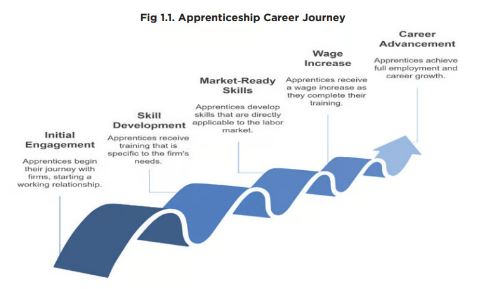
NITI Aayog’s report “Revitalizing Apprenticeship Ecosystem” highlights low completion rates (only 2.51 lakh completed out of 13.1 lakh registrations in 2024–25) and calls for a National Apprenticeship Mission and targeted reforms to strengthen India’s skilling strategy.
Launch of Policy Report
- NITI Aayog launched a policy report titled “Revitalizing Apprenticeship Ecosystem: Insights, Challenges, Recommendations and Best Practices.”
- The report provides a comprehensive review of India’s apprenticeship system and suggests reforms to make it a cornerstone of India’s skilling and employment framework.
Apprenticeship: Concept and Importance
- Apprenticeship is a structured, work-based learning model that bridges the gap between formal education and employment.
Significance
- Provides industry-relevant skills to youth
- Enhances productivity and innovation for businesses
- Reduces skill mismatch in labour markets
- Facilitates smoother school-to-work transition
Demographic Imperative
- Youth (15–29 years) constituted 27.2% of India’s population in 2021
- India projected to have ~345 million youth by 2036 (largest globally)
To convert this demographic potential into a demographic dividend, strengthening the apprenticeship and skilling ecosystem is critical.
Current Landscape of Apprenticeship (2024–25 Data)
1. Gap in Registration and Completion
- Registrations: 13.1 lakh (1.31 million)
- Engaged: 9.85 lakh (985,000)
- Completed training: 2.51 lakh (251,000)
Significant drop between registration, engagement, and completion.
2. Enterprise Participation
- Medium & large enterprises:
- <30% of active establishments
- Account for >70% of apprenticeship engagement
- Low participation by:
- MSMEs
- Start-ups
- Informal sector
3. Gender Gap
- Male participants dominate registrations and engagements
- Limited targeted support for women and marginalized groups
4. Regional Disparities
- Top 10 states contribute 79–84% of total engagement
- Low participation from:
- North-East states
- Union Territories
- Significant district-level variation within states
Key Recommendations by NITI Aayog
1. Policy Reforms
- Establish a National Apprenticeship Mission
- Develop a unified National Apprenticeship Portal
- Provide targeted incentives for:
- Aspirational districts
- North-East states
- Women apprentices
2. Regulatory Measures
- Create an Apprenticeship Engagement Index for benchmarking States/UTs
- Conduct robust evaluation of apprentice competencies
3. State & District-Level Interventions
- Focus on “high-potential but low-performing” districts
- Recognition/reward initiative for Top 25 districts based on growth
4. Enhancing Enterprise Participation
- Cluster-based approach for MSMEs
- Integration with start-up ecosystem
- Alignment with gig and platform economy
5. Support for Women & Marginalized Sections
- Travel and accommodation assistance
- Expanded insurance coverage
- Structured career counselling
- International mobility pathways
- Targeted measures to enhance women’s inclusion
Key Government Initiatives
1. National Apprenticeship Promotion Scheme (NAPS), 2016
- Implemented by Ministry of Skill Development & Entrepreneurship
- Target group: 14–35 years
- Incentives:
- Government shares 25% of stipend (up to ?1,500/month)
- Reimbursement of basic training costs
2. National Apprenticeship Training Scheme (NATS)
- Administered by Ministry of Education
- For graduate and diploma holders
- Provides 6 months to 1 year structured on-the-job training
Green Hydrogen Production
- 24 Jun 2025
In News:
In a significant scientific milestone, Indian researchers have developed a next-generation, scalable solar-driven device for producing green hydrogen—offering a major boost to clean energy innovation and India’s energy transition goals.
Key Highlights:
- Developed By: Centre for Nano and Soft Matter Sciences (CeNS), Bengaluru — an autonomous institute under the Department of Science and Technology (DST).
- Publication: The findings were published in the Journal of Materials Chemistry A (Royal Society of Chemistry).
What Is Green Hydrogen?
Green hydrogen is produced by splitting water molecules using renewable energy sources, especially solar and wind, without any greenhouse gas emissions. It is a clean energy carrier with the potential to decarbonize heavy industries, power vehicles, and store energy.
The Innovation: Solar-Driven Water Splitting Device
- The device uses only solar energy to split water and produce hydrogen.
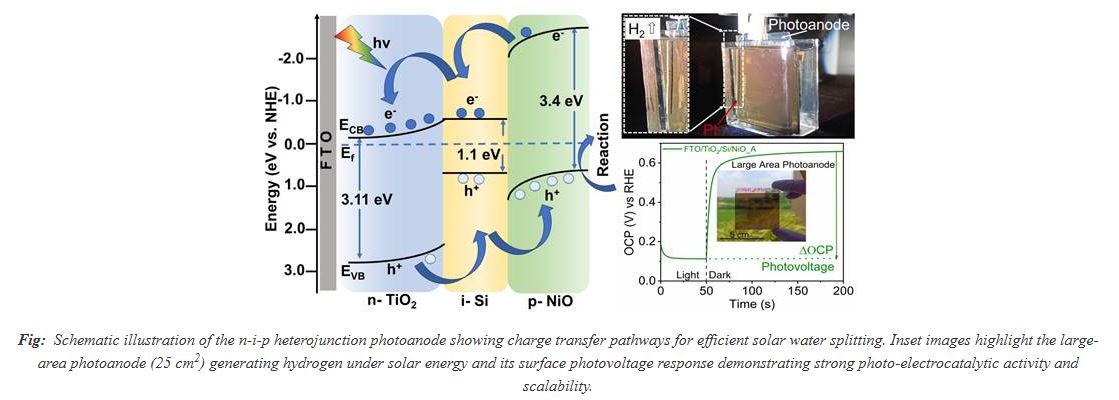
- It employs a silicon-based photoanode with an n-i-p heterojunction structure:
- n-type TiO?, intrinsic (undoped) Si, and p-type NiO layers.
- This structure enhances charge separation and transport efficiency.
- Fabrication via magnetron sputtering, a scalable, industry-compatible process.
Key Performance Metrics
- Surface photovoltage: 600 millivolts (mV)
- Low onset potential: ~0.11 VRHE
- Stability: Operated continuously for over 10 hours in alkaline medium with only ~4% performance degradation.
- Successfully scaled to a 25 cm² photoanode, showing strong solar-to-hydrogen conversion.
Advantages of the Device
Feature Benefit
Pure solar operation No external power or fossil fuel input
High energy efficiency Better light absorption, reduced recombination loss
Material use Low-cost, earth-abundant materials
Durability Stable under alkaline conditions
Scalability Demonstrated potential for industrial-scale production
Strategic Significance
- Accelerates India’s National Green Hydrogen Mission and hydrogen-based economy.
- Supports India’s net-zero emission commitments and climate action.
- Offers a cost-effective, clean energy alternative to fossil fuels in:
- Hard-to-abate sectors like steel and cement
- Clean transport solutions
- Renewable energy storage systems
Bonn Climate Change Conference 2025
- 18 Jun 2025
In News:
The Bonn Climate Change Conference 2025 began in Bonn, Germany, with over 5,000 delegates from governments, international organisations, civil society, and scientific bodies. It serves as a crucial platform for setting the technical and political groundwork ahead of COP29.
What is the Bonn Climate Conference?
- A mid-year climate summit held annually under the United Nations Framework Convention on Climate Change (UNFCCC).
- Also referred to as the Sessions of the UNFCCC Subsidiary Bodies (SBs).
- First held in 1995, after the UNFCCC was signed in 1992.
- Hosted in: Bonn, Germany (home of the UNFCCC headquarters).
- Organised by: The UNFCCC Secretariat.
Main Objectives
- Prepare for COP Summits: Provides a platform for technical discussions that shape the COP agenda (COP29 in this case).
- Review of Commitments: Tracks implementation of earlier climate agreements like the Paris Agreement.
- Science–Policy Integration: Connects IPCC research with policymaking processes.
- Support for Developing Nations: Discusses climate finance and technology transfer mechanisms.
- Inclusive Participation: Engages Indigenous communities, NGOs, experts, and private stakeholders.
Subsidiary Bodies of the UNFCCC
- SBI (Subsidiary Body for Implementation):
- Reviews how climate commitments are implemented.
- Facilitates support for developing countries.
- SBSTA (Subsidiary Body for Scientific and Technological Advice):
- Provides scientific guidance.
- Bridges IPCC reports with UNFCCC decision-making.
Key Focus in 2025
Global Goal on Adaptation (GGA)
- Originally mentioned in the Paris Agreement (2015).
- Received major progress only during COP28 (Dubai).
- Aim: Establish a global, measurable, and equitable adaptation framework, similar to the 1.5°C target for mitigation.
- Bonn 2025 focuses on operationalising this goal, especially for climate-vulnerable nations.
Importance of the Bonn Conference
- Pre-COP Platform: Decisions taken here set the tone and agenda for COP summits.
- Technical + Political Dialogue: Encourages cooperation between scientists, policymakers, and climate negotiators.
- Influences Global Climate Action: Outcomes impact the direction of global climate governance.
National Florence Nightingale Award 2025

- 31 May 2025
In News:
The President of India recently conferred the National Florence Nightingale Awards 2025 to exemplary nursing professionals in a formal ceremony held at Rashtrapati Bhavan.
About the National Florence Nightingale Awards
- Established: 1973
- Administered by: Ministry of Health and Family Welfare, Government of India
- Purpose: To honour exceptional contributions of nursing personnel across India in recognition of their meritorious service to society.
The award is open to nurses working in government, private, and voluntary healthcare settings, including hospitals, community health centres, educational institutions, and administrative roles.
Award Components
- Certificate of Merit
- Cash Prize: ?1,00,000
- Medal of Honour
About Florence Nightingale
- Florence Nightingale (1820–1910) was a pioneering English nurse, social reformer, and statistician, widely considered the founder of modern nursing.
- She gained recognition during the Crimean War for organizing the care of wounded soldiers in Constantinople (now Istanbul).
She also revolutionized nursing education by establishing the Nightingale School of Nursing at St. Thomas’ Hospital, London, the first institution based on scientific nursing principles.
GARBH-INi-DRISHTI
- 04 Feb 2025
In News:
India has made a significant stride in biomedical research and public health with three major developments led by the Translational Health Science and Technology Institute (THSTI) in Faridabad, Haryana.
Key Highlights:
India’s First Ferret Research Facility
- Inaugurated by: Department of Biotechnology (DBT), Ministry of Science & Technology.
- Location: NCR Biotech Science Cluster, Faridabad.
- Purpose: To bolster India's capacity in:
- Vaccine development
- Therapeutic testing
- Research on emerging infectious diseases like influenza, COVID-19, and tuberculosis.
- Significance:
- Strengthens India’s pandemic preparedness.
- Positions India among the select nations with advanced biosafety labs using ferrets—ideal models due to respiratory systems similar to humans.
Launch of GARBH-INi-DRISHTI Data Repository
- Platform: DBT Data Repository and Information Sharing Hub under the GARBH-INi program.
- Dataset Size: Over 12,000 pregnant women, newborns, and postpartum mothers.
- Developed by: THSTI with collaboration from top Indian research institutions and hospitals.
- Features:
- Comprehensive clinical data, medical images, and biospecimens.
- Secure, controlled access promoting ethical research.
- Facilitates predictive tools for preterm birth and maternal health complications.
- Utility:
- Empowers both national and global researchers.
- Informs maternal and neonatal health interventions.
- Supports evidence-based policymaking in public health.
- Program Genesis:
- GARBH-INi (2014): Interdisciplinary initiative to understand preterm birth risks—biological and non-biological.
- Part of: Atal Jai Anusandhan Biotech Mission under the UNaTI initiative.
Technology Transfer Agreement with Industry
- Agreement Between: THSTI and Sundyota Numandis Probioceuticals Pvt. Ltd.
- Technology Transferred:
- Lactobacillus crispatus, a genetically defined synthetic microbial consortium.
- Isolated from reproductive tracts of Indian women enrolled in GARBH-INi.
- Applications:
- Nutraceuticals and probiotics for reproductive health.
- Potential treatments for vaginal infections and urinary tract infections (UTIs).
- Significance:
- Promotes microbiome-based interventions.
- Bridges lab-to-market gap, boosting the biomanufacturing ecosystem.
Strategic Implications for India
- Scientific Diplomacy & Global Standing: With cutting-edge facilities and open data-sharing platforms, India emerges as a key player in global biomedical research.
- Public Health Impact: Supports targeted, data-driven maternal health policies and pandemic response frameworks.
- Innovation Ecosystem: Reflects the convergence of academic research, industry collaboration, and translational science.
Sovereign Artificial Intelligence

- 13 Jan 2025
In News:
- The growth of Artificial Intelligence (AI) has been remarkable in recent years. In 2018, a 340-million-parameter AI model was considered large, whereas models like ChatGPT now have 1.8 trillion parameters.
- As part of its ambition to make the digital economy worth USD 1 trillion by 2028, India is focusing on AI sovereignty and investing in semiconductors and AI technologies to achieve this goal.
What is Sovereign AI?
Definition
- Sovereign AI refers to a nation’s ability to develop, control, and deploy AI using its own resources, including infrastructure, data, workforce, and business networks.
- This involves not just developing AI models but also creating infrastructure and nurturing homegrown talent to lead AI advancements within the country.
Key Aspects of Sovereign AI
- National Control: Ensures AI technologies align with a country's laws, regulations, and ethical standards.
- Data Sovereignty: Emphasizes control of data within the country’s borders, protecting privacy, security, and national interests.
- AI in Governance: Generative AI is transforming industries, markets, and governance, with AI-powered tools assisting professionals and governments.
- Ethical Considerations: Countries define security protocols and ethical frameworks to govern the use of AI technologies.
- Strategic Autonomy: Reduces reliance on foreign technologies, encouraging domestic development in AI to achieve strategic independence.
- Economic Competitiveness: AI is crucial for industrial innovation. Without it, nations risk falling behind in the global economy.
Growth and Importance of AI
Evolution of AI Models
- In 2018, a 340-million-parameter model was considered a significant achievement.
- Today, ChatGPT uses 1.8 trillion parameters, and Google’s Gemini uses 1.5 trillion parameters. In comparison, China’s DeepSeek has a model with 240 billion parameters.
- Parameters are the internal variables of AI models, adjusted during training to improve their performance and accuracy.
Strategic Applications
- Sovereign AI plays a pivotal role in critical sectors such as:
- Defense
- Healthcare
- Transportation
- Governance
- It helps redefine industries, boost innovation, and streamline operations across various sectors.
India’s Position in Sovereign AI
AI Infrastructure Development
- Tata Group and Reliance are building AI infrastructure in India, including the development of Large Language Models (LLMs).
- India has allocated USD 1.2 billion for a sovereign AI project under the IndiaAI Mission, which includes creating an AI supercomputer with thousands of chips.
Government Initiatives
- The IndiaAI Mission is designed to boost India’s AI capabilities by building infrastructure, fostering talent, and supporting innovation within the country.
Global AI Compact
- A Global AI Compact has been proposed to ensure equitable access to AI technologies across nations.
- The compact advocates for sharing AI resources globally while promoting cooperation and addressing challenges associated with AI governance.