
UN Convention to Combat Desertification (UNCCD) – COP17
- 29 Aug 2026
In News:
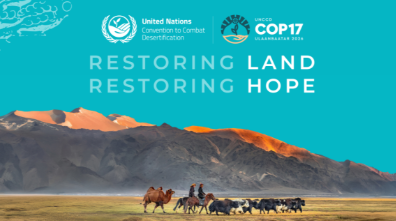
The 17th Conference of the Parties (COP17) to the United Nations Convention to Combat Desertification (UNCCD) opened in Ulaanbaatar, Mongolia, under the theme “Restoring Land, Restoring Hope.” The conference focuses on translating global commitments on land restoration and drought resilience into finance and concrete action.
The UNCCD is the only legally binding international agreement specifically linking environment and development with sustainable land management. It is one of the three Rio Conventions, along with the UNFCCC on climate change and the CBD on biodiversity.
UNCCD: Background & Objective
The Convention was recommended through Agenda 21 at the 1992 Rio Earth Summit (UNCED) and was adopted in Paris on 17 June 1994. It entered into force in December 1996 and has 197 Parties — 196 countries plus the European Union.
Its core objective is to combat desertification, land degradation and drought, particularly in arid, semi-arid and dry sub-humid areas (drylands), while promoting sustainable livelihoods and achieving Land Degradation Neutrality (LDN).
Key Functions
- Land Degradation Neutrality (LDN): Seeks to maintain or improve the quantity and quality of land resources required for ecosystem functioning, food security and livelihoods.
- Drought resilience: Promotes a shift from crisis response to proactive drought preparedness, early-warning systems and resilience-building, including initiatives such as the Riyadh Global Drought Resilience Partnership.
- Participatory governance: National Action Programmes (NAPs) emphasise participation of local communities, farmers, pastoralists, indigenous peoples and women.
- Land and climate finance: The Global Mechanism (GM) helps developing countries mobilise and channel domestic, bilateral, private and multilateral finance towards sustainable land management.
- Peace and ecosystem restoration: The Peace Forest Initiative (PFI) promotes transboundary restoration and cooperation, particularly in conflict-affected regions.