
Night Vision Devices (NVDs)

- 14 Jun 2026
In News:
India is rapidly enhancing its night-combat preparedness through the induction of advanced Night Vision Devices (NVDs) and expansion of indigenous electro-optics manufacturing. Recent initiatives include a ?659.47 crore contract for Netro NW 3000 Gen-III night sights and the inauguration of a dedicated electro-optics production facility by Bharat Electronics Limited in Andhra Pradesh.
What are Night Vision Devices?
Night Vision Devices (NVDs) are advanced optoelectronic systems that enable soldiers to detect, observe and engage targets in low-light or no-light conditions. They are deployed as:
- Weapon-mounted sights
- Helmet-mounted goggles
- Handheld devices
- Sensors on armoured vehicles and aircraft
NVDs provide a critical operational advantage in modern warfare, especially during night operations and adverse weather conditions.
Working Principles
Image Intensification
This technology amplifies available ambient light from sources such as:
- Moonlight
- Starlight
- Infrared illuminators
The incoming photons are converted into electrons within an Image Intensifier Tube (IIT), multiplied several thousand times, and then converted back into a visible image, usually green or white.
Thermal Imaging
Thermal systems do not depend on ambient light. Instead, they detect infrared heat signatures emitted by:
- Human bodies
- Vehicle engines
- Weapons
This allows target detection through darkness, smoke, dust, fog and vegetation cover.
Key Features of Modern NVDs
Advanced Generational Technology
Modern Generation III and Generation IV systems offer:
- Higher sensitivity
- Better signal-to-noise ratio
- Improved target recognition
- Automatic gating against bright flashes
Fused Sensor Technology
Advanced military systems combine:
- Thermal imaging
- Image intensification
to provide a composite battlefield picture, enhancing situational awareness.
Augmented Reality Integration
Modern combat goggles can display:
- Digital maps
- Friendly force locations
- Target information
- Navigation data
directly within the soldier's field of view.
India's Expanding Indigenous Capability
Netro NW 3000 Night Sights
The Ministry of Defence has contracted Indian firms MKU Limited and Medbit Technologies for the supply of nearly 29,762 Netro NW 3000 Gen-III night sights for SIG-716 assault rifles, significantly improving infantry night-fighting capability.
Armoured and Aviation Platforms
Indigenous thermal sights are being integrated into:
- BMP-2M Infantry Combat Vehicles
- HAL Prachand
- HAL Light Utility Helicopter
The Indian Air Force has also inducted Netro NB-3100 Gen-III aviation night vision goggles for helicopter operations.
BEL's Electro-Optics Facility
A new ?362 crore electro-optics manufacturing facility established by Bharat Electronics Limited at Nimmaluru, Andhra Pradesh will produce:
- Night Vision Devices
- Infrared missile seekers
- Electro-optical sensors
- Anti-drone systems
The facility is expected to reduce import dependence and strengthen defence self-reliance.
National SC-ST Hub Scheme
- 14 Jun 2026
In News:
The National SC-ST Hub (NSSH) Scheme is a flagship initiative of the Ministry of MSME aimed at promoting entrepreneurship and enhancing the participation of Scheduled Caste (SC) and Scheduled Tribe (ST) entrepreneurs in India's economic growth process. The scheme is playing a significant role in fostering inclusive development, self-reliance, and equitable access to business opportunities.
About the Scheme
Launched in October 2016, the scheme seeks to build the entrepreneurial capacity of SC/ST communities and facilitate their integration into the mainstream MSME ecosystem.
The scheme is implemented by the National Small Industries Corporation Limited (NSIC) under the Ministry of Micro, Small and Medium Enterprises.
Objectives
The scheme aims to:
- Promote an entrepreneurial culture among SC/ST communities.
- Enhance the competitiveness and capacity of SC/ST-owned MSMEs.
- Facilitate greater participation of SC/ST enterprises in public procurement.
- Improve access to credit, markets, technology, and skill development.
Key Support Provided
Under NSSH, SC/ST entrepreneurs receive support for:
- Purchase of plant and machinery.
- Capacity building and entrepreneurship training.
- Market linkages and vendor development.
- Participation in domestic and international exhibitions.
- Credit facilitation and financial assistance.
- Udyam Registration support.
- Onboarding on the Government e-Marketplace (GeM) platform.
Major Functions
A key objective of the scheme is to facilitate SC/ST-owned enterprises in securing a share of the 4% procurement target earmarked for them in purchases made by Central Ministries, State Governments, CPSEs and other government agencies.
The scheme also:
- Works with industry associations to promote participation in public procurement.
- Facilitates vendor development programmes with CPSEs.
- Provides mentoring and handholding support.
- Organizes entrepreneurship and skill-development programmes.
- Shares SC/ST MSME databases with procuring agencies to increase procurement opportunities.
- Conducts outreach and awareness campaigns across the country.
Dark Patterns

- 14 Jun 2026
In News:
A recent report estimates that Indian consumers lose between ?25,000 crore and ?28,000 crore annually due to deceptive online practices known as dark patterns. As digital commerce expands rapidly, concerns are growing over the use of manipulative interface designs that undermine informed consumer choice and fair market practices.
What are Dark Patterns?
- Dark patterns, also known as deceptive patterns, are user-interface designs deliberately created to manipulate or mislead users into making decisions that primarily benefit the service provider rather than the consumer.
- The term was coined by Harry Brignull in 2010.
- These design tactics exploit human psychology and cognitive biases, nudging users towards actions such as unintended purchases, subions, data sharing, or acceptance of unfavorable terms and conditions.
- Dark patterns can appear across:E-commerce websites, Mobile applications, Online forms ,Subion services, Digital advertisements, Email campaigns
How Do Dark Patterns Work?
Dark patterns leverage behavioral tendencies such as:
- Fear of missing out (FOMO)
- Inertia and default bias
- Social pressure
- Confusion through complex wording
- Information asymmetry
Their objective is to influence user behavior without explicit coercion, often reducing transparency and informed consent.
Regulatory Framework in India
- To address such practices, the Central Consumer Protection Authority (CCPA) notified the Guidelines for Prevention and Regulation of Dark Patterns, 2023.
- The guidelines identify 13 specific dark patterns, including:False Urgency, Basket Sneaking, Confirm Shaming, Forced Action, Subion Trap, Interface Interference, Bait and Switch, Drip Pricing, Disguised Advertisements, Nagging, Trick Wording, SaaS Billing, Rogue Malware
- These practices are recognized as unfair trade practices under India's consumer protection framework.
Common Types of Dark Patterns
False Urgency
Users are pressured into making quick decisions through artificial scarcity claims such as:
- "Only 1 item left!"
- "Offer ends in 5 minutes!"
These tactics exploit fear of missing out and discourage careful decision-making.
Basket Sneaking: Additional products, warranties, insurance
DNA Testing, Right to Privacy and Paternity Disputes
- 14 Jun 2026
In News:
Recently, the Supreme Court upheld a trial court's order directing a DNA test in a paternity dispute, revisiting the delicate balance between a child's right to know their biological parentage and an individual's fundamental Right to Privacy. The case highlights the evolving judicial approach towards scientific evidence, personal autonomy, and family law.
Constitutional and Legal Context
Following the landmark Justice K.S. Puttaswamy v. Union of India, the Right to Privacy was recognized as a fundamental right under Article 21 of the Constitution. Consequently, compulsory DNA testing is now viewed not merely as an evidentiary tool but also as an intrusion into bodily autonomy and informational privacy.
At the same time, courts have recognized that a child may have a legitimate interest in establishing biological identity, inheritance rights, emotional closure, and legal status.
Presumption of Legitimacy
Traditionally, Indian law protects children born during a valid marriage through a strong legal presumption of legitimacy.
- Section 112 of the Indian Evidence Act, 1872 (now Section 116 of the Bharatiya Sakshya Adhiniyam, 2023) presumes that a child born during a valid marriage is legitimate.
- This presumption can be rebutted only if the husband proves "non-access" during the period of conception.
The provision aims to protect children from social stigma and preserve family stability.
Evolution of Supreme Court Jurisprudence
- Goutam Kundu v. State of West Bengal (1993): The Supreme Court held that DNA and blood tests cannot be ordered routinely. A party disputing paternity must first establish a strong prima facie case of non-access before such tests are considered.
- Banarsi Dass v. Teeku Dutta (2005): The Court reiterated that DNA testing should remain an exceptional remedy and not become a routine judicial practice.
- Nandlal WasudeoBadwaik v. Lata Nandlal Badwaik (2014): The Court adopted a more scientific approach, holding that where a conflict arises between legal presumptions and conclusive scientific evidence, scientific truth should prevail.
- Rohit Shekhar v. Narayan Dutt Tiwari (2014): The Supreme Court prioritized the child's right to establish biological parentage and directed DNA testing despite objections based on privacy, recognizing the importance of identity and legitimacy.
- Ivan Rathinam v. Milan Joseph (2025): The Court clarified that neither an unrestricted right to demand DNA testing nor an absolute privacy shield can be accepted. Instead, courts must determine whether there is an "eminent need" for the test and balance competing rights on a case-by-case basis.
Present Judicial Position
The current approach seeks to balance:
- Child's right to identity and parentage.
- Right to dignity and psychological closure.
- Right to inheritance and legal recognition.
Versus
- Right to privacy under Article 21.
- Bodily autonomy.
- Protection from unnecessary intrusion.
Thus, DNA testing is neither automatically granted nor automatically denied. Courts apply the principle of proportionality and assess whether the interests of justice justify the intrusion into privacy.
Significance
The issue reflects the growing intersection of:
- Constitutional rights.
- Family law.
- Scientific evidence.
- Privacy jurisprudence.
It also demonstrates how courts are increasingly moving from rigid legal presumptions towards a balanced framework that accommodates both technological advances and fundamental rights.
Pradhan Mantri SurakshitMatritva Abhiyaan (PMSMA)
- 14 Jun 2026
In News:
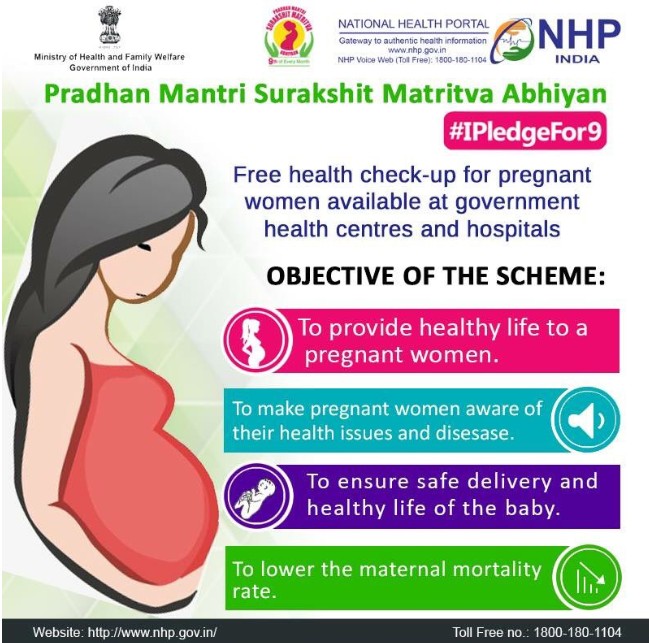
The Government of India recently marked 10 years of the Pradhan Mantri SurakshitMatritva Abhiyaan (PMSMA) under the theme “10 Years of PMSMA – A Decade of Care.” Launched on 9 June 2016, PMSMA is a flagship maternal healthcare initiative aimed at ensuring safe pregnancy, reducing maternal and neonatal mortality, and improving access to quality antenatal care.
About PMSMA
PMSMA provides free, comprehensive and specialist-led antenatal care (ANC) services to pregnant women, particularly during the second and third trimesters, at designated government health facilities on the 9th day of every month.
The programme focuses on:
- Early identification of high-risk pregnancies.
- Timely referral and intervention.
- Improved maternal and newborn health outcomes.
- Universal access to quality antenatal services.
Extended PMSMA
To strengthen maternal healthcare further, the government launched Extended PMSMA (E-PMSMA) in January 2022.
Under this initiative:
- High-Risk Pregnancies (HRPs) are identified and line-listed.
- Pregnant women are individually tracked up to 45 days after delivery.
- SMS-based monitoring and follow-up mechanisms are used.
- ASHA workers provide additional support and counselling.
Major Achievements
Over the last decade, PMSMA has emerged as one of the world's largest targeted antenatal care programmes:
- More than 7.5 crore antenatal check-ups conducted.
- Nearly 1.2 crore high-risk pregnancies identified.
- Improved early risk detection and referral systems.
Maternal and Child Health Outcomes
India has witnessed substantial improvements in maternal and child health indicators:
Maternal Mortality
- Maternal Mortality Ratio (MMR) declined from 130 per lakh live births (2014–16) to 87 per lakh live births (2022–24).
- India has achieved an 86% decline in maternal mortality since 1990, significantly higher than the global average decline of 48%.
Child Health
- Under-Five Mortality Rate declined by 79% since 1990.
- Neonatal mortality declined by 70% during the same period.
NFHS Indicators
According to recent National Family Health Survey (NFHS) data:
- Institutional deliveries: 90.6%
- Antenatal care coverage: 95.9%
- Women receiving at least four ANC visits: 65.2%
- First-trimester ANC registration: 76.2%
These improvements reflect stronger maternal healthcare systems and greater utilization of institutional health services.