
Global Forest Goals Report 2026
- 13 May 2026
In News:
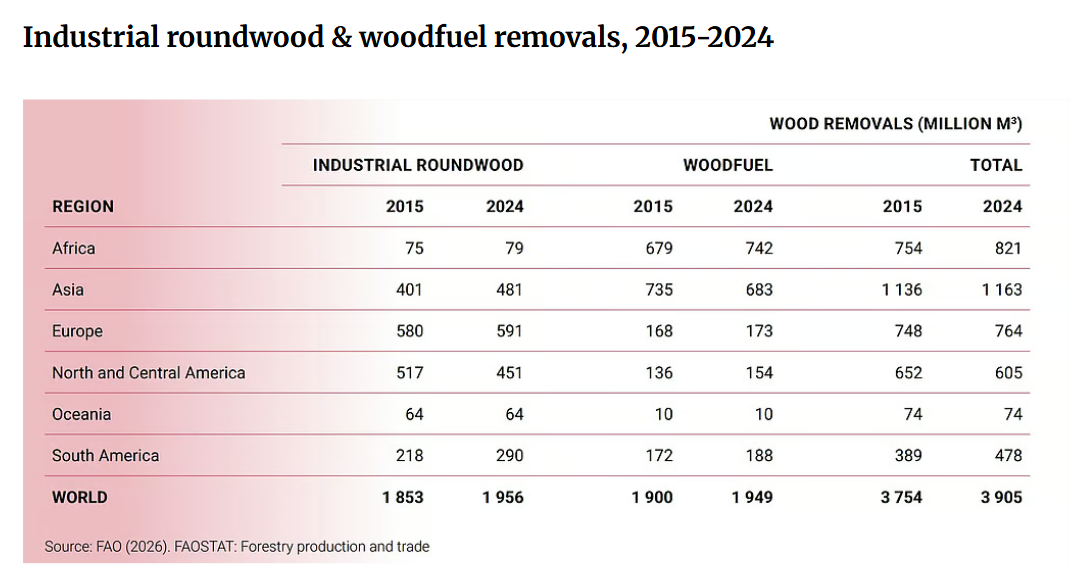
A landmark United Nations assessment, the Global Forest Goals Report 2026, has sounded a critical alarm regarding the state of the world’s terrestrial ecosystems. Prepared by the UN Department of Economic and Social Affairs (UNDESA) and the UN Forum on Forests Secretariat, the report highlights a shift in the drivers of environmental decline. While agricultural expansion remains the primary cause of deforestation, the rising demand for fuelwood and charcoal has emerged as a dominant driver of forest degradation, particularly across Africa and Asia.
The State of Global Forest Cover: 2015–2025
The report provides a sobering quantitative analysis of a decade of forest loss. Global forest cover has diminished from 4.18 billion hectares in 2015 to 4.14 billion hectares in 2025, representing a staggering net annual loss of 4.12 million hectares.
Perhaps most concerning is the fate of primary forests—undisturbed, biodiverse ecosystems that are essential for climate regulation. The world lost nearly 16 million hectares of primary forests in just ten years, with South America witnessing the most severe decline. This loss is irreversible in human timescales, as primary forests harbor unique genetic diversity and sequester significantly more carbon than secondary or plantation forests.
Emerging Drivers: The Fuelwood and Energy Poverty Nexus
While the conversion of forests for large-scale agriculture (industrial soy, palm oil, and cattle ranching) continues to lead in total deforestation, forest degradation—the thinning of forest density and health—is now increasingly driven by the energy needs of the poor.
- Sub-Saharan Africa and Asia: In these regions, a lack of access to clean cooking fuels (like LPG or electricity) forces millions to rely on wood and charcoal.
- The Vicious Cycle of Energy Poverty: Dependence on fuelwood creates a direct link between poverty and environmental decline. As forests are thinned for fuel, the ecosystem’s ability to provide services (water regulation, soil fertility) diminishes, further impoverishing the communities that depend on them.
- Charcoal Production: The report identifies charcoal as an especially destructive commodity, as its production is often inefficient and unregulated, leading to the rapid depletion of hardwood species.
Intensifying Environmental Pressures
The report stresses that forests are no longer just fighting human encroachment; they are also battling a changing climate. Abiotic and biotic stressors are accelerating degradation:
- Extreme Weather: Prolonged droughts and heatwaves are weakening tree resilience.
- Natural Disasters: An increase in the frequency and intensity of wildfires is turning forests from carbon sinks into carbon sources.
- Biological Threats: Rising temperatures have expanded the range of pests and diseases, devastating vast tracts of temperate and tropical forests alike.
The Restoration Gap: Pledges vs. Reality
A significant portion of the report is dedicated to the "Restoration Gap." While global awareness has led to ambitious pledges, implementation remains sluggish:
- The Deficit: 91 countries pledged to restore 190 million hectares of forest by 2025. However, only 44 million hectares—less than a quarter—have actually been restored.
- Asia as a Silver Lining: Asia has emerged as a global leader in forest recovery, accounting for the highest restoration performance. The region successfully restored over 31 million hectares, achieving 42.2% of its pledged area. This success is largely attributed to large-scale afforestation programs in countries like China and India.
National Technology Day 2026

- 13 May 2026
In News:
On May 11, 2026, India celebrated National Technology Day, marking the 28th anniversary of the historic Pokhran-II nuclear tests. Recalling the events of 1998, the Prime Minister described the tests as a defining symbol of India’s scientific excellence and strategic self-reliance. This day serves not only as a tribute to past achievements but as a roadmap for India’s technological trajectory toward becoming an Aatmanirbhar Bharat (Self-reliant India).
Historical Significance: Operation Shakti (1998)
National Technology Day commemorates Operation Shakti, conducted at the Pokhran Test Range in Rajasthan under the leadership of then-Prime Minister Atal Bihari Vajpayee and the technical guidance of Dr. APJ Abdul Kalam.
- The Nuclear Milestone: On May 11, 1998, India successfully conducted a series of five nuclear tests. This followed the 1974 Operation Smiling Buddha (Pokhran-I), officially establishing India as a nuclear-weapon state and reinforcing its strategic autonomy on the global stage.
- A Triple Triumph: The significance of May 11, 1998, extends beyond nuclear physics. On the same day, India achieved two other major milestones:
- The successful test-firing of the Trishul surface-to-air missile.
- The maiden flight of Hansa-3, India’s first indigenous composite aircraft.
- Institutionalization: Recognizing these multifaceted breakthroughs, May 11 was officially declared National Technology Day in 1999.
Theme 2026: Responsible Innovation for Inclusive Growth
The theme for 2026, “Responsible Innovation for Inclusive Growth,” reflects India’s current focus on balancing rapid technological advancement with ethical considerations and social equity. It underscores the vision that innovation must not only be cutting-edge but must also bridge the digital divide and reach the last mile of society.
The New Technological Frontier: Major Missions
India has transitioned from traditional strategic technology to emerging and disruptive fields. The government has launched several "Mission Mode" projects to secure leadership in the 4th Industrial Revolution:
- Strategic Missions: The National Quantum Mission and India Semiconductor Mission 2.0 aim to build indigenous capabilities in high-compute and hardware manufacturing, reducing dependence on global supply chains.
- Exploratory Missions: The Deep Ocean Mission is exploring the "Blue Economy," while the Anusandhan National Research Foundation (ANRF) has been established to provide a unified funding and regulatory framework for R&D across the country.
- Policy Support: The Vigyan Dhara Scheme and the National Mission on Interdisciplinary Cyber-Physical Systems are fostering a culture of research and interdisciplinary collaboration.
- Sector-Specific Innovations: Programs like iDEX (Innovation for Defence Excellence) and Biotech-KISAN are successfully bridging the gap between laboratories and the field, empowering both the defense sector and the farming community.
25 Years of Pradhan Mantri Gram Sadak Yojana
- 13 May 2026
In News:
The Union Ministry of Rural Development recently marked the Silver Jubilee of the Pradhan Mantri Gram Sadak Yojana (PMGSY) in Bhairunda, Madhya Pradesh. This milestone was distinguished by the national launch of PMGSY-IV, a strategic evolution of India’s flagship rural infrastructure program. Since its inception in 2000, PMGSY has transitioned from a basic connectivity project into a high-tech engine for socio-economic transformation, bridging the rural-urban divide and fostering a "Viksit Bharat."
The Evolution of a Rural Lifeline (2000–2024)
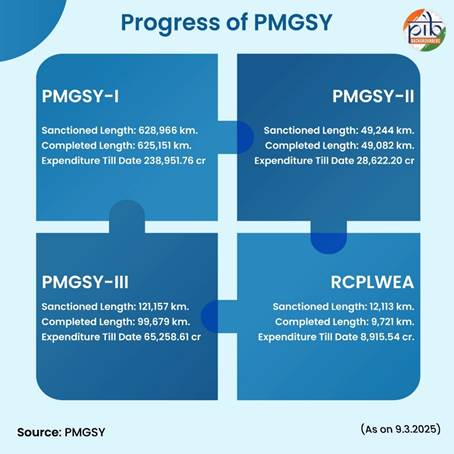
PMGSY began as a Centrally Sponsored Scheme to provide all-weather road connectivity to unconnected rural habitations. Over two and a half decades, its scope has expanded through distinct phases:
- Phase-I (2000): Focused on establishing the first link for previously isolated habitations.
- Phase-II (2013): Shifted the objective toward upgrading existing rural routes to streamline the movement of goods and people to service hubs.
- RCPLWEA (2016): A specialized vertical for 44 districts affected by Left Wing Extremism (LWE). By facilitating the mobility of security forces and integrating underserved populations, this initiative is a cornerstone in the goal to make India "Naxal-free" by March 2026.
- Phase-III (2019): Focused on "Through Routes" that link villages to critical social infrastructure like Gramin Agricultural Markets (GrAMs), hospitals, and schools. As of late 2025, over 80% of the 1,25,000 km target has been met.
PMGSY-IV (2024–2029): The Next Frontier
Launched with a financial outlay of ?70,125 crore, Phase IV aims to construct 62,500 km of roads to connect 25,000 remaining unconnected habitations.
New Connectivity Criteria
Eligibility for Phase IV is based on Census 2011 data:
- Plain Areas: Habitations with a population of 500 .
- NE & Himalayan States/UTs: Habitations with a population of 250 .
- Special Categories: Tribal (Schedule V) areas, Aspirational Districts/Blocks, and desert areas.
Convergence and Inclusion
PMGSY-IV is intricately linked with tribal development schemes such as PM-JANMAN and the Dharti Aaba Janjatiya Gram Utkarsh Abhiyan, ensuring that the most marginalized tribal settlements receive priority connectivity.
Digital Governance and Quality Assurance
The success of PMGSY is anchored in its rigorous Three-Tier Quality Control mechanism, which ensures that infrastructure is both durable and transparently built:
- First Tier: Internal quality control by state executing agencies.
- Second Tier: Monitoring by independent State Quality Monitors (SQM).
- Third Tier: Oversight by National Quality Monitors (NQM) under the National Rural Infrastructure Development Agency (NRIDA).
Technology acts as a force multiplier in this framework. The OMMAS (Online Management, Monitoring, and Accounting System) provides real-time tracking, while the e-MARG platform monitors maintenance during the 5-year Defect Liability Period, linking contractor payments directly to road performance. Furthermore, all alignments are now mapped via the PM Gati Shakti portal and the PMGSY Gram Sadak Survey App to prevent infrastructure overlap.
Green Technology and Sustainability
Aligning with global climate goals, PMGSY-IV mandates the use of "Green Technologies." As of mid-2025, over 1.24 lakh km of roads have been constructed using:
- Waste Utilization: Waste plastic, fly ash, and construction debris.
- Cold Mix Technology: Reduces the carbon footprint by eliminating the need to heat bitumen.
- Full Depth Reclamation (FDR): Recycles existing road base, reducing the need for stone aggregate mining.
- Bio-Engineering: Use of geosynthetics and cell-filled concrete to stabilize roads in flood-prone and mountainous terrains.
Jute Crop Information System
- 13 May 2026
In News:
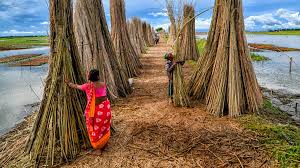
India’s jute sector, historically a cornerstone of the rural economy in the eastern states, is undergoing a profound digital transformation. Spearheaded by the National Jute Board (NJB), the implementation of the Jute Crop Information System (JCIS) marks a shift from fragmented, manual monitoring to a sophisticated, evidence-based technological framework.
Launched in 2023, JCIS is a collaborative endeavor involving the Indian Space Research Organisation (ISRO), the Jute Corporation of India (JCI), and the NJB. This platform addresses long-standing structural limitations in the sector by integrating space technology with ground-level intelligence.
The Technological Architecture: BHUVAN JUMP and PATSAN
The JCIS ecosystem is built upon two specialized digital pillars that synchronize field data with satellite observations:
- BHUVAN JUMP: A dedicated mobile application used by field personnel for on-ground monitoring. It facilitates the large-scale collection of geo-tagged field data, ensuring that every data point is linked to a specific geographic coordinate for scientific validation.
- PATSAN (Prospective Assessment of Jute Using Mobile App-Based Field Observations): A web-based analytics dashboard that serves as a command center for officials. It provides near real-time surveillance, vegetation indices, and crop-related assessments, enabling stakeholders to make data-driven policy decisions.
Addressing Structural Limitations
Before the introduction of JCIS, the jute industry faced several systemic challenges:
- Fragmented Estimates: Area and yield assessments were often based on manual, non-standardized reports, leading to inconsistencies and delayed responses.
- Data Silos: Satellite data, weather analytics, and field inputs operated independently, preventing a holistic view of crop health.
- Vulnerability to Disasters: A lack of real-time detection for floods and droughts resulted in significant crop and quality losses.
Key Features and Operational Impact
The JCIS framework has introduced a "Smart-Sampling" approach to agricultural management through several high-tech interventions:
- Geospatial Smart-Sampling: The system supports Crop Cutting Experiments (CCEs) by combining satellite-derived crop maps with robust statistical sampling. This has drastically improved the accuracy of yield estimation and production modeling.
- Flood Impact Modeling: Using satellite data and field validation, the NJB can now generate quantitative models to estimate yield and quality losses in flood-affected regions, facilitating objective insurance and relief assessments.
- Early Warning Systems: The integration of weather analytics allows the platform to issue district-level alerts regarding rainfall variations, dry spells, and temperature fluctuations, supporting proactive planning.
- I-CARE Field Network: Leveraging its extensive field network, the NJB has institutionalized the use of technology at the grassroots level, ensuring that the transition is not just top-down but deeply embedded in field operations.
National Mission for Sustainable Agriculture
- 13 May 2026
In News:
Under the updated framework of the National Mission for Sustainable Agriculture (NMSA), a transformative target has been set: bringing 100 lakh hectares under micro-irrigation over the five-year period from 2025-26 to 2029. This initiative underscores the critical shift from traditional irrigation to precision water management as a cornerstone of national food security.
Evolution and Institutional Framework
- Launched in 2014-15 as one of the eight missions under the National Action Plan on Climate Change (NAPCC), NMSA was designed to mitigate the adverse impacts of weather variability on Indian farming. Since the fiscal year 2022-23, the mission has been integrated into the umbrella scheme of Pradhan Mantri Rashtriya Krishi Vikas Yojana (PMRKVY).
- Operated by the Ministry of Agriculture and Farmers Welfare, the mission acts as a strategic intervention to ensure that agricultural productivity does not come at the cost of environmental degradation.
Strategic Interventions: The Four Pillars of NMSA
The mission employs a multi-pronged strategy to enhance water-use efficiency, improve soil health, and build climate-resilient farming systems:
1. Per Drop More Crop (PDMC): Precision in Water Management
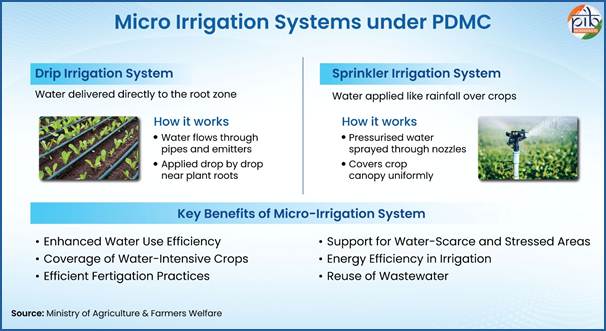
The PDMC initiative is the primary vehicle for achieving the newly set 100 lakh hectare target. By promoting micro-irrigation technologies—specifically drip and sprinkler systems—it aims to maximize crop productivity per unit of water used. This is vital for India, where agriculture consumes nearly 80% of the country’s freshwater resources.
2. Rainfed Area Development (RAD): Diversifying Risks
Recognizing that nearly 60% of India’s cultivated area is rainfed, RAD encourages Integrated Farming Systems (IFS). This approach integrates crops with livestock, fisheries, and horticulture, providing farmers with multiple income streams and a buffer against localized crop failures caused by erratic rainfall.
3. Soil Health Management (SHM): Sustaining the Foundation
Supported by the SHC Scheme, SHM focuses on the scientific testing of soil to promote balanced nutrient application. By discouraging the overuse of chemical fertilizers, it protects long-term soil fertility and reduces the input costs for small and marginal farmers.
4. Climate Change Monitoring and Networking (CCSAMMN)
The CCSAMMN component serves as the mission’s intellectual backbone. It facilitates a bidirectional flow of information: translating high-level scientific research into actionable data for farmers, while feeding grassroots field observations back to research establishments.