
Electronic Gold Receipt (EGR)

- 30 Jul 2026
In News:
India's Electronic Gold Receipt (EGR) ecosystem has gained attention as the SEBI-regulated Gold Exchange promotes transparent, standardized, and exchange-based trading of physical gold.
What is an Electronic Gold Receipt (EGR)?
- An Electronic Gold Receipt (EGR) is a SEBI-regulated electronic security that represents ownership of physical gold stored in SEBI-accredited vaults.
- Introduced under the Gold Exchange Framework (2022), EGRs enable investors to trade standardized physical gold electronically on recognized stock exchanges while retaining the option to convert them into physical gold whenever required.
- Unlike physical gold, EGRs are held in demat form, making ownership secure, transparent, and easily transferable. Every EGR is fully backed by an equivalent quantity and purity (995 or 999 fineness) of physical gold stored with a SEBI-registered Vault Manager.
Need for EGR
SEBI introduced the Gold Exchange Framework (2022) to address problems in India's fragmented bullion market such as:
- Lack of uniform purity standards
- Opaque pricing
- High transaction costs
- Dominance of the unorganised bullion trade
The framework seeks to establish a transparent national market for physical gold, improve price discovery, standardize quality, and strengthen investor protection.
How Does the EGR Ecosystem Work?
The EGR ecosystem functions through three stages:
- Creation: Eligible gold (995/999 purity) is deposited with a SEBI-registered Vault Manager, which verifies and stores the gold. The depository (NSDL/CDSL) then issues equivalent EGRs in the depositor's demat account.
- Trading: EGRs are traded electronically on recognized stock exchanges such as NSE and BSE, with ownership transferred on a T 1 settlement basis, while the physical gold remains safely stored in the vault.
- Redemption: Investors may convert EGRs into physical gold by placing a request through their broker or Depository Participant (DP). The Vault Manager delivers the gold and extinguishes the corresponding EGR.
Key Participants
- Vault Manager: Stores, assays, verifies and delivers physical gold.
- Depositories (NSDL/CDSL): Maintain EGRs in demat accounts.
- Stock Exchanges (NSE/BSE): Provide trading platform.
- Stock Brokers: Facilitate trading and redemption.
- Investors: Individuals, HUFs, NRIs, trusts and institutions.
Alanine Aminotransferase (ALT/SGPT)

- 30 Jul 2026
In News:
The Union Health Ministry has advised people to monitor Alanine Aminotransferase (ALT) levels as an early indicator of liver injury, highlighting the importance of routine liver health screening.
What is Alanine Aminotransferase (ALT)?
- Alanine Aminotransferase (ALT), also known as Serum Glutamic-Pyruvic Transaminase (SGPT), is an enzyme found mainly inside liver cells (hepatocytes), with smaller amounts present in muscles and the heart.
- It plays an important role in amino acid metabolism, helping convert amino acids into energy required for normal body functions.
- Normally, only small amounts of ALT circulate in the bloodstream. When liver cells are damaged due to inflammation, infection, or injury, ALT leaks into the blood, making it one of the earliest laboratory markers of liver injury.
Why is ALT Important?
ALT is a sensitive indicator of ongoing liver damage and forms an important part of the Liver Function Test (LFT). Elevated ALT levels may indicate liver disorders such as:
- Viral hepatitis (Hepatitis B & C)
- Metabolic Dysfunction-Associated Steatotic Liver Disease (MASLD)
- Alcohol-related liver disease
- Autoimmune hepatitis
- Drug-induced liver injury
However, raised ALT alone does not confirm liver disease, as the enzyme is also present in other tissues. Further clinical evaluation and investigations are required.
Limitations of ALT Testing
Although ALT is an important screening marker, normal ALT values do not rule out liver disease.
People with MASLD may have normal or only mildly elevated ALT despite significant liver damage. Similarly, in advanced liver cirrhosis, ALT levels may return to normal because very few healthy liver cells remain to release the enzyme.
Therefore, ALT should always be interpreted along with other liver function tests and clinical findings.
Who Should Undergo ALT Testing?
- ALT testing is performed through a simple blood test and is routinely included in comprehensive health check-ups.
- Annual testing is generally sufficient for healthy adults. More frequent monitoring is recommended for people with:Obesity, Diabetes, High cholesterol, Thyroid disorders, Viral hepatitis, Long-term medication use, Alcohol consumption, Family history of liver disease, and Sedentary lifestyle
Moken People (Sea Nomads)

- 30 Jul 2026
In News:
Scientists have confirmed that Moken sea nomad children living along the Andaman Sea possess exceptional underwater vision, enabling them to see underwater with nearly twice the clarity of other children by constricting their pupils through years of diving practice.
Who are the Moken People?
- The Moken are an indigenous sea nomadic community living along the Andaman Sea off the coasts of Thailand and Myanmar. Often referred to as "Sea Nomads" or "Sea Gypsies", they are among the last surviving sea-based nomadic communities in the world.
- Their name, in the Moken language, means "sea drowned." They have traditionally moved among nearly 800 islands in the Andaman Sea, following seasonal winds, tides, and marine resources.
Key Features
- The Moken traditionally live and travel in wooden boats called Kabang, relying on fishing, free diving, and shellfish collection for their livelihood.
- Children begin swimming and diving from an early age, developing exceptional underwater skills such as free diving, spear fishing, and reef navigation.
- The Moken speak an Austronesian language, a language family widely spoken across Southeast Asia and Oceania.
- Most Moken remain stateless, lacking citizenship in either Thailand or Myanmar, largely due to their traditional nomadic lifestyle.
Why are the Moken Famous?
- The Moken gained international recognition during the 2004 Indian Ocean Tsunami, when many community members survived after recognising natural warning signs such as the unusual retreat of seawater and moving to safer locations based on their traditional ecological knowledge.
- Their remarkable underwater vision is considered an adaptation developed through continuous exposure to the marine environment rather than a genetic trait.
Atmanirbhar Panchayat Programme & SAMARTH Panchayat Portal
- 30 Jul 2026
In News:
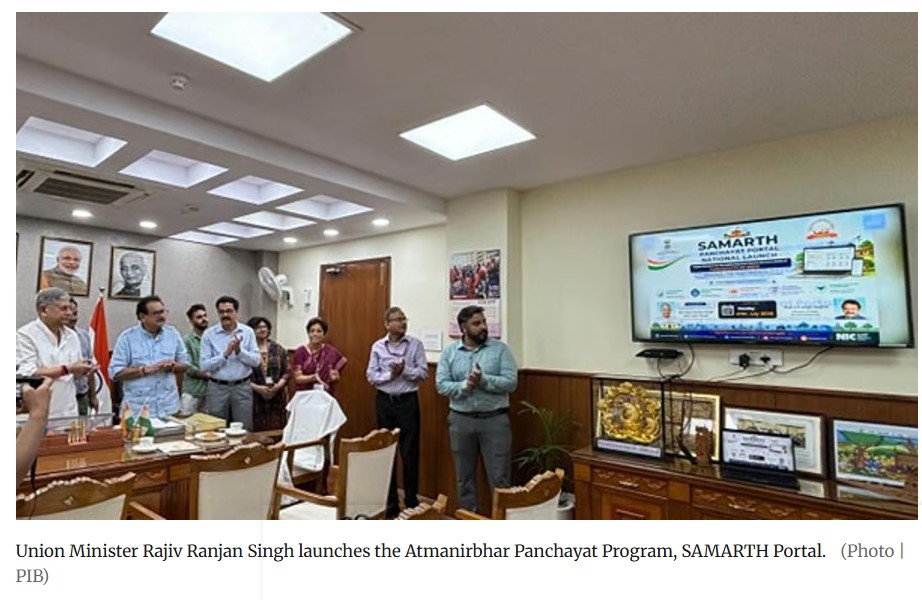
The Ministry of Panchayati Raj has launched the Atmanirbhar Panchayat Programme along with the SAMARTH Panchayat Portal to strengthen the financial autonomy of Panchayati Raj Institutions (PRIs) by enhancing their Own Source Revenue (OSR).
Atmanirbhar Panchayat Programme
- The Atmanirbhar Panchayat Programme is an initiative of the Ministry of Panchayati Raj under the Rashtriya Gram Swaraj Abhiyan (RGSA).
- It aims to help Gram Panchayats and Block Panchayats identify underutilised local assets and convert them into revenue-generating projects, thereby reducing dependence on Central and State grants.
Key Features
- The programme plans to develop 350 revenue-generating projects over four years, beginning with 50 projects in the first year, followed by 100 projects annually during the next three years.
- It is open to Gram Panchayats with a minimum annual Own Source Revenue (OSR) of ?50 lakh and Block Panchayats with at least ?1 crore OSR, subject to prescribed tenure conditions.
- The Ministry will provide technical assistance to prepare commercially viable project proposals and facilitate funding through Public-Private Partnerships (PPP), Corporate Social Responsibility (CSR), scheme convergence, and institutional bank credit.
SAMARTH Panchayat Portal
- The SAMARTH Panchayat Portal is a national digital platform designed for the end-to-end management of Own Source Revenue (OSR) of Gram Panchayats.
- It aims to digitise revenue administration, improve transparency, and enhance tax collection efficiency.
Key Features
- The portal manages the complete revenue cycle, including taxpayer registration, demand notice generation, online payment, receipt generation, and real-time revenue monitoring.
- It digitises various local revenue sources such as property tax, trade licences, user charges, and other non-tax revenues.
- The portal is already operational in Chhattisgarh and Himachal Pradesh, with over 51 lakh taxpayers registered, demand notices worth ?95 crore generated, and more than ?27 crore collected. Expansion is underway in Maharashtra, Mizoram, Assam, Haryana, West Bengal, and Uttar Pradesh.
Thane Creek Flamingo Sanctuary

- 30 Jul 2026
In News:
The Maharashtra Government has approved the development of a ?45-crore Eco-Nature Park at the Thane Creek Flamingo Sanctuary (TCFS), which will feature India's first Artificial Intelligence (AI)-powered bird detection and monitoring centre.
What is the AI-Based Monitoring System?
The sanctuary will deploy AI-enabled cameras and monitoring systems to automatically identify bird species, monitor migration patterns, and generate scientific data.
Using image and sound recognition, the system will analyse bird activity across a 1.5-km stretch, enabling real-time monitoring and improving biodiversity conservation and research.
About Thane Creek Flamingo Sanctuary
- The Thane Creek Flamingo Sanctuary (TCFS) is located between Mumbai and Navi Mumbai along the Thane Creek. It was declared a Wildlife Sanctuary in 2015 and is India's first dedicated flamingo sanctuary.
- The sanctuary is an important coastal wetland ecosystem, supporting thousands of migratory flamingos and over 200 species of birds, including herons, egrets, kingfishers, and shorebirds.
- It also lies along the Central Asian Flyway, an important migratory route connecting Europe, Central Asia, and the Indian subcontinent.
About Flamingos
Flamingos are large wading birds recognised by their long legs, long S-shaped neck, and distinctive pink plumage. They inhabit shallow wetlands, mudflats, salt pans, saline lagoons, and alkaline lakes, where they feed on algae, molluscs, and crustaceans.
Their pink or orange colouration is derived from carotenoid pigments present in their diet.
Globally, there are six species of flamingos, while India is home to two species:
- Greater Flamingo (Phoenicopterus roseus)
- Lesser Flamingo (Phoeniconaias minor)
Threats
Flamingo populations are threatened by wetland degradation, pollution, coastal development, human disturbance, and changes in water quality, all of which affect their feeding and breeding habitats.