
Hamburg Sustainability Conference (HSC) 2026

- 30 Jun 2026
In News:
The United Nations Sustainable Development Solutions Network (SDSN) released the Sustainable Development Report (SDR) 2026 during the Third Hamburg Sustainability Conference (HSC) 2026, where India improved its ranking to 94th in the global Sustainable Development Goals (SDG) Index.
About the Hamburg Sustainability Conference (HSC)
- The Hamburg Sustainability Conference (HSC) is an international multi-stakeholder platform that seeks to accelerate progress towards achieving the United Nations Sustainable Development Goals (SDGs) by fostering practical cooperation among governments, businesses, financial institutions, civil society, academia, and international organisations.
- The conference aims to strengthen partnerships between the Global North and the Global South, promote sustainable economic development, and build collaborative solutions to emerging global challenges such as climate change, digital transformation, geopolitical conflicts, and sustainable finance.
- The inaugural conference was held in October 2024, while the 2026 edition marks its third annual session.
- The theme of HSC 2026 is "Together we co-create sustainable development."
Major Focus Areas
The conference discussions are organised around three broad pillars:
- Resilient Economies, Technology and the Future of Our Planet, focusing on industrial decarbonisation, sustainable investments, responsible Artificial Intelligence, and digital transformation.
- Risk, Uncertainty and Conflict, addressing the impact of geopolitical tensions on global supply chains, food security, energy security, and critical minerals.
- Ensuring the Future of Human Collaboration, which seeks to strengthen multilateral cooperation and bridge the trust deficit between developed and developing countries.
Sustainable Development Report (SDR) 2026
- The Sustainable Development Report is published annually by the United Nations Sustainable Development Solutions Network (SDSN).
- It assesses countries' progress towards achieving the 17 Sustainable Development Goals (SDGs) adopted under the 2030 Agenda for Sustainable Development.
- The report ranks countries using the SDG Index, which measures performance across social, economic, and environmental indicators.
India's Performance
India has continued to improve its position in the SDG Index.
|
Year |
Global Rank |
|
2015 |
112 |
|
2025 |
99 |
|
2026 |
94 |
India's SDG Score in 2026 stands at 68.3 out of 100, reflecting an improvement of 18 positions since 2015.
Key Achievements
The report recognises India's progress in several areas, particularly:
- Expansion of rural electrification under SDG 7 (Affordable and Clean Energy).
- Rapid improvement in digital connectivity under SDG 9 (Industry, Innovation and Infrastructure).
- Overall improvement in SDG performance compared to many other emerging economies.
Major Challenges
Despite improvements, the report highlights that India continues to face significant developmental challenges.
Key concerns include:
- Only about 3% of SDG targets are currently on track for achievement by 2030.
- Rising levels of child wasting, stunting, and undernourishment, affecting progress under SDG 2 (Zero Hunger).
- Increasing adult obesity, indicating the growing burden of malnutrition in all its forms.
- Higher per capita carbon dioxide (CO?) emissions and continued deterioration in air quality, affecting progress under SDGs 13, 14, and 15.
- Declining scores on press freedom and institutional indicators, posing challenges under SDG 16 (Peace, Justice and Strong Institutions).
About the Sustainable Development Solutions Network (SDSN)
The United Nations Sustainable Development Solutions Network (SDSN) is a global initiative launched by the United Nations in 2012 to mobilise scientific expertise, academic institutions, businesses, and civil society in support of the implementation of the Sustainable Development Goals (SDGs) and the Paris Agreement on Climate Change.
The network promotes evidence-based policy solutions, publishes the annual Sustainable Development Report, and supports governments in designing strategies for sustainable development.
Murchison Widefield Array (MWA) & SMART Pulsar Survey

- 30 Jun 2026
In News:
Astronomers have recently discovered a new millisecond pulsar using the Murchison Widefield Array (MWA) as part of the ongoing Southern-sky MWA Rapid Two-metre (SMART) survey. The discovery is expected to enhance our understanding of neutron stars and support future radio astronomy missions.
About Murchison Widefield Array (MWA)
The Murchison Widefield Array (MWA) is a low-frequency radio telescope located at the Murchison Radio-astronomy Observatory (MRO) in Western Australia, which also hosts the future Square Kilometre Array-Low (SKA-Low).
It is an international collaboration involving 20 research institutions from Australia, Canada, China, Japan, and the United States, led by Curtin University, Australia.
The telescope consists of 4,096 spider-like antennas that operate in the 70–300 MHz frequency range. It is designed with a very wide field of view, high angular resolution, nanosecond time resolution, and digital pointing capability, enabling it to rapidly scan large portions of the sky and detect faint or short-lived cosmic phenomena.
Major Scientific Applications
The MWA is used to study a wide range of astrophysical phenomena, including:
- The Epoch of Reionization, when the first stars and galaxies formed.
- Structure and evolution of galaxies and galaxy clusters.
- The Sun and space weather, including solar flares and coronal mass ejections.
- Transient radio sources such as pulsars and Fast Radio Bursts (FRBs).
- The interstellar medium and cosmic magnetic fields.
Southern-sky MWA Rapid Two-metre (SMART) Survey
The SMART Survey is an ongoing pulsar search programme using the MWA to identify previously unknown pulsars in the Southern Hemisphere.
It is the only pulsar survey currently operating at low radio frequencies (140–170 MHz) in the Southern Hemisphere. Once completed, the survey is expected to discover hundreds of new pulsars and will provide an important reference database for future observations with the Square Kilometre Array (SKA-Low).
Square Kilometre Array (SKA)
The Square Kilometre Array (SKA) is an international project to build the world's largest and most sensitive radio telescope for exploring the universe.
The telescope is being developed across two continents:
- SKA-Low in Australia
- SKA-Mid in South Africa
Its operational headquarters are located in the United Kingdom, while construction officially commenced on 5 December 2022.
The SKA aims to investigate some of the most fundamental questions in astronomy, including the origin of the Universe, formation and evolution of galaxies, cosmic magnetism, and the search for extraterrestrial life.
India became a member of the SKA project in December 2022.
What are Pulsars?
Pulsars are rapidly rotating neutron stars that emit highly regular beams of electromagnetic radiation, primarily in the radio wavelength.
Neutron stars are extremely dense remnants formed after the gravitational collapse of massive stars during a supernova explosion. Although they possess masses between 1.18 and 1.97 times that of the Sun, they are only about 20 km in diameter, making them among the densest known objects in the Universe.
Pulsars possess extremely strong magnetic fields, which channel charged particles towards the magnetic poles, producing narrow beams of radiation. Since the magnetic axis is usually inclined relative to the rotational axis, these beams sweep across space like a lighthouse. When the beam points toward Earth, it is detected as a pulse of radiation.
The interval between successive pulses—ranging from milliseconds to several seconds—is known as the pulsar period.
LineShine Supercomputer

- 30 Jun 2026
In News:
China's LineShine supercomputer has topped the latest TOP500 rankings, replacing the United States' El Capitan as the world's fastest publicly ranked supercomputer. The achievement marks China's growing leadership in high-performance computing despite restrictions on advanced semiconductor technologies.
What is the TOP500 List?
The TOP500 is the globally accepted ranking of the world's most powerful supercomputers. Published twice every year since 1993, it evaluates supercomputers using the High Performance LINPACK (HPL) benchmark, which measures a system's ability to solve large-scale mathematical computations at high speed.
The ranking serves as the global benchmark for assessing advances in High-Performance Computing (HPC) and is widely used by governments, research institutions, and industry.
About LineShine
LineShine is located at the National Supercomputing Center, Shenzhen (China) and has achieved a computing performance of approximately 2.19 exaflops, enabling it to perform more than two quintillion (2 × 10¹?) calculations per second.
Its entry into the TOP500 expands the number of exascale supercomputers worldwide from four to five. It is also the first time that Asia, North America, and Europe simultaneously host publicly ranked exascale computing systems.
Key Features
One of LineShine's most distinctive features is that it operates entirely on general-purpose Central Processing Units (CPUs) without relying on Graphics Processing Units (GPUs). It is the first CPU-only supercomputer to exceed the two-exaflop performance mark, demonstrating the continued potential of CPU-based architectures for scientific computing.
The system also reflects the growing convergence of High-Performance Computing (HPC) and Artificial Intelligence (AI), enabling both traditional numerical simulations and AI-driven computational workloads on a single platform.
Applications
LineShine supports a wide range of advanced scientific and engineering applications, including:
- AI-assisted weather forecasting.
- Rainfall prediction across East Asia.
- Atomic-scale simulations of magnetic and advanced materials.
- Large-scale scientific modelling and engineering research.
- Artificial Intelligence and machine learning applications.
India's Shipbuilding Sector
- 30 Jun 2026
In News:
According to the United Nations Conference on Trade and Development (UNCTAD), India emerged as the world's largest ship recycling nation in 2025, achieving a key target under the Maritime India Vision (MIV) 2030 ahead of schedule. Simultaneously, growing cooperation with South Korea is expected to accelerate India's ambition of becoming a global shipbuilding hub.
Current Status of India's Shipbuilding Sector
India has made significant progress in ship recycling, increasing its global share from 30.1% in 2024 to 35.4% in 2025 by recycling 2.99 million Gross Tonnes (GT) of ships. Building on this success, the Government aims to transform India into a leading shipbuilding nation under the Maritime India Vision (MIV) 2030 and Maritime Amrit Kaal Vision 2047, with the target of becoming one of the world's top 10 shipbuilding nations by 2030 and top five by 2047.
Despite handling nearly 95% of India's trade volume through maritime transport, the country accounts for less than 1% of global shipbuilding output, highlighting the need for large-scale capacity expansion and technological advancement.
Government Initiatives
To strengthen the sector, the Government has introduced several policy measures:
- Shipbuilding Financial Assistance Scheme (SBFAS): Provides financial assistance ranging from 15% to 25% of vessel cost to improve the competitiveness of Indian shipyards.
- Shipbuilding Development Scheme (SbDS): Supports the establishment of greenfield shipbuilding clusters, modernisation of existing shipyards, and creation of an India Ship Technology Centre at the Indian Maritime University.
- Maritime Development Fund (MDF): A dedicated ?25,000 crore fund comprising the Maritime Investment Fund (MIF) and Interest Incentivisation Fund (IIF) to facilitate long-term financing.
- Ship-breaking Credit Note Scheme: Grants ship owners a credit equivalent to 40% of the scrap value of recycled ships, which can be utilised while constructing new ships in Indian shipyards.
- Green Tug Transition Programme (GTTP) and Harit Nauka Guidelines: Promote construction of environmentally sustainable vessels using alternative fuels such as LNG, hydrogen, methanol, and battery-electric propulsion.
India has also aligned its ship recycling industry with the Hong Kong International Convention for the Safe and Environmentally Sound Recycling of Ships through the Recycling of Ships Act, 2019.
India–South Korea Cooperation
South Korea, one of the world's leading shipbuilding nations, is expected to play a key role in India's maritime transformation.
Areas of collaboration include:
- Development of India's first mega greenfield shipyard at Thoothukudi under the India–Republic of Korea (ROK) Comprehensive Framework.
- Technology transfer in advanced ship design, automation, green propulsion, and construction of specialised vessels.
- Localisation of marine equipment manufacturing through the Korea Marine Equipment Association (KOMEA).
- Cooperation in naval shipbuilding under the Make in India initiative.
- Skill development and research partnerships involving the Indian Maritime University (IMU) and Korea Maritime & Ocean University (KMOU).
Challenges
Despite policy support, India's shipbuilding industry continues to face several structural challenges:
- High cost of capital and limited access to long-term finance.
- Heavy dependence on imported marine equipment and specialised shipbuilding-grade steel.
- Inadequate large dry docks and modern shipbuilding infrastructure.
- Weak domestic demand for Indian-built commercial vessels.
- Limited share in the global Maintenance, Repair and Operations (MRO) market.
- Shortage of skilled manpower in advanced marine engineering and green shipbuilding technologies.
- Regulatory delays and procedural bottlenecks affecting investment.
Way Forward
To emerge as a global shipbuilding hub, India needs to adopt an integrated cluster-based development model similar to South Korea's Ulsan model, linking shipyards with ancillary industries, research institutions, and training centres. Greater localisation of critical components, effective technology transfer through international partnerships, integration of ship recycling with domestic shipbuilding, promotion of green vessels, and strict implementation of the Right of First Refusal (RoFR) policy for Indian-built ships can significantly strengthen the sector. Expanding domestic shipbuilding capacity while leveraging India's leadership in ship recycling will help create a globally competitive and sustainable maritime ecosystem.
BRICS Space Cooperation
- 30 Jun 2026
In News:
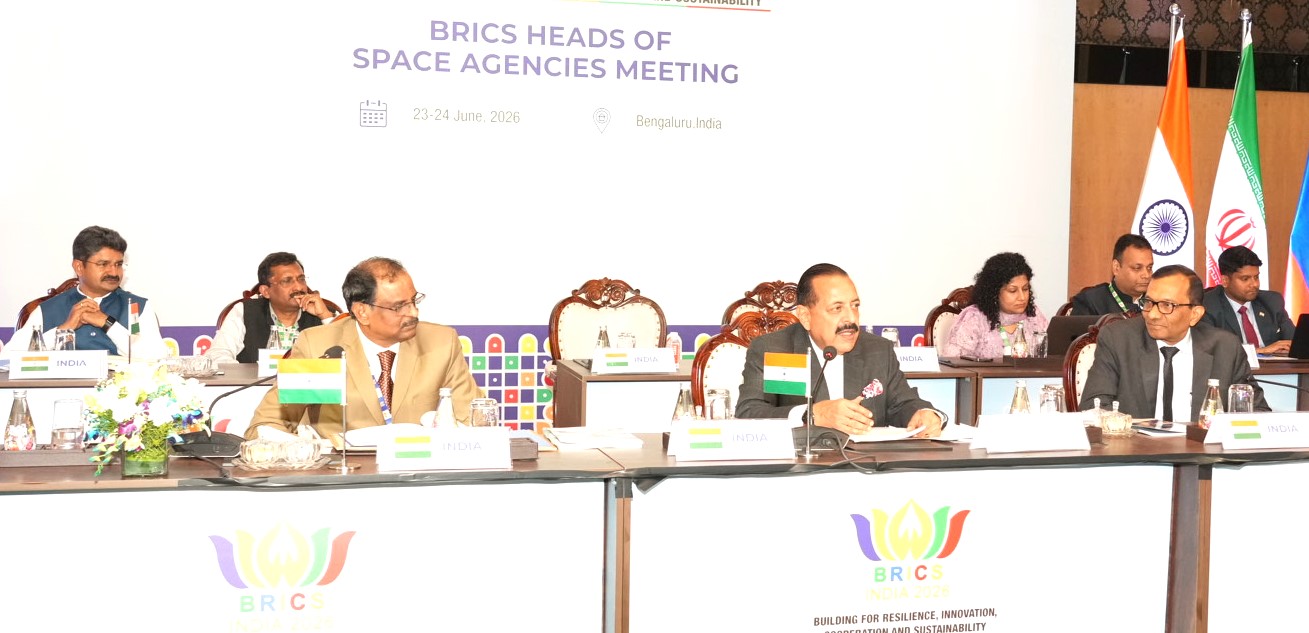
During the BRICS Heads of Space Agencies Meeting held in Bengaluru under India's BRICS Chairship 2026, the Union Minister of Earth Sciences proposed the concept of a "BRICS Space Economy", calling for deeper collaboration to make space a catalyst for innovation, entrepreneurship, investment, and sustainable development.
About the BRICS Heads of Space Agencies Meeting
The meeting was hosted by the Indian Space Research Organisation (ISRO) and brought together the heads of space agencies and senior officials from Brazil, China, Egypt, Ethiopia, India, Indonesia, Iran, Russia, South Africa, and the United Arab Emirates.
The primary objective was to review the progress of existing BRICS space cooperation and identify new avenues for harnessing space technology to address shared developmental and global challenges. The meeting reflected the growing importance of space diplomacy and scientific collaboration among emerging economies.
Key Areas of Discussion
The deliberations focused on strengthening cooperation in several priority areas, including:
- Space sustainability and responsible use of outer space.
- Development of debris-free and environmentally sustainable space missions.
- Expansion of the BRICS Remote Sensing Satellite Constellation.
- Greater participation of the newly inducted BRICS members in space initiatives.
- Establishment of a proposed BRICS Space Council to institutionalise long-term cooperation.
The member countries also explored opportunities for collaboration in disaster management, Earth observation, satellite data sharing, capacity building, scientific research, and knowledge exchange, with the aim of improving resilience against natural disasters and supporting sustainable development.
India's Space Ecosystem
During the meeting, India highlighted the rapid growth of its space sector, particularly the emergence of a vibrant NewSpace ecosystem driven by private industries and startups.
India also showcased several recent achievements, including:
- Chandrayaan-3, which successfully demonstrated a soft landing near the Moon's south polar region.
- Aditya-L1, India's first dedicated solar mission.
- Progress towards the Gaganyaan Mission, India's first human spaceflight programme.
These achievements underline India's growing capabilities in scientific research, space exploration, and commercial space activities.
What is the Proposed BRICS Space Economy?
The proposed BRICS Space Economy envisions moving beyond conventional cooperation towards joint innovation, co-development, and commercial collaboration among BRICS countries.
The initiative seeks to promote:
- Joint development of space technologies.
- Investment and entrepreneurship in the space sector.
- Sharing of satellite data and scientific expertise.
- Responsible and sustainable space operations.
- Stronger partnerships in emerging areas of the global space economy.
It also aims to create a collaborative framework where member countries can collectively leverage their technological strengths to enhance economic growth and address developmental challenges.