
UN Military Gender Advocate of the Year Award 2025
- 11 Jun 2026
In News:
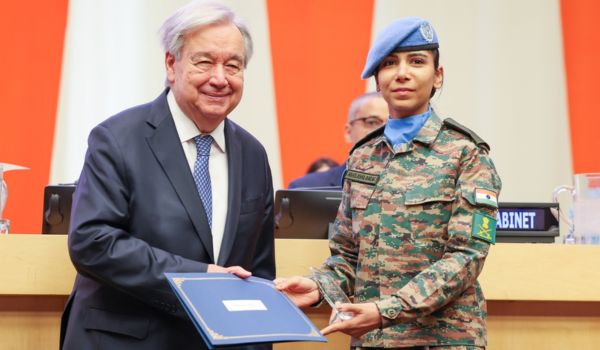
Recently, Major Abhilasha Barak of the Indian Army was conferred the prestigious United Nations Military Gender Advocate of the Year Award, becoming the third Indian peacekeeper to receive this global recognition.
About the Award
The UN Military Gender Advocate of the Year Award is an annual international honour instituted in 2016 by the United Nations Department of Peace Operations (DPO) through its Office of Military Affairs.
The award recognizes military peacekeepers who have made outstanding contributions to advancing the principles of United Nations Security Council Resolution 1325 (UNSCR 1325) on Women, Peace and Security.
It aims to promote the integration of gender perspectives into peacekeeping operations and ensure that the security, protection, and humanitarian needs of women and girls are adequately addressed in conflict zones.
Key Features
- Awarded annually to an individual military peacekeeper serving in UN missions.
- Candidates are nominated by Force Commanders and Heads of UN Peacekeeping Missions.
- Recognizes innovations such as:
- Gender-responsive peacekeeping.
- Mixed-gender patrols.
- Community engagement initiatives.
- Capacity-building and awareness programmes.
- Provides a global platform for sharing best practices in gender-sensitive peacekeeping.
Major Abhilasha Barak
Major Abhilasha Barak is an officer of the Indian Army currently serving with the United Nations Interim Force in Lebanon (UNIFIL).
She serves as:
- Engagement Team Commander, leading interactions with local communities.
- Gender Focal Point, acting as a bridge between UN military leadership and local women's groups.
Her contributions include:
- Addressing gender-specific security concerns.
- Improving outreach to women and vulnerable communities.
- Promoting inclusive community safety mechanisms.
- Strengthening humanitarian coordination and resource distribution.
Her work has helped enhance trust between local communities and UN peacekeepers in a sensitive conflict-affected region along the Blue Line between Lebanon and Israel.
Indian Recipients of the Award
India has emerged as a significant contributor to gender-responsive peacekeeping:
|
Year |
Awardee |
Mission |
|
2019 |
Major Suman Gawani |
UN Mission in South Sudan (UNMISS) |
|
2023 |
Major Radhika Sen |
UN Stabilization Mission in DR Congo (MONUSCO) |
|
2025 |
Major Abhilasha Barak |
UN Interim Force in Lebanon (UNIFIL) |
Ease of Doing Business
- 11 Jun 2026
In News:
India has undertaken a comprehensive transformation of its business and regulatory framework over the last decade, shifting from a compliance-heavy administrative system to a digital, trust-based and facilitation-oriented governance model.
Led by the Department for Promotion of Industry and Internal Trade (DPIIT) and supported by multiple ministries, these reforms aim to reduce compliance burdens, improve investor confidence, encourage entrepreneurship and enhance India's global competitiveness.
The reforms form a critical component of India's broader vision of building a Viksit Bharat by 2047 through digital governance, streamlined regulations, transparent administration and efficient service delivery.
India's Progress in Global Competitiveness
The impact of these reforms is reflected in India's improved performance across various global governance and competitiveness indicators.
- India's rank in the World Bank's Ease of Doing Business Index improved dramatically from 142nd in 2014 to 63rd in 2019, one of the fastest improvements globally. Similarly, India's ranking in the IMD World Competitiveness Ranking improved from 43rd in 2021 to 41st in 2025.
- The country has also been placed in the top-tier Group A category of the World Bank's GovTech Maturity Index in 2020, 2022 and 2025, reflecting significant progress in digital governance. Furthermore, the UN E-Government Survey has recognized India's strong performance in online public services, telecommunications infrastructure and human capital.
Simplifying Business Entry and Formalisation
A major focus of reforms has been reducing barriers to starting and operating businesses.
Startup India
- The Startup India initiative has significantly expanded India's startup ecosystem. The number of recognized startups increased from 502 in 2016 to more than 2.23 lakh in 2026, generating over 23.3 lakh jobs.
- Notably, nearly 48% of recognized startups have at least one woman director or partner, highlighting increasing inclusivity.
SPICe and MCA21
- The SPICe (Simplified Proforma for Incorporating Company Electronically Plus) system integrated ten separate incorporation procedures into a single online application, significantly reducing the time and cost involved in starting a business.
- The MCA21 Version 3.0 platform processed 3.84 crore filings between 2021 and 2025, with most approvals granted through Straight Through Processing (STP), reducing human intervention and delays.
Udyam Registration Portal
- Launched in 2020, the Udyam Portal provides a free, paperless, self-declaration-based registration system for MSMEs.
- Monthly registrations increased from about 10,000 in 2020 to over 8.58 lakh in 2026, promoting formalisation and improving access to government support.
Land and Property Reforms
- Land administration has traditionally been one of the most challenging aspects of doing business in India. Significant reforms have therefore focused on digitisation and transparency.
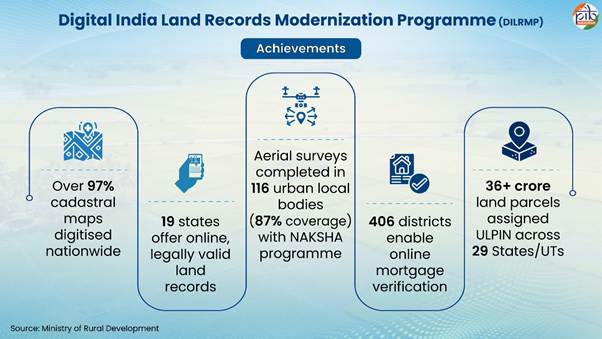
Digital India Land Records Modernization Programme (DILRMP)
- The Digital India Land Records Modernization Programme (DILRMP) has digitized 97.37% of cadastral maps and assigned Unique Land Parcel Identification Numbers (ULPINs) to more than 36 crore land parcels.
- ULPIN is often referred to as the "Aadhaar for Land" because it provides a unique identity to each land parcel, reducing disputes and improving transparency.
National Generic Document Registration System (NGDRS)
- The NGDRS seeks to standardize and digitize property registration processes across states. However, implementation remains uneven and is currently limited to a relatively small number of States and Union Territories.
Single-Window Clearances and Regulatory Simplification
National Single Window System (NSWS)
The National Single Window System (NSWS) acts as a unified digital platform for investors by integrating approvals from:
- 32 Central Ministries and Departments
- 34 States and Union Territories
The system has facilitated more than 8.29 lakh approvals and clearances, significantly reducing procedural complexity.
PARIVESH 2.0
The PARIVESH platform has transformed environmental clearances through digital processing and monitoring. Clearance timelines have reportedly been reduced to approximately 64 days, improving project execution while maintaining environmental safeguards.
Strengthening Market Access and Logistics
Government e-Marketplace (GeM)
The Government e-Marketplace (GeM) has revolutionized public procurement by creating a transparent digital marketplace for government purchases.
Key achievements include:
- Cumulative procurement exceeding ?18.4 lakh crore
- Procurement worth nearly ?5 lakh crore in FY 2025–26
- Around 68% of orders sourced from Micro and Small Enterprises (MSEs)
PM Gati Shakti
- The PM Gati Shakti National Master Plan integrates planning across 58 ministries and all States and Union Territories through over 3,199 GIS layers.
- The platform has evaluated 352 infrastructure projects worth approximately ?16.1 lakh crore, promoting integrated infrastructure development and reducing logistics costs.
Logistics Performance
- India's rank in the World Bank Logistics Performance Index improved from 54th in 2014 to 38th in 2023.
- The Logistics Data Bank (LDB) 2.0 now tracks nearly 100% of EXIM containers, covering around 95 million container movements, thereby improving supply chain visibility and efficiency.
Expanding Credit Access and Digital Financial Infrastructure
Credit Support to MSMEs
- The Credit Guarantee Fund Trust for Micro and Small Enterprises (CGTMSE) has extended guarantees worth approximately ?9.34 lakh crore, supporting easier access to credit for MSMEs.
- Under the Pradhan Mantri Mudra Yojana (PMMY), more than 57 crore loans amounting to ?40.07 lakh crore have been sanctioned since 2015.
- Importantly, women account for nearly 60% of Mudra loan beneficiaries, highlighting the scheme's role in promoting financial inclusion.
UPI Revolution
- India's digital payments ecosystem has witnessed unprecedented growth through Unified Payments Interface (UPI).
- Transactions increased from around 2 crore in FY 2016–17 to over 24,162 crore transactions in FY 2025–26, with a transaction value exceeding ?314 lakh crore, making UPI the world's largest real-time payment system.
GST Reforms
The implementation of Goods and Services Tax (GST) has simplified indirect taxation by creating a unified national market.
Key indicators include:
- GST taxpayer base increasing from about 60 lakh to 1.64 crore
- Processing of ?107.64 lakh crore in tax payments
- Generation of 188.27 crore e-Way Bills in FY 2025–26
Emerging Reforms and Open Digital Commerce
India has also focused on reducing compliance burdens through trust-based governance.
Labour Reforms
The Labour Codes introduced:
- Risk-based inspections
- Randomized web-based allocation of inspections
- Transformation of inspectors into Inspector-cum-Facilitators
These measures seek to reduce discretionary powers and improve compliance support.
Consent to Operate Reforms
Revisions to industrial consent guidelines have made the Consent to Operate (CTO) valid until cancelled in many cases, eliminating the burden of repeated renewals.
Open Network for Digital Commerce (ONDC)
The Open Network for Digital Commerce (ONDC) is democratizing e-commerce by reducing platform monopolies.
The network has onboarded:
- Over 7.64 lakh sellers
- Across more than 616 cities
This has improved market access for small retailers and MSMEs.
Challenges Ahead
Despite substantial progress, several challenges remain:
- Uneven implementation of reforms across States and districts.
- Delays in insolvency resolution due to tribunal bottlenecks.
- Legacy land record discrepancies affecting property transactions.
- Digital literacy and language barriers for rural enterprises.
- Variations in local-level administrative capacity.
These issues continue to affect the uniform implementation of reforms across the country.
Way Forward
Further improvements can be achieved through:
- Faster disposal of insolvency cases under the Insolvency and Bankruptcy framework.
- Expansion of the District Business Reform Action Plan (D-BRAP).
- Wider adoption of Trade Receivables Discounting System (TReDS) to improve MSME liquidity.
- Continued decriminalization of minor business offences under the Jan Vishwas Act framework.
- Strengthening export promotion initiatives and integration into global value chains.
Project 18 (P-18)

- 11 Jun 2026
In News:
India's Project 18 (P-18) is the Indian Navy's proposed Next-Generation Destroyer (NGD)programme, envisioned as the successor to the Visakhapatnam-class destroyer. The project aims to develop some of the most powerful and technologically advanced surface combatants ever built in India, significantly enhancing the Navy's blue-water capabilities.
About the Programme
The programme is being overseen by the Indian Navy's Warship Design Bureau (WDB) in collaboration with Mazagon Dock Shipbuilders Limited (MDL) and Garden Reach Shipbuilders & Engineers (GRSE).
The P-18 class is envisaged as a fleet of multi-role stealth destroyers capable of undertaking air defence, anti-surface, anti-submarine, and land-attack missions.
Key Features
With an estimated displacement of over 13,000 tonnes, Project 18 ships will be among the largest warships ever operated by India. Since warships exceeding 10,000 tonnes are generally classified as cruisers, Project 18 could effectively mark India's entry into the cruiser-class category.
The vessels are expected to feature:
- Advanced Integrated Electric Propulsion (IEP) powered by gas turbines and diesel generators.
- Extensive automation, reducing crew requirements by 25–30% compared to existing destroyers.
- Advanced stealth features and network-centric warfare capabilities.
Advanced Weapon Systems
Each vessel is expected to be equipped with 114 Vertical Launch System (VLS) cells, capable of deploying a diverse range of indigenous missile systems, including:
- BrahMos and BrahMos Next Generation
- Long-Range Land Attack Cruise Missiles (LR-LACM)
- Precision-Guided Long-Range Surface-to-Air Missiles (PGLRSAM)
- Short-Range Surface-to-Air Missiles (SRSAM)
- SMART anti-submarine weapon system
Future Warfare Capabilities
Project 18 is being designed with emerging warfare requirements in mind. The ships are expected to operate:
- Unmanned Underwater Vehicles (UUVs)
- Kamikaze/loitering drones
- Advanced anti-submarine systems
- Mine-detection and surveillance platforms
The destroyers are also expected to be equipped with next-generation radar systems capable of 360-degree surveillance and detection of threats up to 500 km away.
India Showcases Carbon Credit Trading Scheme (CCTS) at WTO Trade and Environment Week 2026
- 11 Jun 2026
In News:
On World Environment Day 2026, India showcased its Carbon Credit Trading Scheme (CCTS) and renewable energy standardization efforts at the WTO Trade and Environment Week in Geneva. The event highlighted India's progress towards a low-carbon economy, clean energy transition, and achievement of its Nationally Determined Contributions (NDCs) under the Paris Agreement.
India's Climate Achievements
India emphasized that its climate strategy is guided by the principles of Equity and Common but Differentiated Responsibilities and Respective Capabilities (CBDR-RC) under the UNFCCC framework.
Notably, India has achieved key climate targets ahead of schedule:
- Non-fossil fuel-based installed power capacity reached 53.21% in March 2026, surpassing the NDC target of 50% by 2030.
- Emissions intensity of GDP declined by 37.38% between 2005 and 2022, exceeding the target of 33–35% reduction by 2030.
Carbon Credit Trading Scheme (CCTS)
- The Carbon Credit Trading Scheme (CCTS) forms the foundation of India's Indian Carbon Market (ICM). It was notified by the Ministry of Power in 2023 under the Energy Conservation Act, 2001.
- The scheme seeks to establish a national electronic carbon credit trading platform and promote market-based mechanisms for reducing greenhouse gas emissions.
Key Features
- Operates on a Cap-and-Trade Model.
- Entities exceeding prescribed emission reduction targets earn Carbon Credit Certificates (CCCs).
- 1 Carbon Credit Certificate = 1 tonne of CO? equivalent emissions reduced or avoided.
- Includes both compliance and offset mechanisms.
Institutional Framework
- Administrator: Bureau of Energy Efficiency (BEE)
- Market Regulator: Central Electricity Regulatory Commission (CERC)
- Registry: Grid Controller of India Limited (GRID-INDIA)
Green Hydrogen Standardisation
India also showcased progress under the National Green Hydrogen Mission, highlighting the notified emission thresholds and technical criteria for classifying hydrogen as "Green Hydrogen."
These standards aim to:
- Ensure transparency and credibility.
- Provide certainty for investors and producers.
- Support the development of a robust green hydrogen ecosystem.
Land Port Management System
- 11 Jun 2026
In News:
The Union Home Minister launched the Land Port Management System (LPMS) on 9 June 2026 as a major step towards technology-enabled smart border management, trade facilitation, and secure cross-border movement of goods and passengers.
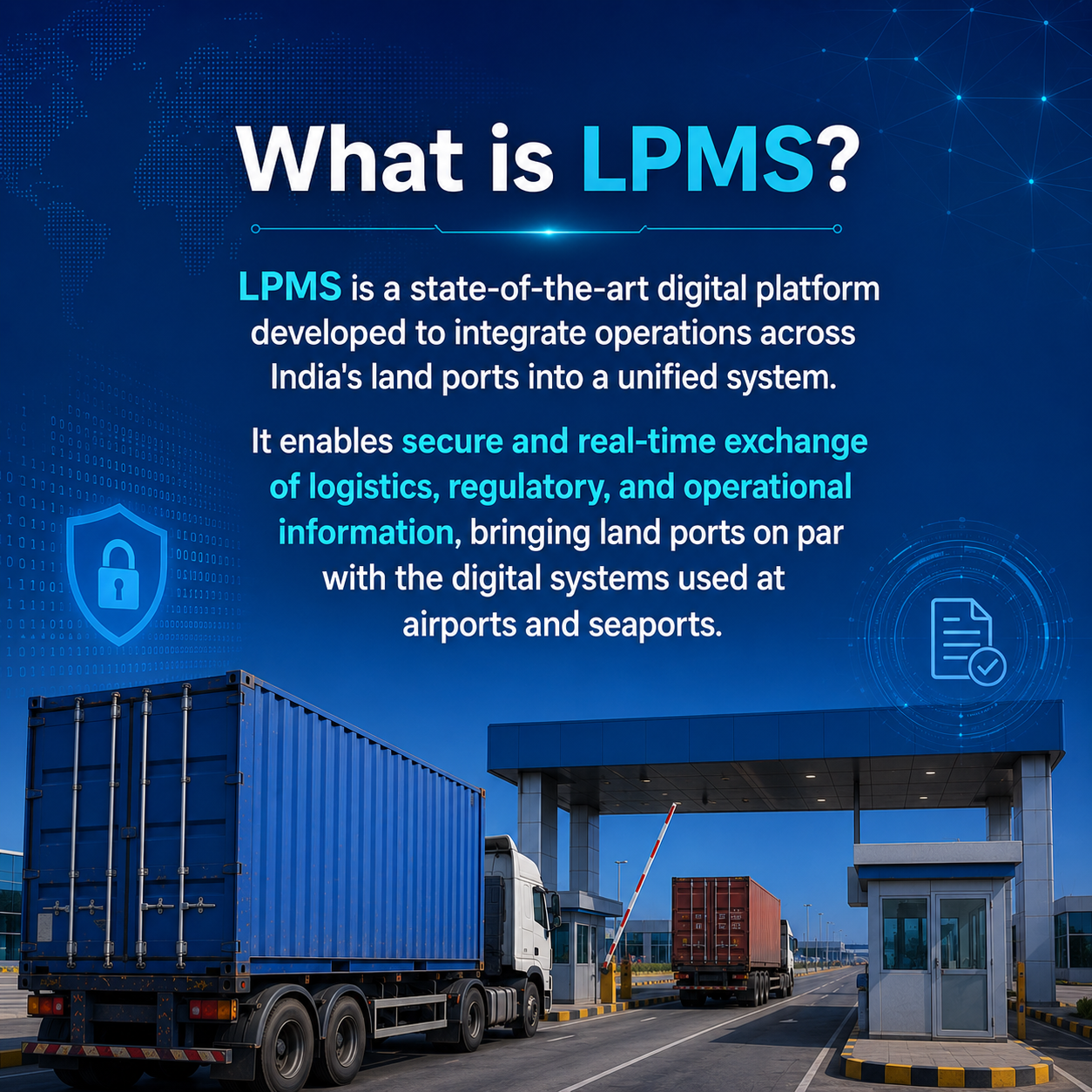
What is LPMS?
LPMS is a state-of-the-art digital platform developed to integrate operations across India's land ports into a unified system. It enables secure and real-time exchange of logistics, regulatory, and operational information, bringing land ports on par with the digital systems used at airports and seaports.
Key Features
- Provides end-to-end digital processing of cargo and passenger movement.
- Enables:
- Slot booking
- Online payments
- Cargo tracking
- Single-window clearances
- Facilitates seamless coordination among government agencies and private stakeholders.
- Reduces delays, improves transparency, and enhances operational efficiency.
- Integrated with major national digital platforms such as:
- ICEGATE (Indian Customs Electronic Gateway)
- ULIP (Unified Logistics Interface Platform)
- Motor Vehicle Ecosystem
Significance
LPMS is expected to:
- Strengthen border security and surveillance.
- Improve ease of cross-border trade.
- Enhance transparency and efficiency in border operations.
- Support regional connectivity and economic integration.
- Contribute to the vision of Viksit Bharat 2047 through smart infrastructure and digital governance.
Land Ports Authority of India (LPAI)
The Land Ports Authority of India (LPAI) is a statutory body under the Department of Border Management, Ministry of Home Affairs.
Functions
- Develops and manages Integrated Check Posts (Land Ports).
- Facilitates trade, passenger movement, connectivity, and regional cooperation across India's international borders.
Present Coverage
LPAI currently operates 15 land ports along India's borders with:
- Pakistan
- Nepal
- Bhutan
- Bangladesh
- Myanmar