
Aspero
- 22 Apr 2026
In News:
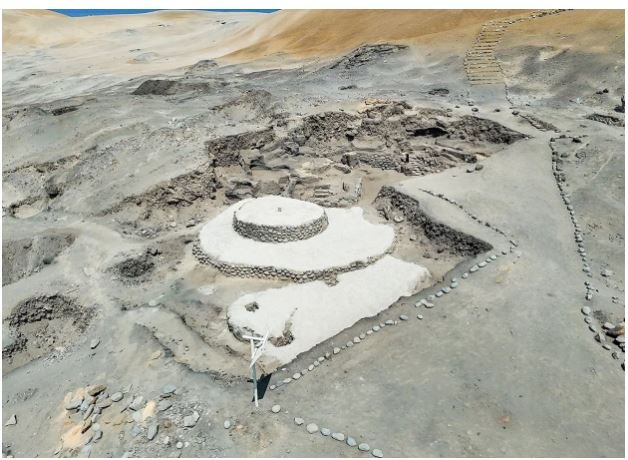
In a landmark finding for pre-Columbian history, archaeologists in Peru have recently uncovered an architectural structure at Áspero specifically designed for celestial observation. This discovery provides unprecedented insight into the early scientific prowess of the Caral Civilization (Norte Chico), one of the oldest known urban societies in the Americas.
The Maritime Capital of Caral
Áspero serves as a coastal counterpart to the Sacred City of Caral. Located on the right bank of the Supe River, just 500 meters from the Pacific Ocean, it functioned as the primary fishing and marine supply hub for the inland urban centers of the Supe Valley.
- Timeline: Occupied during the Late Archaic (Preceramic) period, approximately 3000 BC to 1800 BC.
- Civilizational Link: It is a key site of the Norte Chico/Caral-Supe civilization, characterized by its monumental architecture without the use of ceramics.
- Social Complexity: The site features 25 architectural complexes, including platform mounds and sunken circular plazas, reflecting a highly organized society capable of large-scale cooperative labor.
The Discovery: An Ancient Observatory
The newly identified structure, located in Sector J1, represents a specialized "astronomical center." This find confirms that the inhabitants of Áspero were not just expert fishers but also early scientists who mastered the observation of natural cycles.
Key Features of the Structure:
- Strategic Positioning: The observatory is situated near the settlement's main pyramid buildings. From this elevated vantage point, there is a clear, unobstructed view of both the coastline and the lower Supe Valley.
- Dual-Level Design: Unlike similar astronomical markers found in inland Caral, the Áspero observatory is a two-level structure. Researchers suggest this design was specifically tailored to its coastal location to monitor maritime and riverine phenomena simultaneously.
- The Shadow Effect: Constructed using rounded stones and pebbles bound with clay, the structure was engineered to cast specific shadows on its surfaces. By tracking these shadows, the ancient inhabitants could determine the cycles and movements of the sun, moon, and stars.
Functional Significance: Science in Service of Survival
The ability to "read the sky" was not merely a ritualistic endeavor; it was a critical tool for sustainable environmental management:
- Predicting Tides: Precise astronomical knowledge allowed the Caral people to predict tide changes, essential for their primary industry—fishing and shellfish gathering.
- Climate and Agriculture: While Áspero was maritime-focused, it engaged in intensive trade with agricultural inland sites. Monitoring celestial cycles helped predict El Niño events and the seasonal drying of the Supe River (which occurs between April and November), facilitating food security through exchange.
- Ritual and Governance: Such scientific knowledge likely reinforced the authority of the elite. Notable finds like the Lady of the Four Tupus and high-status child burials indicate a stratified society where "knowledge-keepers" held significant power.
Global and Comparative Significance
The discovery at Áspero challenges the notion that complex science only followed the advent of agriculture. It supports the "Maritime Foundations of Andean Culture" theory, suggesting that abundant marine resources provided the caloric surplus necessary to support a class of people dedicated to architecture, trade, and astronomy.
- Comparative Link: This observatory mirrors structures in the Sacred City of Caral, proving a unified civilizational knowledge system across the Supe Valley.
- Advanced Urbanism: The presence of such specialized scientific infrastructure 5,000 years ago places the Caral Civilization on par with the early civilizations of Mesopotamia, Egypt, and the Indus Valley.
Stauranthera aureoglossa
- 22 Apr 2026
In News:
In a significant contribution to India’s botanical diversity, a team of researchers has identified a new plant species, Stauranthera aureoglossa, within the pristine but fragile ecosystems of the Eastern Himalayas. This discovery underscores the role of Arunachal Pradesh as a global biodiversity hotspot and highlights the urgent need for conservation in the face of infrastructure expansion.
Botanical Profile and Identification
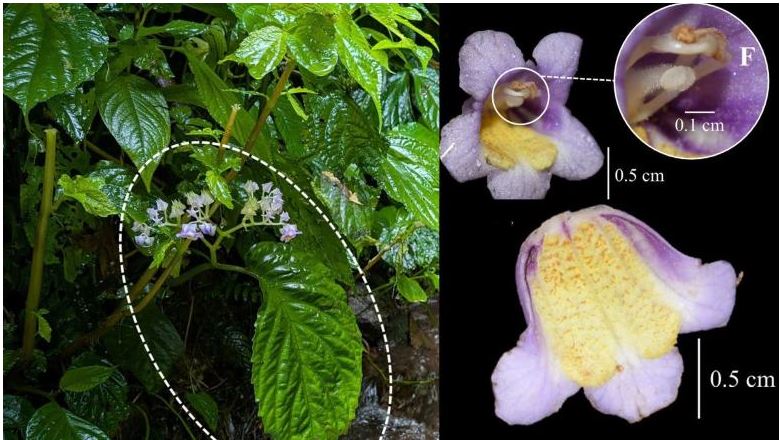
Stauranthera aureoglossa is a perennial herb belonging to the family Gesneriaceae. It was specifically located in the mid-elevation evergreen forests of the Kamle and Upper Subansiri districts of Arunachal Pradesh.
- Habitat and Ecology: The species is highly specialized, thriving in shaded, humid environments. It is typically found clinging to damp rocks and soil in the immediate vicinity of perennial streams and rivulets.
- Morphological Features: The plant is characterized by its diamond-shaped or spear-shaped leaves. Unlike its closest relatives, its flower is uniquely bell-shaped with a bluish-purple hue.
- The ‘Golden Tongue’: The defining feature of this species—and the inspiration for its name—is the absence of a basal "spur" (a tubular projection) found in similar plants. Instead, it possesses a prominent raised, bumpy, yellow patch on the internal lower lip of its petals.
- Etymology: The specific epithet "aureoglossa" is derived from Latin, where aureo (golden) and glossa (tongue) refer to this distinct yellow appendage.
Ecological Significance and Conservation Status
The discovery of Stauranthera aureoglossa is a reminder of the "taxonomic gap" in the Eastern Himalayas, where many species remain unknown to science. However, the joy of discovery is tempered by the immediate threats facing its habitat.
- Endangered Status: Due to its extremely limited geographical range and the specific nature of its habitat, scientists have provisionally classified the species as Endangered.
- Threats to Habitat: The streamside niches where this herb thrives are under immense pressure from:
- Infrastructure Development: Road-widening projects in the border state often lead to debris being dumped into stream beds.
- Deforestation: Logging activities disrupt the canopy cover, altering the micro-climate required for these moisture-loving plants.
- Natural Disasters: The region is prone to landslides, which are often exacerbated by the aforementioned human activities, leading to the destruction of fragile populations.
Vishwa Sutra Initiative

- 22 Apr 2026
In News:
In a significant stride toward elevating India’s traditional craftsmanship, the Ministry of Textiles recently launched the ‘Vishwa Sutra – Weaves of India for the World’ initiative. Orchestrated by the Office of the Development Commissioner (Handlooms) in partnership with the National Institute of Fashion Technology (NIFT), this program seeks to bridge the gap between ancient heritage and modern international aesthetics.
The Core Vision: Globalizing Tradition
The "Vishwa Sutra" initiative is designed to place Indian handlooms within a contemporary global design framework. Rather than viewing handlooms as static relics of the past, the project treats them as dynamic canvases capable of resonating with international consumers.
- Diverse Representation: The initiative brings together 30 distinct handloom weaves, each curated to represent a specific Indian state.
- Cultural Fusion: Each of these 30 weaves has been creatively reinterpreted using design inspirations from 30 different countries. This cross-cultural dialogue blends traditional Indian techniques with global fashion sensibilities.
Notable Cross-Cultural Reinterpretations:
- Odisha Ikat: Reimagined through the lens of Greek geometric forms.
- Kanchipuram (Tamil Nadu): Infused with Norwegian minimalist lines.
- Muga Silk (Assam): Integrated with structural Egyptian elements.
- Patola (Gujarat): Reinterpreted with vibrant Spanish influences.
- Banarasi (Uttar Pradesh): Designed into UAE-inspired ensembles.
Strategic and Economic Significance
1. The 5F Framework: Vishwa Sutra acts as a practical implementation of the government’s 5F Vision:
- Farm (Cotton/Silk cultivation) Fibre(Spinning) Factory(Weaving) Fashion(Design) Foreign (Export).
This linear progression ensures that the benefits of global demand reach the primary producers—the weavers—strengthening the rural economy.
2. From "Vocal for Local" to "Local to Global": The initiative marks a transition in the government's industrial policy. By making traditional industries globally competitive, it aims to increase India's share in the global textile market, which is currently dominated by mass-produced fast fashion.
3. Preservation of Intangible Heritage: By providing a modern market for traditional techniques, the initiative ensures the survival of skills that have been refined over generations. It provides a financial incentive for the younger generation of weaver communities to continue their ancestral crafts.
R-37M Missile

- 22 Apr 2026
In News:
In a major strategic recalibration following the air combat lessons of 2025, Russia has officially greenlit the export of the R-37M (AA-13 Axehead) ultra-long-range air-to-air missile to India. Valued at approximately $1.2 billion for nearly 300 missiles, this deal is designed to restore the "Beyond Visual Range" (BVR) edge for the Indian Air Force (IAF) against the growing influence of Chinese-made missile systems in the region.
The Strategic Context: Operation Sindoor (2025)
- The urgency of the R-37M acquisition stems from the aftermath of Operation Sindoor (May 2025). Triggered by a terror attack in Pahalgam, the operation involved high-intensity air skirmishes where the IAF encountered Pakistani J-10C fighters armed with Chinese-origin PL-15 missiles.
- Reports from the clash suggested that the PL-15's range created a "technological gap," allowing adversary aircraft to threaten Indian fighters before they could return fire. To counter this, and the even more formidable PL-17 (range ~400 km) deployed by China, India has opted for the R-37M as a vital interim stabilizer while domestic programs like Astra Mk-2 and Mk-3 move toward operationalization.
The "AWACS Killer": Technical Specifications
The R-37M is not a standard dogfight missile; it is a specialist weapon designed for long-range air denial.
- Hypersonic Speed: It is the world’s fastest air-to-air missile in its class, reaching speeds of Mach 6. This velocity is critical for intercepting fast-moving jets and high-value assets.
- Massive Engagement Range: With a range of 300 to 400 kilometers, it enables the IAF to strike from deep within its own territory.
- Trajectory Profile: The missile employs a lofted trajectory, climbing into the thinner atmosphere before diving onto its target. This conserves kinetic energy and maximizes the "No-Escape Zone" for the enemy.
- The Target Profile: Its primary role is that of an "AWACS Killer." It targets high-value enablers such as Airborne Warning and Control Systems (AWACS), refueling tankers, and jamming aircraft, effectively "blinding" the enemy's air network.
Integration with the Su-30MKI Fleet
A major factor in selecting the R-37M is its compatibility with the Su-30MKI, the backbone of the IAF.
- Seamless Fit: Since the missile is already integrated into the Russian Su-30SM (a variant very similar to India’s MKI), technical risks are minimal.
- Modernization Link: The deployment is being synchronized with the "Super Sukhoi" upgrade program, which involves 84 aircraft. A fully upgraded Su-30MKI will be capable of carrying between six to eight R-37M missiles.
- Force Multiplier: By integrating the R-37M, the IAF can more than triple the current BVR engagement envelope of its frontline fighters.
Impact on Regional Air Dynamics
The acquisition shifts the focus from fighter-versus-fighter dogfights to network-centric warfare:
- Standoff Parity: It neutralizes the range advantage currently held by the Chinese PL-15 and PL-17 missiles.
- Deterrence: By threatening support aircraft (like the KJ-500 AEW&C), India forces the adversary to push their "enablers" further back from the frontline, reducing their coordination and radar coverage.
- Strategic Stabilizer: While India pursues indigenous "Astra" variants, the R-37M ensures there is no "capability vacuum" during the transition period.
Marine Heatwaves
- 22 Apr 2026
In News:
In early 2026, a groundbreaking study published in Science Advances revealed a perilous synergy between the ocean and the atmosphere: Marine Heatwaves (MHWs) are now acting as high-octane fuel for tropical cyclones. This phenomenon has led to a 60% increase in billion-dollar disasters due to the "rapid intensification" of storms.
Understanding Marine Heatwaves (MHWs)
A Marine Heatwave is defined as a prolonged period (lasting days to months) of abnormally high ocean temperatures in a specific region.
- The Threshold: Typically, an anomaly of 1°C to 3°C above the long-term seasonal average is characterized as an MHW.
- Duration and Intensity: These events are not just about surface spikes; they often involve a "heat dome" effect within the water column, measured by their cumulative intensity and annual frequency.
The Mechanics of Formation
MHWs form when the ocean’s natural cooling mechanisms break down. This is driven by both atmospheric and oceanic factors:
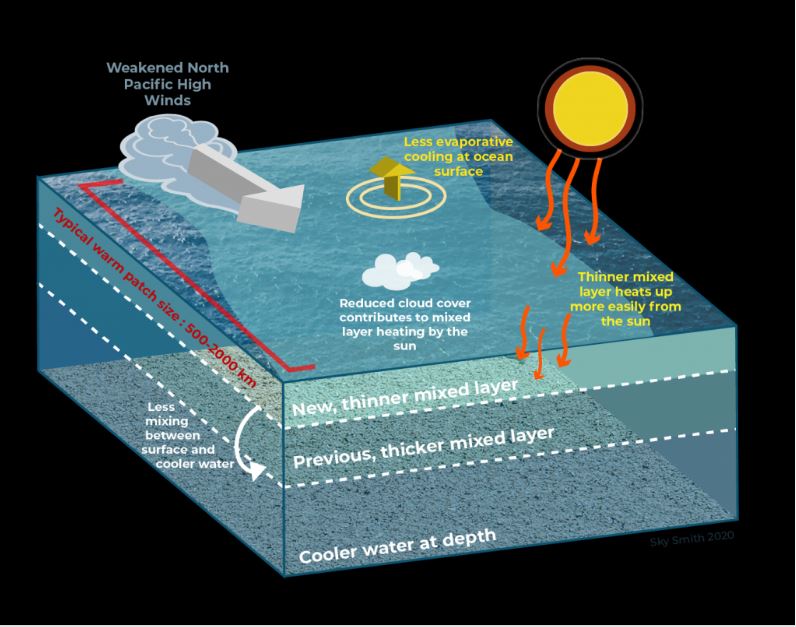
- Weakening Winds: Strong winds normally cool the ocean via evaporation and by mixing the warm upper layer with cooler, deeper waters. When winds fail, this mixing stops.
- Ocean Stratification: Without wind-driven mixing, the top layer of the ocean becomes thin and "trapped."
- Solar Heating: This thin surface layer absorbs solar radiation rapidly. Because it cannot transfer heat to the depths, the temperature spikes, creating localized extreme heat.
- Global Drivers: Climate change ensures the oceans absorb 90% of excess global heat. Events like El Niño and shifts in atmospheric pressure (e.g., the North Pacific High) further trigger these massive pools of warm water.
How MHWs "Supercharge" Tropical Cyclones
The most critical takeaway for disaster management is the role of MHWs in Rapid Intensification (RI).
- Fueling the Engine: Tropical cyclones draw energy from the evaporation of warm ocean water. Passing over an MHW is like a car hitting a "gas station"; it provides an abundance of energy that boosts wind speeds by 20% and rainfall by 12%.
- Stalling and Decay: These "supercharged" storms tend to move more slowly over land and decay at a much lower rate, leading to catastrophic flooding.
- Economic Fallout: MHW-influenced cyclones are 1.6 times more likely to become billion-dollar disasters. This was evidenced by the back-to-back devastation of Hurricanes Helene and Milton in late 2024, where record-high sea surface temperatures in the Gulf of Mexico led to unprecedented destruction.
Ecological and Economic Implications
Beyond storm intensification, MHWs trigger a cascade of environmental crises:
- Ecosystem Collapse: MHWs are the primary cause of massive coral bleaching and the death of kelp forests, which are vital carbon sinks.
- Harmful Algal Blooms (HABs): Toxic algae thrive in warm water. These blooms produce neurotoxins like domoic acid, which contaminate the food chain and force the closure of commercial fisheries.
Biodiversity Loss: While some species migrate north ("the Winners"), cold-water species like salmon face mass die-offs ("the Losers").