
U.S. Proposed Additional Tariffs on India under Section 301

- 12 Jun 2026
In News:
The United States Trade Representative (USTR) has proposed an additional 12.5% tariff on imports from India and 53 other economies following an investigation under Section 301 of the U.S. Trade Act of 1974. The proposal is linked to concerns regarding the alleged import of goods produced through forced labour in global supply chains. The tariffs are currently at the proposal stage and have not yet been finalized.
What is Section 301 of the U.S. Trade Act, 1974?
Section 301 is a trade enforcement mechanism that empowers the United States to investigate and respond to foreign trade practices considered unjustifiable, unreasonable, or discriminatory and that burden U.S. commerce.
Under this provision, the U.S. President and the Office of the United States Trade Representative (USTR) can impose tariffs, trade restrictions, or other retaliatory measures against trading partners. The provision is often viewed as controversial because it allows unilateral action outside the multilateral dispute settlement framework of the World Trade Organization.
India's Position
India has rejected any suggestion that forced labour is prevalent within its domestic regulatory framework. The country prohibits forced labour through:
- Article 23 of the Constitution of India (Right against Exploitation).
- Bonded Labour System (Abolition) Act, 1976.
India has maintained that concerns raised by the U.S. largely relate to complex international supply chains rather than domestic labour practices. New Delhi remains engaged in discussions with Washington on the issue.
Potential Impact on India
If implemented, the additional tariff could affect India's export competitiveness in the U.S. market.
Labour-Intensive Sectors at Risk
Industries that may face significant pressure include:
- Textiles and garments
- Carpets
- Leather products
- Brassware and handicrafts
Impact on Manufacturing Exports
Higher tariff burdens could also affect:
- Automobiles
- Electronics
- Engineering goods
Supply Chain Adjustments
The measure may encourage Indian firms to reduce dependence on imported inputs originating from countries facing forced-labour scrutiny, particularly within global manufacturing networks. Such adjustments could increase production costs in the short term.
India’s 7th Regional Meteorological Centre at Jammu
- 12 Jun 2026
In News:
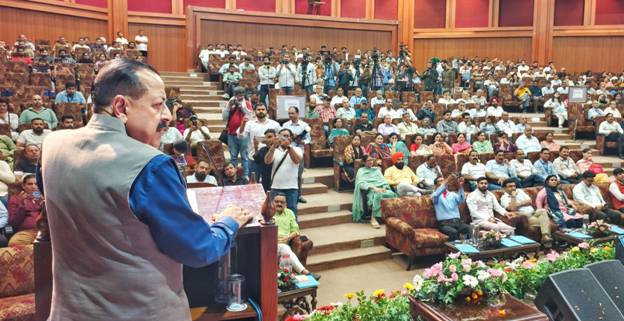
The India Meteorological Department (IMD) has inaugurated its 7th Regional Meteorological Centre (RMC) at Jammu, marking a significant step towards strengthening weather forecasting and disaster preparedness in the Himalayan region. The government has also announced the establishment of another RMC at Lucknow.
Background
Prior to this expansion, IMD operated through six Regional Meteorological Centres located at:Mumbai, Chennai, New Delhi, Kolkata, Nagpur, and Guwahati
These centres serve as regional hubs for weather forecasting, climate services, and disaster early-warning systems.
Coverage and Functions
- The newly established RMC Jammu will cater to Jammu & Kashmir, Ladakh, and Himachal Pradesh, while the proposed Lucknow RMC will serve Uttar Pradesh and Uttarakhand.
- The centre will strengthen monitoring and forecasting of weather-related hazards such as:Flash floods, Cloudbursts, Landslides, Avalanches, Heavy snowfall, and Thunderstorms
- It will provide specialized forecasts at regional, district, city, tourist destination, and mountain levels, along with advisories for pilgrims, farmers, transport operators, and disaster management agencies.
Significance
The establishment of RMC Jammu is particularly important given the vulnerability of the Himalayan region to extreme weather events and climate-related disasters. It will enhance:
- Early warning and disaster preparedness.
- Himalayan weather and climate services.
- Agricultural and tourism advisories.
- Support for infrastructure planning and transportation.
- Scientific understanding of mountain meteorology.
The initiative also strengthens India's meteorological infrastructure and contributes to more localized and impact-based weather forecasting.
About India Meteorological Department (IMD)
The India Meteorological Department (IMD) is the national meteorological service of India.
- Established: 1875
- Ministry: Ministry of Earth Sciences
- Headquarters: New Delhi
- Functions: Weather forecasting, climate monitoring, seismology, cyclone warnings, and meteorological services.
4 years of Jan Samarth Portal
- 12 Jun 2026
In News:
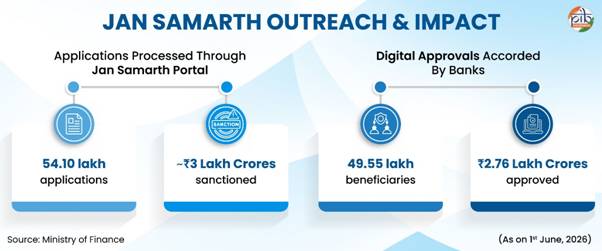
Launched in June 2022, the Jan Samarth Portal has emerged as a comprehensive single-window digital platform for accessing government-sponsored credit-linked schemes. Designed to simplify the loan delivery process, the portal connects beneficiaries, lending institutions, and government schemes through a technology-driven ecosystem, thereby expanding access to institutional credit across the country.
Objective
The portal was created to streamline access to credit-linked government schemes, reduce procedural complexities, and improve financial inclusion through a transparent and digital application process. It aims to ensure that eligible beneficiaries can easily identify suitable schemes and obtain loans without navigating multiple agencies.
Key Features
Jan Samarth serves as a unified gateway for 16 credit-linked Central Government schemes covering sectors such as:
- Agriculture and Agri-Infrastructure
- MSMEs and Business Activities
- Livelihood Promotion
- Housing
- Renewable Energy
The platform caters particularly to entrepreneurs, women-led enterprises, agri-entrepreneurs, start-ups, and small businesses, especially in rural areas and Tier-2 and Tier-3 towns.
To improve accessibility, the portal is available in eight languages—English, Hindi, Gujarati, Telugu, Tamil, Marathi, Bengali, and Kannada.
Digital Integration
A major strength of Jan Samarth is its integration with key national databases, including:
- UDYAM
- UIDAI
- AgriStack
- DPIIT Startup Portal
- CBDT
- GST Network
- CGTMSE
These integrations facilitate faster verification, reduce paperwork, and improve loan processing efficiency.
Lending Ecosystem
The platform has onboarded 269 Member Lending Institutions, including:
- Public Sector Banks
- Private Sector Banks
- NBFCs
- Regional Rural Banks
- Small Finance Banks
- Cooperative Banks
- All-India Financial Institutions
This broad institutional network enhances credit accessibility across regions and sectors.
Maulana Barkatullah Bhopali
- 12 Jun 2026
In News:
Recently, the Executive Council of Barkatullah University approved a proposal to rename the institution, bringing renewed attention to the legacy of Maulana Barkatullah Bhopali, one of the most significant yet lesser-known figures of India's freedom struggle.
Early Life and Ideological Foundations
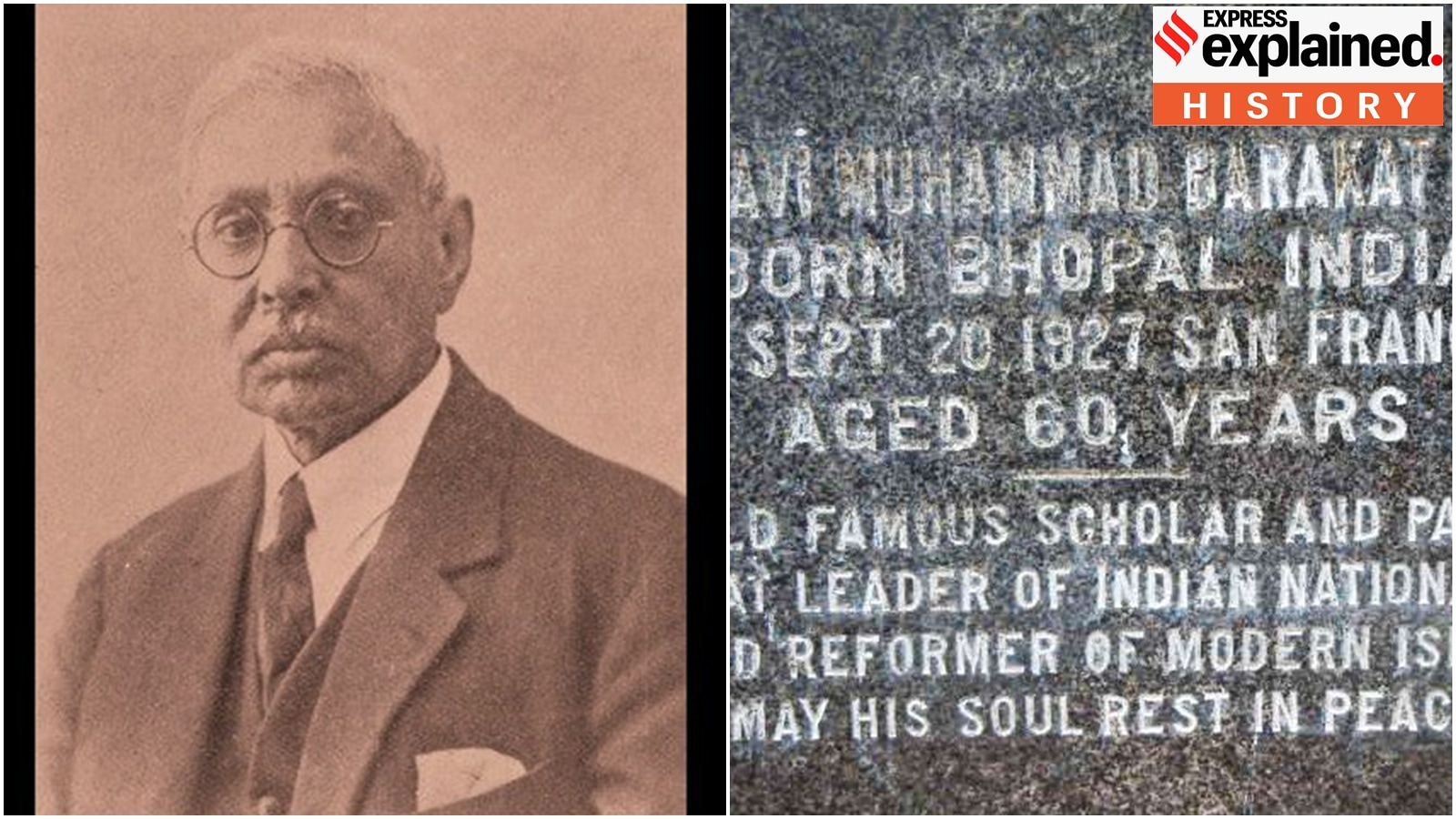
- Born on 7 July 1854 in Bhopal, Maulana Barkatullah was a scholar, journalist and revolutionary who dedicated his life to securing India's independence from British rule.
- Educated in Bhopal, Bombay and later England, he became deeply involved in anti-colonial activism while teaching Arabic and Persian in Liverpool.
- A firm believer in Hindu-Muslim unity, Barkatullah argued that British colonial exploitation affected all Indians irrespective of religion and that national liberation required a united struggle against colonial rule.
Globalizing India’s Freedom Struggle
Unlike many nationalist leaders who operated within India, Barkatullah spent most of his life abroad building international support for Indian independence. His activities extended across Asia, Europe and North America, making him one of the earliest architects of a global anti-colonial network.
His revolutionary work sought to transform India's freedom movement from a domestic political struggle into an international campaign against British imperialism.
Provisional Government of India in Kabul (1915)
A landmark contribution came on 1 December 1915, when Barkatullah helped establish the Provisional Government of India in Kabul, often regarded as India's first Government-in-Exile.
Its leadership included:
- Raja Mahendra Pratap – President
- Maulana Barkatullah Bhopali – Prime Minister
- Maulana Ubaidullah Sindhi – Home Minister
The government aimed to secure international support for India's liberation and challenge British authority during the First World War.
Association with the Ghadar Movement
- Barkatullah was a prominent leader of the Ghadar Party, established in 1913. The party advocated armed revolution against British rule and sought to inspire uprisings within the British Indian Army.
- During the First World War, he collaborated with Germany and attempted to mobilize Indian prisoners of war and expatriates to support the anti-colonial struggle.
International Outreach
- In 1919, Barkatullah met Vladimir Lenin in Moscow to seek international support for India's independence movement. His diplomatic efforts reflected the global dimension of India's anti-colonial struggle long before independence became a mass movement.
Legacy and Significance
Maulana Barkatullah's contributions were significant in three respects:
- He served as the Prime Minister of India's first Government-in-Exile.
- He internationalized the Indian freedom movement through global advocacy and diplomacy.
- His revolutionary efforts influenced later movements, including those associated with Subhas Chandra Bose and the Indian National Army.
Despite constant surveillance and exile, he remained committed to India's freedom until his death in San Francisco in 1927, where he was attending a Ghadar Party gathering.
e-Jagriti Platform
- 12 Jun 2026
In News:
The e-Jagriti platform, an AI-enabled initiative of the Department of Consumer Affairs, was awarded the Silver Award at the National Awards for e-Governance 2026, recognizing its contribution to digital transformation in consumer dispute redressal. The platform represents a major step towards creating a transparent, paperless, and technology-driven consumer justice ecosystem in India.
What is e-Jagriti?
Launched on 1 January 2025, e-Jagriti is an integrated digital platform designed to modernize the consumer dispute resolution framework across the country. It seeks to replace physical paperwork and fragmented processes with a unified virtual system, enabling consumers to file, track, and resolve complaints online.
Developed by the Department of Consumer Affairs under the Ministry of Consumer Affairs, Food and Public Distribution, the platform aims to reduce pendency, improve efficiency, and democratize access to consumer justice for citizens, including Non-Resident Indians (NRIs).
Key Features
A major strength of e-Jagriti is the integration of four legacy consumer grievance systems—OCMS, e-Daakhil, NCDRC CMS, and CONFONET—into a single cloud-based platform.
The system incorporates advanced technologies such as:
- AI-powered chatbot assistance.
- Voice-to-text complaint filing.
- Real-time case tracking dashboards.
- Automated data analytics for judicial and administrative monitoring.
The platform also offers a fully digital payment ecosystem integrated with Bharat Kosh, PayGov, and SBI ePay, ensuring seamless online filing and fee payment.
Virtual Consumer Courts
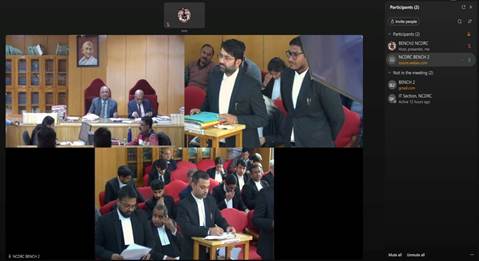
e-Jagriti promotes virtual hearings through integrated video-conferencing facilities and digital document exchange mechanisms. It supports proceedings across the National Consumer Disputes Redressal Commission (NCDRC) and all State Consumer Commissions, reducing costs and improving accessibility.
The platform has also enabled NRIs from countries such as the USA, UK, UAE and Canada to file and pursue consumer complaints remotely, without visiting India.